Month: September 2011

  • Verifiable Oddities in Colorado’s History

    The Day Colorado Had 3 Governors

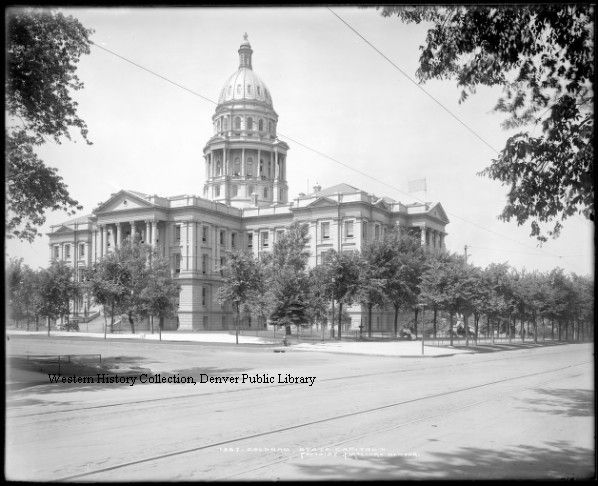
    Colorado State Capitol in the early 1900s. Courtesy of the Western History Collection, Denver Public Library.

    by Ashley Zimmerman

    In the summer and fall of 1903, Colorado entered what would become two of her most turbulent years in history.  Union and non-union miners were engaged in violent showdowns with each other, and politicians with very different ideas of how to manage the escalating violence were up against each other in the polls.

    The mining towns around the state had entered into labor disputes over wages and union negotiations, and the mine owners, non-union miners, and union members were engaged in a war that was quickly getting out of hand.  In September 1903, Governor James H. Peabody  dispatched the Colorado National Guard to Cripple Creek at the behest of the mine owners in the area to deal with the escalating violence and all-out warfare in the mining camps.1 The violence and striking continued nearly unabated for the next year until June 6, 1904, when union employee Harry Orchard set off dynamite at a railroad station in Independence, Colorado, killing 13 non-union miners. This led to mass arrests of striking union members by the Colorado National Guard, led by General Sherman Bell. Many were rounded up and held in town in animal stockades, and some were taken out of town and dropped off at the Colorado-Kansas border.

    In November of 1904, Governor Peabody was up for reelection as the governor of Colorado against former Governor Alva Adams, whose Democratic party was running under the slogan “Anybody but Peabody!” Adams had previously dealt with violent conflicts between union and non-union miners and believed arbitration, not military intervention, was the best way to settle labor disputes.2 On election day, the outcome appeared to go in Governor Adams’ favor.

    Governor Alva Adams, Colorado State Archives.

    However, the Republican-led legislature, along with (now former) Governor Peabody, believed otherwise. On January 6, 1905, a joint session of the Fifteenth Colorado General Assembly considered a written protest by Mr. Peabody that expressed his concerns about recent ballot-tampering in the gubernatorial election.  He claimed that Governor Adams had committed voter fraud and rigged the election in multiple counties around the state, including Denver, Teller, Pueblo, Huerfano, and Las Animas – all of which included mining communities. In Denver, one district reported 717 ballots cast for Governor Adams, despite the fact that only 100 legal voters lived within that district.

    Governor James H. Peabody, Colorado State Archives.

    After considering Mr. Peabody’s protest, the legislature passed a resolution finding his claims to be of merit and set up a subcommittee to investigate the elections held within Denver and its surrounding areas.  The committee was charged with making daily progress reports to the joint General Assembly with the end goal of determining which candidate received the plurality of votes and should be elected Governor of the state of Colorado. On March 16, 1905, after reviewing the election evidence, the committee declared voter fraud had been committed by both candidates and declared James H. Peabody the winner of the gubernatorial election on one condition:

    That he resign the very next day.

    Governor Peabody was sworn in as Colorado’s governor on March 16, 1905, replacing sitting Governor Alva Adams, who had been declared the initial winner after the election.  Governor Peabody resigned the next day on March 17, 1905, and was replaced by his lieutenant governor, Jesse F. McDonald.  Governor McDonald served as Colorado’s governor from 1905 to 1906. And that is how Colorado earned the dubious distinction of having gone through three governors within approximately 24 hours.3

    1. See James O. Chipman biography from the Colorado State Archives website – https://archives.colorado.gov/#biog↩︎
    2. See Jason Brockman biographyfrom the Colorado State Archives website – https://archives.colorado.gov/#biog. ↩︎
    3. For more information on this event and the Governors involved, visit the State Archives elections and governors pages. ↩︎
  • Can I choose a specific drafter to draft my bill?

    You may request a specific drafter to draft your bill, and we will make every effort to fulfill your request. However, the team leader for each subject matter team has discretion in assigning bills to the drafters on his or her team. Usually, the team leader bases bill assignments on subject matter expertise and workload. But, if you would like to work with a particular drafter, please let us know. If the drafter’s expertise is appropriate to the bill request, the team leader will certainly take the request into account and generally assign the bill to the requested drafter if possible.