Month: February 2016

  • “Why Don’t We Fix the Radiator?”: How a Broken Appliance Led to a Dazzling Restoration at the Colorado Capitol

    by Darren Thornberry

    When the chambers of the Colorado Senate and House of Representatives were built in 1894, they were adorned with gold filigree stenciling over red and green paint, respectively, that was the work of Denver artist Manuel Hill. It’s hard to imagine now, but Hill’s beautiful work fell out of favor over the decades, and in 1954 the walls and ceilings of both chambers were covered in acoustic tiles in a décor scandal we now refer to as TileGate.

    The tiles were removed in 2013 and tested for lead and asbestos as part of a multiyear project to restore both chambers to their “historic and regal condition,” as former House Speaker Frank McNulty told The Denver Post.

    It was Speaker McNulty who unintentionally spearheaded the renovations. See, he wanted a tilted radiator in the House gallery fixed. And then, as it turned out, a peek behind the tiles wouldn’t hurt anything, either. After all, black and white photos of the stenciling had tantalized state architects, though no one knew what condition it was in. As the project commenced in 2013, and workers began peeling back the tiles, they were astonished by what they saw.

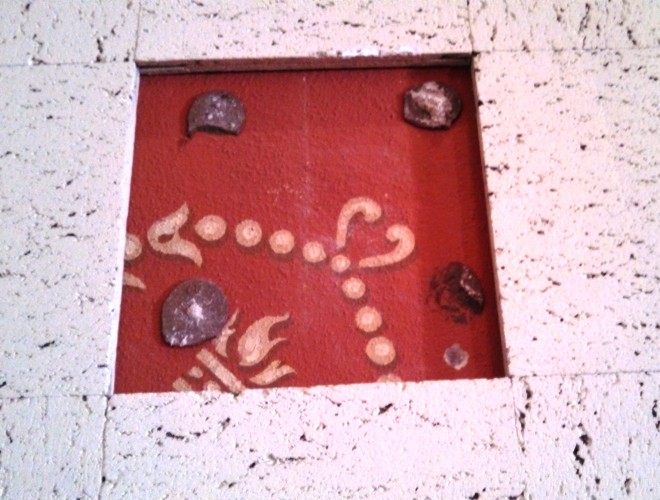
    Senate Renovation Tile PhotoA photo of the original stenciling underneath the acoustic tiles in the Senate Chambers. Photo shared by Chief Clerk Marilyn Eddins.

    Thus began a huge renovation, funded by the Senate and House budgets and also the state’s capitol construction fund, which included painstakingly recreating the ornate stenciling and restoring the chandeliers in both chambers. Speaker McNulty would ultimately pass the project baton to his successor as House Speaker, Mark Ferrandino.

    On January 6th, more than a half century after it disappeared, the artistry hidden under those infamous acoustic tiles on the ceiling of the House of Representatives was again on display. That day, House Speaker Dickey Lee Hullinghorst officially declared the chamber open, and capitol staffers were invited to see not just the stenciled ceiling but also the restored chandelier in all its glory.

    Many of us walked the planks and braved the ceiling coffer (officially the “lay light space”) in the weeks prior to the reveal, both in the House and the Senate. Who recalls wondering if the scaffolding would really keep you from falling into the Well? (This writer does.) Both the coffer’s flat glass surface and the skylight in the roof above date to the 1890s.

    House of Representatives Ceiling Coffer Photo. Photo Credit: Ashley Zimmerman

    A view of the ceiling coffer in the House of Representatives Chamber prior to the reveal. Photo credit: Ashley Zimmerman

    St. Louis Antique Lighting restored the immense House chandelier to its turn-of-the-20th-century glow. They recreated the top tiers and the top escutcheon plate based on photos and the original chandelier that is still in place in the Supreme Court Chambers. The Senate chandelier is due to be restored during the interim this year.

    Here is an incredible time-lapse film of the House of Representatives restoration process, courtesy of Rocket House Pictures, LLC.

    Replica “Edison” bulbs were installed at the perimeter and ceiling of the House in favor of the originals. Replacing the old cloth-wrapped wiring in the originals, to light them up once again, was simply one project too many.

    During the ceiling restoration process, it was discovered that prior to the most recent stencil pattern found, there was an earlier set of stencils and paintings. In the House, there were shields, eagles, and Greek or Roman profiles. In the Senate, similar profiles were found, as well as what appears to be a portrait of President Lincoln on the back east wall and another portrait on the back west wall. The west side portrait could not be identified due to the glue dobs (to hold the tiles in place) that had been placed over the face on the eyes.

    The Denver Art Museum brought in equipment used to look under paintings to help document the earlier stencils/paintings. State architect Lance Shepherd states that he believes the early stencils/paintings were installed just before legislators moved into the chambers and were meant to be temporary. Likely soon afterward, the stencils now seen in both chambers, and for which there is photographic documentation, were created.

    The recreated stenciling on the ceiling is based on photographs of the original design. A water-based paint was used all those years ago, probably to save money, and most of the ceiling stenciling had been washed away prior to the installation of the acoustic tiles.

    Our House of Representatives and Senate chambers surely are among the most beautiful working legislative spaces in the country, thanks to their restorers’ hard work and attention to detail. May we all work as diligently this session as they did during the interim!

    Author’s Note: Thanks to Lance Shepherd, manager of design and construction programs for the DPA’s Office of the State Architect, for his invaluable contributions to this article.

  • Statutory Construction: Severing Statutes and Resolving Conflicts

    by Julie Pelegrin

    Editor’s Note: This week’s article is the seventh in our series on statutory construction. For previous installments, click on “statutory interpretation” in the tag cloud.

    In addition to presumptions and tools for discerning legislative intent, the statutes on construction of statutes provide specific guidance for when a court can salvage part of an otherwise unconstitutional statute and how a court should decide which statute to apply when two statutes conflict.

    Statutory Salvage Operations: Severability

    Suppose a court interprets a statute and finds that part of that statute is unconstitutional. Does that mean the entire statute is unconstitutional, or can some portions of the statute survive?
    The answer turns on the concept of severability. Section 2-4-204, C.R.S., says that, if a court finds part of a statute to be unconstitutional, the remaining constitutional parts of the statute are valid, unless the court finds that those remaining parts are:

    • So essential to the unconstitutional part, that the General Assembly would not have passed the constitutional part without the unconstitutional part; or
    • So incomplete that they cannot be implemented without the unconstitutional portion.

    To illustrate, let’s consider a hypothetical situation: Assume there’s a statute that regulates caterpillar breeders. Under this statute, a caterpillar breeder cannot have more than 1,000 caterpillars at a time and the caterpillar breeder cannot advertise her caterpillar breeding business. A caterpillar breeder sues the state claiming that the statute is unconstitutional because limiting the number of caterpillars and prohibiting advertising restricts her freedom of commercial speech. The court agrees that the prohibition on advertising is unconstitutional and cannot be enforced. However, the court finds that the limit on the number of caterpillars has nothing to do with commercial speech and is constitutional. The court will find that the statute is severable because the limit on the number of caterpillars is not directly related to the prohibition on advertising and can be implemented even though the prohibition on advertising is not enforced.

    When Statutes Collide Part I: Specific Controls Over the General…Usually

    Sometimes a statute will state a general requirement that is intended to apply in a variety of situations. But another statute may impose a different requirement in a specific situation. How is a court supposed to apply both of these statutes?

    Section 2-4-205, C.R.S., directs a court to read the statutes together and give effect to both of them if possible. If the two requirements conflict and they cannot both apply, the court must apply the specific requirement instead of the general requirement. But, if the General Assembly passed the general requirement after it passed the specific requirement and made it clear that the general requirement was intended to replace the specific one, then the court will apply the general requirement, not the specific requirement.

    AnotCaterpillar Cliparther illustrative hypothetical: Assume there’s a statute that says applications for a professional license must be filed in triplicate with the appropriate licensing agency. But, the statute for licensing professional caterpillar breeders says a caterpillar breeder may submit a single copy of the license application with the professional caterpillar breeders board. Obviously, a court could not apply both of these statutes; one must prevail. The court would allow the caterpillar breeder to file a single copy of the license application with the board, unless the statute that requires the application in triplicate was passed after the caterpillar breeders’ statute, and the bill for the general licensing statute included a statement of legislative intent that it is imperative to good government that all licensing applications be filed in triplicate.

    When Statutes Collide Part II: Later In Time Controls

    Sometimes two statutes conflict, not because one is general and the other is specific, but because one prohibits what the other allows or requires. As in other cases, the court will first try to reconcile the differences and give effect to both sections. But, under section 2-4-206, C.R.S., if the differences are irreconcilable – there is a true conflict – the statute that has the latest effective date is the one the court will apply. If both statutes were passed in the same legislative session with the same effective date, the statute that has the latest date of passage will apply.

    Again, to illustrate: A caterpillar breeder loses his license because he does not post his license in the front window of the breeding building, as required by House Bill 1705. But, the caterpillar breeder argues to the court that he should keep his license because, under Senate Bill 923, a person who posts anything in the window of an insect breeding facility commits the crime of insect cruelty (papers in the window block the sunlight). The court cannot reconcile the conflict between the two statutes, so it looks to the effective dates of the bills. House Bill 1705 had an effective date clause that said it took effect July 1, 2009. Senate Bill 923 passed in 2009 without an effective date clause and without a safety clause – so it took effect August 5, 2009. Senate Bill 923 took effect last, so it controls. The caterpillar breeder does not have to post his license.

    If House Bill 1705 and Senate Bill 923 had both passed without a safety clause and without an effective date clause, they would have both taken effect on August 5, 2009. In that case, the court would look for the date on which the Governor signed each of the bills. If the Governor signed House Bill 1705 on May 3, 2009, and signed Senate Bill 923 on May 4, 2009, the court would apply Senate Bill 923.

  • Ensuring Decorum and Civility in the Legislative Committee Hearing Process

    by Dan Cartin

    If you attend a legislative committee meeting at the State Capitol, you will see this sign posted in the Senate and House committee room hallways:

    sign I

    Maintaining decorum and civility during the course of legislative committee meetings is the cornerstone of a productive hearing on the bills before that committee. Persons who come to testify on legislation and those who attend a committee hearing to peacefully observe and listen to the proceedings often travel long distances to the Capitol on the day of the hearing. Everyone attending can reasonably expect that the meeting will proceed in an environment of mutual respect among the legislators, witnesses, and audience that is free from disruptions. One commentator has observed that “[p]reventing disturbances at public meetings is essential to achieving the dual goals of fostering citizen participation and ensuring the efficient accomplishment of public business.” (“Civility in Government Meetings: Balancing First Amendment, Reputational Interests, and Efficiency.” 10 First Amend. L. Rev. 51 (2011)) The right to attend and participate in a committee meeting is necessarily balanced with the committee’s right to ensure that its proceedings are not disrupted.

    But legislative committee meetings are occasionally disrupted by verbal outbursts, such as cheering, booing, shouting, or applauding, by persons attending the meeting. Signs, clothing, or distracting electronic or photographic equipment may have a similar, if less audible, disruptive effect on the ability of persons to freely testify on legislation. These distractions illustrate the need to balance the public’s right to freedom of speech and to petition the government with the right of the legislative branch and committee witnesses to engage in a process that ensures decorum and civility.

    The Colorado constitution, state statutes, and legislative rules all authorize the General Assembly to preserve decorum generally and in legislative committee meetings specifically. Article V, section 12 of the constitution authorizes each house to adopt rules that address disorderly behavior and enforce obedience to its process.

    State statute authorizes the Senate and House to adopt rules or joint rules or to authorize the Senate President or the Speaker to adopt regulations protecting the safety of legislators, staff, and the general public. The rules must be “consistent with public convenience, the public’s right of freedom of expression and to peaceably assemble and petition government, and the established democratic concepts of the openness of the legislative process.” This includes the ability to adopt rules:

    • Regulating admission to legislative areas;
    • Prohibiting signs, banners, placards, and similar display materials without authorization;
    • Restricting the placement of television and photographic equipment;
    • Authorizing the sergeants-at-arms to clear the committee rooms and the chamber galleries if there is a disturbance that disrupts legislative proceedings or endangers legislators, staff, or the public; and
    • Addressing any other matters that may be appropriate for the orderly conduct of the General Assembly’s affairs and protection of the health, safety, and welfare of all the participants in the legislative process.

    Senate Rules 22A and 31 and House Rules 23 and 25 address decorum in the chambers and committee rooms. House committee chairpersons are specifically authorized to have a sergeant-at-arms remove persons who impede, disrupt, or hinder a meeting or endanger the meeting’s participants. The Senate does not have a similar rule, but Mason’s Manual of Legislative Procedure, section 805, suggests that Senate committee chairpersons also have this authority. Fortunately, removing a person or persons from a committee hearing for disruptive behavior occurs very rarely.

    Before 2013, the Chief Clerk of the House of Representatives and the Secretary of the Senate each developed policies for the use of committee rooms. Each policy prohibits signs, placards, and banners, as well as clothing with words, pins, or buttons that express support or opposition to issues before a legislative committee. During the 2013 legislative session, Senate and House leadership directed staff to post the “Welcome to the Colorado General Assembly” signs in the hallways outside of the Senate and House committee rooms.

    Legislative staff have also created a “Guide to Public Hearings” to supplement the signs. It’s available under “General Legislative Information” on the General Assembly’s website.

    So, welcome to the Colorado General Assembly! Hopefully, the information in this article will help ensure that, whether you are coming to the Capitol to testify on a bill or just watch a committee meeting, your experience will be respectful, civil, and free from disruption.

  • Statutory Construction: What was the General Assembly Thinking?

    by Julie Pelegrin

    Editor’s Note: This week’s article is the sixth in our series on statutory construction. For previous installments, click on “statutory construction” in the tag cloud.

    If the language of a statute is not plain, the court will try to interpret it by applying various presumptions: The statute is intended to be constitutional; the interpretation should lead to a just and reasonable, not absurd, result; every word matters and should be read in context; the interpretation should not require an impossible task; and the interpretation should benefit the public interest.

    Taking all of these presumptions into consideration, the court will next look to the legislative intent: What did the General Assembly intend to accomplish by passing the statute?

    Section 2-4-203, C.R.S., specifies several items the court may consider in trying to interpret an ambiguous statute:

    Legislative History

    In Colorado, the legislative history is somewhat sparse. The General Assembly does not generate long committee reports that explain the intent and research behind each bill as Congress does. In Colorado, the legislative history consists of the various versions of the bill and the amendments considered in committee and on second and third reading. Legislative history also includes the testimony offered on the bill in committee and the debates on the bill. The court may consider witnesses’ and the bill sponsor’s explanations of a bill and what the bill is intended to accomplish.

    Legislative Intent

    In interpreting an ambiguous statute, the court may also consider the General Assembly’s intent in passing the statute. To understand legislative intent, the court looks to any legislative declarations or statements of legislative intent that were passed with the statute. Although legislative declarations are not binding on a court, they do provide some indication of what the statute is supposed to mean and how it should be applied.

    The court may also consider the title of the bill that created or amended the ambiguous statute. In interpreting a workers’ compensation provision, the Colorado Supreme Court held that the statute should be read the same way that certain recommendations by a national commission on workers’ compensation laws were read, because the title of the bill that amended the statute was “Concerning Workmen’s Compensation, and Providing Extended Coverage Necessary to Conform to Essential Recommendations of the National Commission on State Workmen’s Compensation Laws….”

    A court may also consider later legislation that amends the underlying statute the court is trying to interpret, but only if the later legislation passes. If the General Assembly introduces a bill to clarify a statute, but the bill doesn’t pass, the court does not consider the intended clarification in interpreting the statute. If the bill does pass, however, it is entitled to “great weight” in construing the original statute.

    Circumstances of Legislation

    A court may also look to the circumstances that surrounded the adoption of the statute. This is similar to considering the legislative history in that the court considers the explanation a sponsor provides for why he or she introduced a bill. The court may also look at who testified for or against a bill as some indication of the persons the bill was intended to affect. For example, in Gleason v. Becker-Johnson Associates, the court found that a statute was intended to apply to the persons involved in constructing a building, not persons who later inspected the finished building, partly because all of the witnesses were builders, architects, and engineers.

    Interpretation by an Administrative Agency

    The court will consider how an administrative agency interprets legislation. If an administrative agency is responsible for implementing a statute, and the agency adopts rules or policies that define terms or explain how the agency will apply the statute, a court will give deference to the agency’s interpretation in deciding what the statute means. But the court is not required to follow an agency’s interpretation, and the court will not follow the agency interpretation if it contradicts the plain language of the statute.

    The Common Law or Similar Statutes

    When interpreting an ambiguous statute, the court may consider how statutes on related or similar subjects are interpreted. The court may also look to the common law on the same subject to help interpret an unclear statute.

    The common law is the collection of rules of action and principles relating to the government and the security of persons and property that have arisen from usage and customs over centuries and from appellate court decisions that apply and interpret these rules and principles. The statutes are assumed to follow the common law. If the General Assembly intends for a statute to abrogate or change rights that are available under the common law, the statute must expressly state or very clearly imply that intent.

    Interpretation Favors the Person Intended to Benefit

    Finally, if the court has gone through the full analysis and it still isn’t sure what the statute means, as a last resort the court will generally resolve the ambiguity in favor of the person or party that the statute is supposed to benefit – consider it the legal equivalent of “tie goes to the runner.” For example: