
Category: Bill Drafting

  • The 2026 Legislative Session Is Comin’ in Hot

    The Second Regular Session of the Seventy-Fifth General Assembly will convene on January 14, 2026.

    The 2026 legislative session will convene at 10 a.m. on Wednesday, January 14, but, as those of us who follow the legislature know—particularly OLLS drafting attorneys—bill drafting starts long before that date. In fact, legislators have been submitting bill requests for the upcoming session since the end of the last session. (Thank you, early birds!)

    Life outside the Capitol can get very busy – especially when there is a special session like we had in August –  making it easy to forget that the first bill request deadline for legislators is December 1. This first deadline is for a legislator’s first three bill requests. After December 1, a legislator may submit up to two additional bill requests, for a total of five bill requests allowed by rule per legislator per session.*

    Once a legislator has submitted bill requests to the OLLS, the legislator must choose one of those requests to be a “prefile” bill. The designated prefile bill must be drafted, edited, revised, finalized, and filed with the House or the Senate several days before the January convening date. Generally, the bill deadlines require legislators to have completed, with the help of OLLS drafters, the bulk of their bill drafting well before the first day of the legislative session.

    What legislators need to know about requesting bills [Joint Rule 24 (b)(1)(A)]:

    • The Joint Rules allow each legislator five bill requests each session. These five bill requests are in addition to any appropriations, committee-approved, or sunset bill requests that a legislator may choose to carry. (Legislators are not required to carry five bills.)
    • To reach the five-bill request limit within the bill request deadlines, legislators must submit at least three bill requests to OLLS by the early request deadline (December 1). Then legislators must submit the remaining  two requests (assuming the legislator is under the five-request limit), by the seventh legislative day. For the 2026 legislative session, this deadline is January 20.
    • If a legislator submits fewer than three requests on or before the early bill request deadline, the legislator forfeits the remaining of those three bill requests due by that date, but the legislator may still request two additional bills by the January 20 deadline.* (Legislators are not required to carry five bills.)
    • The first bill request deadline is still a couple of months away, but OLLS recommends legislators work with drafters well ahead of the December 1 deadline on the first three bill requests. (Hint hint!) The legislator will also need to quickly decide which of these requests will become a “prefile” bill, which needs to be filed for introduction prior to the first day of the legislative session. For the 2026 legislative session, the deadline to file prefile bills with the House and Senate is Friday, January 9.

    Legislators can submit bill requests to OLLS by phone, email, or in person. (We like it when you stop by! Note, however, that we are all working remotely until we can move into our new location on the third floor of the Annex Building, so please wait to stop by in person until after we move into the Annex in late October.) Including as much drafting information as possible and the names of any contacts with drafting authority helps bill drafters start work on the bill request right away.

    Legislators: If you have not yet submitted a bill request, you are encouraged to do so as soon as possible. Bill requests may address any subject and do not need to be completely conceptualized. The assigned bill drafter will help you with the wording of your bill, and the bill drafting process allows for potential issues or problems to rise to the surface and make it easier for you to decide whether the idea is “workable.” If a request is no longer needed or wanted, you can withdraw and replace it with a new request, as long as that decision is communicated to the bill drafter before the December 1 bill request deadline. By submitting bill requests and draft information as quickly as possible, legislators give OLLS drafters and editors more time to work on the drafts and make it easier to determine if there are duplicate bill requests and work out any drafting kinks before the first day of session.

    Legislators can submit more than three requests before the early bill request deadline. If a legislator submits three requests by December 1 and later withdraws one of them, the legislator forfeits the withdrawn bill request because the rules allow a legislator to submit only two bill requests after the December deadline.* If a legislator submits four bill requests by the early bill request deadline and later withdraws one, the legislator is left with three bill requests that met the early request deadline. That legislator can still submit the two requests that are allowed after the early bill request deadline—for a total of five bill requests.

    Upcoming deadlines: Too many to remember and too important to forget! Click here for the 2026 deadline schedule. 

    But for now, remember these 2026 bill request deadlines:

    • Monday, December 1, 2025. The last day for legislators to request their first three (or early) bill requests. After this date, legislators are only allowed two additional bill requests, with a limit of up to five bill requests total. 
    • Tuesday, January 20, 2026. The last day for legislators to request their final two (or regular) bill requests. (This applies only to legislators who have not yet requested all five of their allowed bills.)

    Good luck, legislators, and please don’t hesitate to reach out to OLLS with any questions!

     * A legislator may seek permission from the House or Senate Committee on Delayed Bills, whichever is appropriate, to submit additional bill requests or to waive a bill request deadline. 

  • How to Keep Up with a Changing Bill

    Site Icon

    Editor’s Note: This article was originally written by Julie Pelegrin and Patti Dahlberg and published on February 6, 2020. The article has been edited where appropriate.

    You’re running late, you’re trying to get a handle on the bills they just called up on special orders, and there are seven bills on your committee calendar for this afternoon. When you need to quickly remind yourself of what’s in a bill, you will be tempted to just check the summary that appears on the first page of the bill. But, unless the bill is in the first committee in the first house, you must resist this temptation. That’s not to say the bill summary printed on a bill can’t be helpful. While the bill summary may not tell you all you need to know, it does provide a quick overview of what the bill is doing when it’s introduced. But beware: If the bill has already passed out of a committee in the first house, it may have been amended by that committee, and those amendments will not appear in the bill summary. In this situation, there may be other options you can turn to.

    Bill Summaries on Introduced Bills

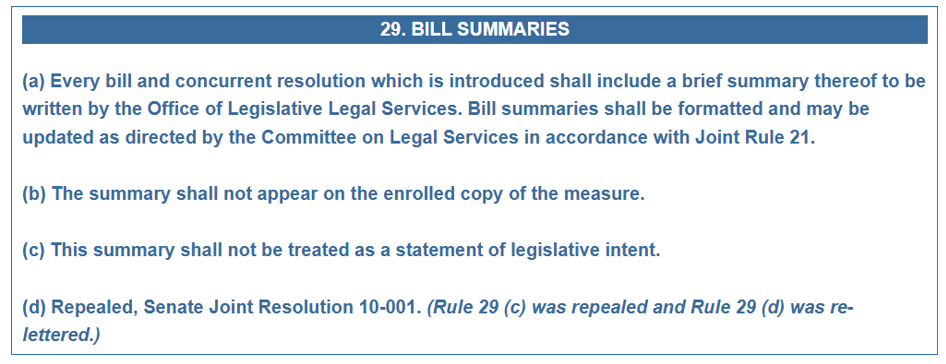
    Rule No. 29 of the Joint Rules of the Senate and House of Representatives requires that every bill and concurrent resolution must include a brief summary written by the Office of Legislative Legal Services (OLLS). These summaries attempt to describe in plain language what the introduced version of the bill or concurrent resolution will accomplish if passed.

    Text of Rule No. 29 of the Joint Rules of the Senate and House of Representatives.

    The OLLS aims to write bill summaries that are brief (relative to the size and scope of the bill) and provide a succinct, clear, and accurate synopsis of the major points of the bill in a format that’s easier to read and, hopefully, understand than the actual language in the bill. Drafters try to avoid using legalistic and technical words in the bill summary, but sometimes using legal terms is necessary to avoid confusion or a misleading summary.

    Bill summaries take many forms and may include:

    • A description of how the bill will change existing statutes and, if useful in understanding those changes, an explanation of existing law and the legal context of the changes;
    • An explanation of the substance of a repealed statute if necessary to understanding the bill;
    • A structure that presents the statutory changes in a logical order, usually the order of importance, and may group related changes together; and
    • If the bill is recommended by an interim or statutory committee, the name of the committee in bold at the beginning of the summary.

    Preamended and Other Bill Versions

    On paper and electronic copies of bills, all bill summaries start with this note:

    Bill Summary

    This summary applies to this bill as introduced and does not reflect any amendments that may be subsequently adopted. If this bill passes third reading in the house of introduction, a bill summary that applies to the reengrossed version of this bill will be available at http://leg.colorado.gov.

    Each bill also has its own page on the General Assembly’s website, which includes the bill summary. There is a note at the end of this summary that specifies which version of the bill the summary applies to. For example, (Note: This summary applies to this bill as introduced.)

    If a bill is amended in a committee or on second or third reading, the bill summary that’s printed on the bill or that appears on an electronic copy of the bill does not changeThis is true whether the amendment occurs in the house of introduction or the second house. So how can you quickly see how a bill may have changed?

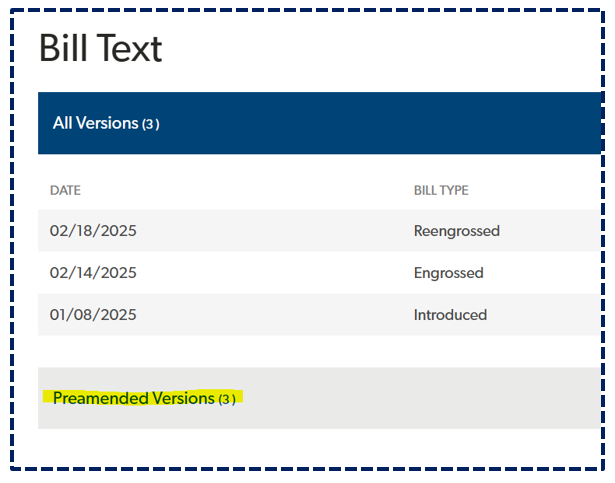
    Each bill’s webpage includes links to the text of the official versions of the bill and links to what are called “preamended versions.” These are unofficial versions of the bill that show amendments adopted by a committee as they appear in the text of the bill. The changes made by a House committee are shaded; the changes made by a Senate committee are double-underlined. If you open the unofficial preamended bill, you can easily scroll through it to see any changed language. These changes, combined with the original bill summary, will help you quickly come up to speed on the bill before it’s heard in another committee or on second reading.

    Screen cap from the general assembly website highlighting "Preamended Versions" on the Bill Text tab.

    Once the bill passes second reading, all of the adopted amendments are enrolled into the bill. At that point, you should read the engrossed bill – also available on the bill page. But note: The printed and the electronic version of the bill summary is still not changed. The same is true of the reengrossed version of the bill, created after the bill passes on third reading in the first house. As with the preamended versions, changes made by the House are shaded; changes made by the Senate are double-underlined.

    Updated Bill Summaries – Available Only Online

    So, is the bill summary ever updated? Yes—but never on the bill itself.

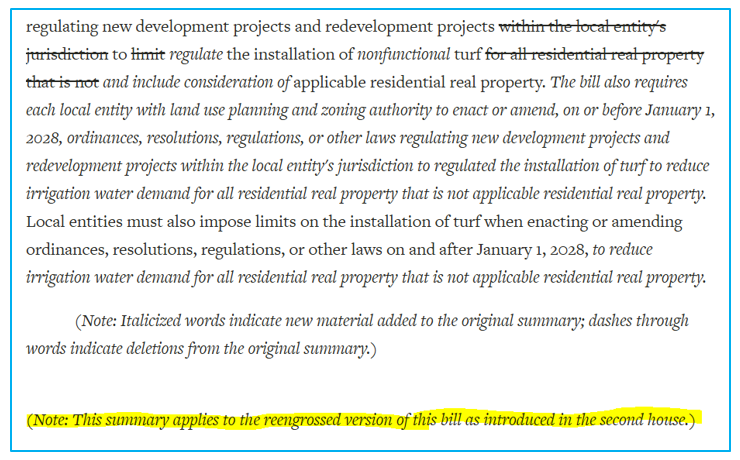
    If a bill is significantly amended in the first house, and the original bill summary no longer accurately describes the bill, the bill drafter updates the bill summary when the bill is introduced in the second house. The updated bill summary is posted on the bill’s webpage, but it does not appear on the paper or electronic copy of the bill itself. To make the changes in the updated bill summary readily apparent, new language appears in italics and deleted language appears in strike type. Also, once the bill is introduced in the second house, the note at the bottom of the online bill summary will read: (Note: This summary applies to the reengrossed version of this bill as introduced in the second house.).

    Screen cap of a sample updated bill summary highlighting the note that reads: "(Note: This summary applies to the reengrossed version of this bill as introduced in the second house.)."

    Before considering a bill in the second house, you should check the summary on the bill’s webpage to see how the first house changed the bill. If the online bill summary does not show any language in italics or strike type, then the first house did not significantly amend the bill.

    Final Bill Summary

    After the legislative session ends, the bill drafters prepare a final summary (with no editing marks) for each bill that the General Assembly enacts. The final summary is posted to the bill’s webpage with this note: (Note: This summary applies to this bill as enacted.) The OLLS also collects these final bill summaries and annually publishes them in paper copy and online as the digest of bills for each legislative session.

  • Back to the Basics: Bill Sponsorship Overview

    Editor’s Note: This article was originally written by Jennifer Gilroy, Michael Dohr, and Jessica Chapman and published on December 15, 2022. The article has been edited and updated.

    by Alana Rosen

    Bill drafting season is well underway at the Office of Legislative Legal Services, which means now is probably a good time to review some of the basics of bill sponsorship.

    Prime Sponsorship Basics

    Prime Sponsorship – First Chamber. The legislator who introduces and carries a bill is called the prime sponsor of the bill. Bills cannot be introduced without a prime sponsor. In both the House and the Senate, the prime sponsor (and joint prime sponsor if there is one) is responsible for explaining the bill in committee and in debate on the House or Senate floor. A prime sponsor also typically arranges for witnesses to testify in favor of the bill in committee.

    A legislator can be the first prime sponsor or joint prime sponsor for only five bills, unless the legislator has special permission from the Committee on Delayed Bills (also known as leadership) to carry more. But a legislator can agree to be the prime sponsor or joint prime sponsor of a bill in the second chamber on as many bills as the legislator wants.

    Prime Sponsorship – Second Chamber. The prime sponsor in the first chamber (also known as the house of introduction) is responsible for asking a legislator in the second (or opposite) chamber to carry the bill in the second chamber. The prime sponsor in the first chamber does not have to identify a prime sponsor in the second chamber before the bill is introduced in the first chamber, but the bill must have a prime sponsor in the second chamber before the bill can be heard on third reading in the first chamber.

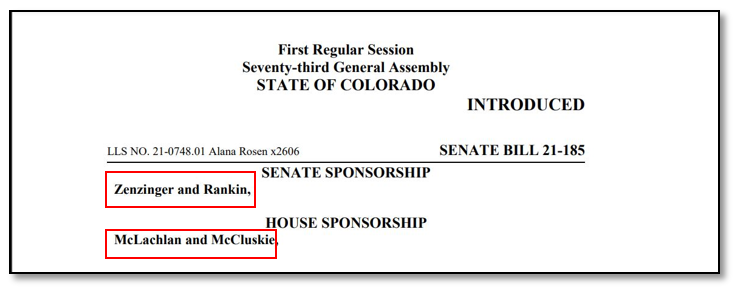
    Before a bill can move to the second chamber, the prime sponsor in the second chamber must inform the House Chief Clerk or the Secretary of the Senate of that legislator’s intent to serve as the prime sponsor in the second chamber. Prime sponsors’ names in both chambers are listed on the bill in bold text.

    Prime sponsor names highlighted on the first page of a bill.

    Joint Prime Sponsorship Basics

    Joint Prime Sponsorship. When two legislators in one chamber want to carry a bill together, they are referred to as joint prime sponsors. A bill that has joint prime sponsors in one chamber may or may not have joint prime sponsors in the other chamber. The rules for joint prime sponsorship are similar for the House (House Rule 27A(b)) and the Senate (Senate Rule 24A(b)).

    For legislators who joint prime sponsor a bill in the first chamber, the joint prime sponsorship counts against both legislators’ five-bill limit. Both joint prime sponsors must verify their desire to be joint prime sponsors. A legislator cannot be added as a joint prime sponsor in the first chamber if that legislator has already submitted five bill requests, unless that legislator has received permission from leadership. The prime sponsor in the first chamber must notify the House Chief Clerk or the Secretary of the Senate, as appropriate, of any changes in bill sponsorship so that the changes are reflected in subsequent versions of the bill.

    Joint prime sponsorship does not count against the five-bill limit for either legislator in the second chamber. Again, both joint prime sponsors must verify their desire to be joint prime sponsors.

    Joint prime sponsors are typically determined prior to the bill’s introduction. However, in limited circumstances, joint prime sponsors may be added or changed after introduction immediately after second reading but prior to adoption of the bill on third reading. The House and Senate front desk staff can help with this process.

    Sponsorship and Co-sponsorship Basics

    Sponsorship and Co-sponsorship. When legislators want to show support for a bill, but not take on the responsibility of actually carrying the bill, they may sign on as sponsors or co-sponsors of the bill. If a legislator adds their name to a bill before it is introduced, the legislator is a sponsor of the bill. If a legislator adds their name to a bill after it is introduced, the legislator is referred to as a co-sponsor. Co-sponsors are added immediately following adoption of a bill on third reading. Sponsorship or co-sponsorship does not count against the legislator’s five-bill limit.

    Bill Sponsor FAQs:

    How do I add sponsors to my bill before it is introduced? You may add prime sponsors, joint prime sponsors, and sponsors in two ways if the bill is still in the Office’s possession:

    1. Before your bill is introduced, you, the bill sponsor, may notify the drafter in person, by phone, or by email that you would like to add a legislator as a prime sponsor, joint prime sponsor, or sponsor to your bill. To add a prime sponsor or joint prime sponsor, the drafter will need permission from both you and the legislator who will be added as the prime sponsor or joint prime sponsor. This process is referred to as “sponsorship verification”. Please remember that if the joint prime sponsor in the first chamber has already requested or introduced five bills, that joint prime sponsor must obtain delayed bill permission from the appropriate Committee on Delayed Bills. To add a sponsor, the drafter will need permission only from the legislator being added as a sponsor. Please give your drafter ample time to verify prime sponsorship, joint prime sponsorship, or sponsorship before the bill is scheduled to be filed for introduction.
    2. Before your bill is introduced, you can also invite other legislators to sponsor your bill via the Electronic Sponsorship feature in iLegislate. Electronic Sponsorship operates similarly to an Evite: You may invite legislators to sponsor your bills and you may share draft files with them. Those legislators may choose whether they want to be a sponsor on your bill.
    Screen cap of the Electronic Sponsorship feature in iLegislate.

    Once your bill is delivered by the Office to your chamber’s front desk, the Office cannot add any more sponsors. In special circumstances, the House or Senate front desk staff may be able to add sponsors before a bill is printed, but you must contact your chamber’s front desk staff to see if this special circumstance exists.

    The Office will deliver your prefile bill (your first bill to be introduced) directly to the House or Senate front desk because that bill must be ready for introduction on the first day of session. The Office will deliver your other bills to the front desk or to you, as you direct. Do not contact the Office to add sponsors after your bill has been delivered to the front desk or to you. Once a bill is delivered, all sponsor additions or changes must go through House or Senate staff.

    How do I add sponsors to my bill after it is delivered for introduction? If you direct the drafter to deliver your bill (other than your prefile bill) to you personally and not your chamber’s front desk, Office staff will give the bill to the sergeants who will then deliver it to you. If the bill is delivered to you prior to its introduction deadline you can show it to other legislators and have them sign the sponsor form attached to the bill or go through iLegislate. The bill delivered to you will include a sponsor form stapled to a heavier sheet of green paper (if you’re a Representative) or cream-colored paper (if you’re a Senator). This is called a bill back. Please do not separate the bill from the bill back and sponsor form.

    After you give the bill back (and attachments) to the House or Senate front desk staff, the House or Senate front desk staff will review the sponsor form and add the names of those legislators who have signed the form indicating their desire to be sponsors of your bill. These sponsor names will appear on the introduced version of the bill. Sponsors cannot be added to your bill after the House or Senate front desk staff have submitted it for printing. After your bill has been introduced, however, other legislators may add their names as co-sponsors following passage of your bill on third reading.

    Feel free to contact the Office staff, your drafters, or the House and Senate front desks with any questions regarding bill sponsorship. You may contact Office staff to inquire about sponsorship prior to the delivery of your bill to the House or Senate for introduction, at (303) 866-2045 or olls.ga@coleg.gov. Once your bill has been delivered for introduction, you may contact the House or Senate front desk staff with your sponsorship questions.