Category: State Government

  • Who Does What? The Boundaries of Each Branch’s Authority

    Editor’s note: This article was originally written by Julie Pelegrin and posted on July 19, 2012. This version has been edited and updated for this week’s publication.

    by Jery Payne

    During the legislative session, legislators and legislative staff are so busy working with bills and amendments that we sometimes lack the time to step back and see the operations of the legislature in context with the other branches of state government. That is why it can be jarring when the drafter raises separation of power concerns. The specific constitutional authority given to and requirements imposed on each of the branches of state government can get confused and even overlooked in the rush of the legislative session.

    The legislative interim affords us the luxury of time to review the state constitution and some of the court cases interpreting it and to remind ourselves of the roles of the executive, judicial, and, especially,  legislative branches. This article looks at the constitutional authority of each branch of government, including the General Assembly, the constitutional limitations on that authority, and the constitutional requirements imposed on the General Assembly.

    To understand the authority and role of the General Assembly in state government, we must first review how the state constitution generally distributes power in state government. Similar to the organization of powers at the federal level, Article III of the Colorado Constitution organizes power within the state government as follows:

    The powers of the government of this state are divided into three distinct departments,—the legislative, executive and judicial; and no person or collection of persons charged with the exercise of powers properly belonging to one of these departments shall exercise any power properly belonging to either of the others, except as in this constitution expressly directed or permitted.

    The state constitution then specifies the powers of the executive branch in Article IV, recognizing the governor as holding the “supreme executive power of the state” and charging the governor with faithfully executing the laws of the state. The governor has several specific constitutional powers, including acting as the commander in chief of the state’s military forces, granting reprieves and pardons, requesting information and reports from the executive branch agencies, annually reporting on the state of the state to the General Assembly, and annually accounting for the state’s expenditures and estimating the state’s anticipated revenues.

    The state constitution gives the governor several powers that relate specifically to the General Assembly. The governor can convene the General Assembly in a special legislative session or adjourn the General Assembly if the House and  Senate cannot agree on an adjournment date. The governor can veto entire substantive bills and veto specific line-items in appropriations bills. If the governor does not act to either sign or veto a bill within specified time periods, however, the bill becomes law without the signature.

    The state constitution also lays out the powers of the judicial branch. Article VI specifically creates several courts, most notably a Supreme Court and district courts, to exercise the judicial power of the state. And Article VI authorizes the General Assembly to create additional courts. The General Assembly used this authority to create the Colorado Court of Appeals in statute.

    Article VI goes on to describe the jurisdiction of the Supreme Court, the district courts, and the other courts listed in the constitution and the terms and qualifications of justices and judges. The state constitution also specifically authorizes the Supreme Court to adopt rules for the administration of the courts and for procedures in civil and criminal cases.

    Article V of the state constitution establishes the legislative branch, giving it the “legislative power of the state,” but reserving to the people the powers of initiative and referendum. The other specific powers given to the General Assembly are the powers to adopt rules governing its proceedings and rules for enforcing its procedures, disciplining members, protecting members from violence and offers of bribes, and expelling members. The General Assembly’s list of specific powers is short because, unlike Congress and unlike the executive and judicial branches, the Colorado General Assembly’s power is plenary, rather than enumerated. This means that the General Assembly need not find a grant of power to legislate on a topic. So long as the legislation does not violate the state or federal constitutions, the General Assembly has the power to legislate on the subject.

    The state constitution separates the powers of the executive, judicial, and legislative branches with the intent that each will exercise only those powers assigned to it and will not attempt to exercise powers assigned to one of the other branches; each will play in its own sandbox, so to speak. Not surprisingly, however, there is significant overlap among the separated powers.

    For example, the General Assembly may adopt mandatory parole requirements, but these do not violate the court’s authority to sentence a defendant. (People v. Barth, 981 P.2d 1102 (Colo. App. 1999)). And although the state constitution gives the Supreme Court authority to set the procedural rules for criminal and civil trials, the General Assembly by statute may change those rules for substantive policy reasons, so long as the changes do not violate constitutional rights. (People v. Smith, 182 Colo. 228, 512 P.2d 269 (1973).)

    Similarly, the state constitution gives the legislative power to the General Assembly, but the General Assembly can authorize an executive branch agency to adopt rules, so long as there are sufficient guidelines and safeguards. (Colo. Auto & Truck Wreckers Ass’n v. Dept. of Rev., 618 P.2d 646 (Colo. 1980)). And a court, in interpreting a statute, can require an executive branch agency to spend its appropriated funds for specific uses. (Goebel v. Colo. Dept. of Institutions, 764 P.2d 785 (Colo. 1988)).

    The separation of powers among the three branches of government  is real and enforceable, but these divisions are often neither as bright nor as distinct as some would like. When one of the branches does not exercise its authority, one of the other branches may attempt to use these ambiguities to usurp that authority. For example, if the General Assembly does not enact a policy through legislation, the executive branch may attempt to enact that policy either through an executive order or by rule-making. If this happens, the General Assembly may protect its constitutional authority either by enacting legislation to affirm or reverse the executive branch’s action or by bringing suit against the executive branch.
  • If you build it, it will get used (and used and used)

    by Patti Dahlberg and Jessica Chapman

    CDOT – So What Do They Do?

    The Colorado Department of Transportation (CDOT) has been around in some form or another since 1910—its inception was roughly parallel to the increasing availability of automobiles in the state. In a previous LegiSource article, we explored the history and transformation of the department over the years and its role in building Colorado’s roadway system. But what is the department doing for Colorado transportation now? Maybe a better question is what isn’t the Colorado Department of Transportation doing?

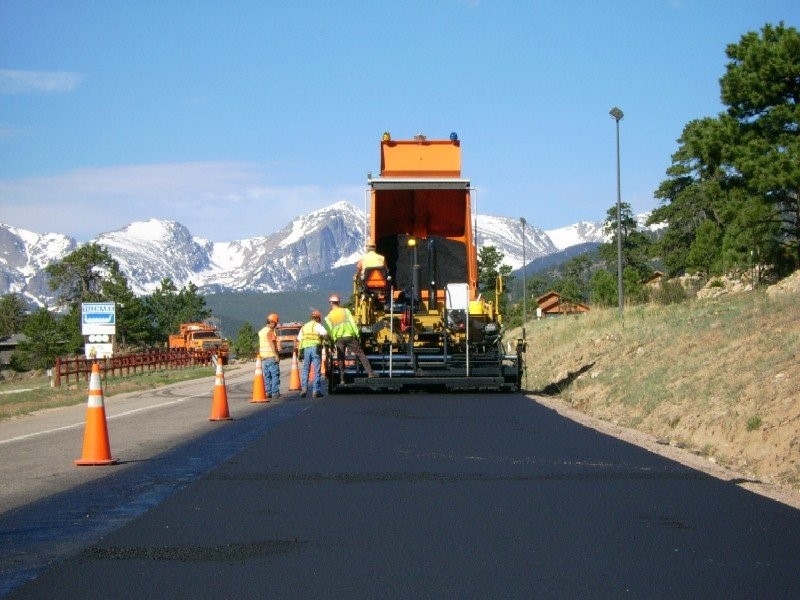
    Road crew paving a road.

    Overview

    The department’s prime directive is to ensure that Colorado has a safe and efficient transportation system by building and maintaining state and federal highways (not local and residential roads, which are the responsibility of cities and counties). Of the department’s budget (which totals over $1.7 billion for FY 2024-25), 58% is used just to maintain the current system of roads in the state.

    In order to ensure safe, efficient roads, the department provides three main services:

    • snow and ice operations;
    • roadway maintenance and preservation; and
    • construction management.

    To enhance public safety, CDOT provides:

    • traffic monitoring;
    • avalanche control;
    • rockfall mitigation;
    • mudslide clean-up and mitigation;
    • transit development and grants; and
    • traffic safety education.

    Some Specifics

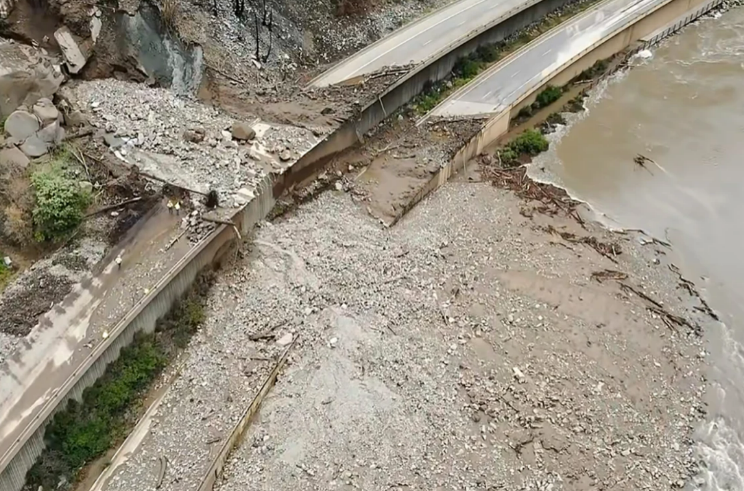
    Emergency Response. One example of CDOT’s valuable service to the state involves its response to the mudslides, caused by heavy rain in July 2021, that closed I-70 through Glenwood Canyon for more than two weeks. CDOT employees were immediately on-site to assess the damage, help trapped motorists, and put in place an emergency plan for clean-up and repair.

    Interstate 70 washed out by a mudslide.

    Multi-year Projects. CDOT also undertakes many multi-year projects at any given time. Currently, the department is working to expand I-25 from Mead to Berthoud. Once this project is completed it will be the first time there will be more than two lanes on I-25 from Denver to Fort Collins in both directions. Other highway projects include the I-70 Floyd Hill project, I-70 mountain corridor project, I-76 York to Dahlia bridge reconstructions, and improvements to U.S. 85 (Santa Fe Drive). In addition, there is always the normal ongoing work of resurfacing streets; replacing traffic signals; constructing retaining walls, curbs, and bridge safety work; installing wildlife fencing; improving on-ramps; and relocating bike trails throughout the state to keep CDOT busy.

    Quite simply, CDOT helps Colorado motorists (as well as planes, trains, and buses) get where they need to go in rain, snow, or shine. There are no breaks for the maintenance and response crews—they are called out day and night, weekends, and holidays to highway accidents and road repairs.

    CDOT Facts

    • Maintains, repairs, and plows over 23,000 total lane miles of highway
    • Maintains 3,447 bridges
    • Oversees 28 billion miles of vehicle travel annually
    • Plows about 6 million lane miles each year
    • Spends $69 million annually on snow removal
    • Keeps over 35 mountains passes open year-round
    • Monitors 278 of 522 avalanche paths
    • Administers about $11 million in federal grants for transit operators and $41 million in federal aviation grants for airports
    • Manages over $5 million in federal grants for safe driving programs

    Thinking Outside the Box

    And if road maintenance and repair isn’t enough, CDOT, in collaboration with the Town of Frisco and the Department of Local Affairs, developed a plan to build single-family homes and apartments in Frisco to provide affordable housing for mountain-based employees. Making mountain housing more accessible will allow CDOT to recruit more employees and keep essential snowplow operators and other road maintenance specialists closer to the areas where they are needed.

    CDOT also boasts a Division of Aeronautics, a Division of Transit and Rail, regional bus service and environmental and research services. They even have an Archaeology and History department and a paleontologist on staff!  CDOT has been involved with the planning for establishing rail service through northwest Colorado and working with the Front Range Passenger Rail District on providing service along the Front Range, from Pueblo to Fort Collins and eventually to Wyoming and New Mexico. The recent enactment of Senate Bill 24-184 along with the availability of federal transportation money is expected to help fund these projects.

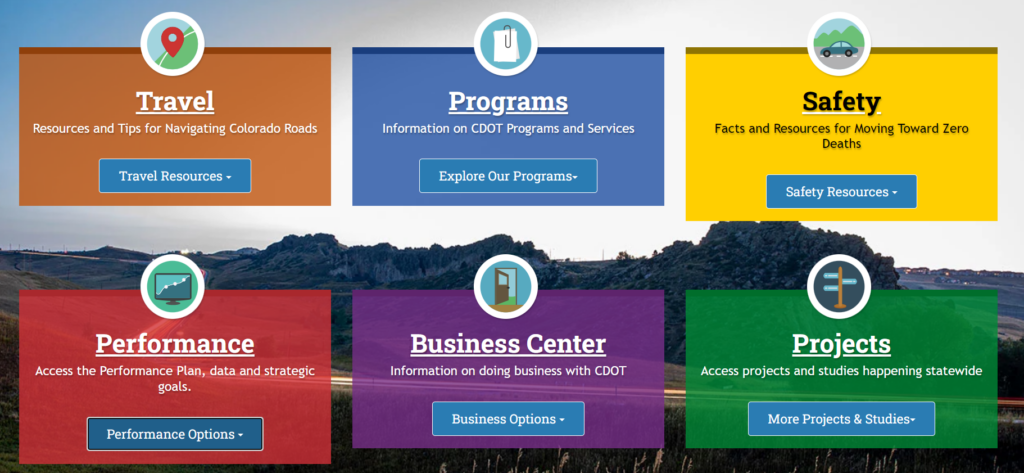
    Public Service. CDOT doesn’t just take care of the roads. It also plays an active role in trying to keep travelers informed on road conditions and even provides estimated travel times to help motorists make informed decisions. Their website houses extensive information on its programs, projects, and goals, as well as road and weather conditions (easily accessed through www.cotrip.org or by calling 511). Construction reports are available through the Travel page. For information about safety initiatives, visit the Safety page. You can also get general information about Express Lanes. And they even have their own YouTube channel.

    The CDOT webpage.

    Planning for the Future

    Good transportation systems require a solid transportation planning process. Colorado’s transportation planning process includes the development of a Statewide Transportation Plan, Regional Transportation Plans, and a Statewide Transportation Improvement Program. The planning process goes through several levels of planning and routinely invites public involvement.

    • Regional Transportation Plans. The department gathers input from 15 planning regionsto develop regional transportation plans for each region. These plans typically establish long-term transportation investment priorities and are consolidated and incorporated in the Statewide Transportation Plan
    • Statewide Transportation Plan. State law requires that the department produce a 20-year plan and update it every few years. The current Statewide Transportation Plan (2045)estimates the state’s needs and revenue for the years 2016 to 2045.  The plan outlines funding, anticipated future transportation needs, and strategies to achieve its goals. 
    • Statewide Transportation Improvement Program. Federal regulations require the state to produce a Statewide Transportation Improvement Program (STIP).This is a 4‑year planning document for state transportation projects which CDOT updates annually. Projects included in the annual plans come from the 20-year statewide transportation plan. 

    CDOT also takes climate change into account in its planning process. For example, a rule change in 2021 requires transportation projects demonstrate that potential greenhouse gas emissions from the project not exceed certain limits.

    There’s no doubt about it, Colorado has a mobile society and transportation impacts its citizens—residents and visitors alike—on a daily basis.

    An FYI for legislators. The department’s Office of Policy & Government Relations (GR) can conduct research, meet with constituents, explain transportation processes, and provide transportation-related resources and outreach to officials at the federal, state and local levels. They can be reached at 303-757-9772.

    Sources: