Category: Archive

Archived posts were published before July 1, 2024. They are maintained for historical reference and may not meet current accessibility standards.

  • New and Improved Senate Chamber Ready for Prime Time

    by Katelyn Guderian

    When the 2022 legislative session ended, there wasn’t much time for resting before extensive changes to the Senate Chamber began. The official kick-off meeting to plan the renovations, the newly renovated Senate Chamber has undergone significant structural and cosmetic changes.

    Almost six months to the day since this leg of the project began, construction crews are wrapping up the final touches in the new and improved Senate Chamber just in time for the beginning of the 2023 session.

    Old Becomes New

    In an effort to modernize and upgrade the Chamber while preserving the original character and historical uniqueness, renovation crews relied on a mixture of both old and new ideas to make the updated Senate Chamber a reality. And when you’re talking about a room that’s approaching its 130th birthday, there was a lot to be done!

    Senate chamber with floor removed - preserving the old while building the new.

    Beginning in January 2023, visitors to the Senate Chamber will probably discover a space that looks and feels very familiar with a handful of noticeable changes, such as the new elevated and relocated “well”, or speaking area for Senators, and the larger and more ergonomic amendment clerk desk. The updates have left the Chamber looking like a newer, shinier, brighter version of itself, while also improving safety and accessibility for those who conduct their business within its walls.
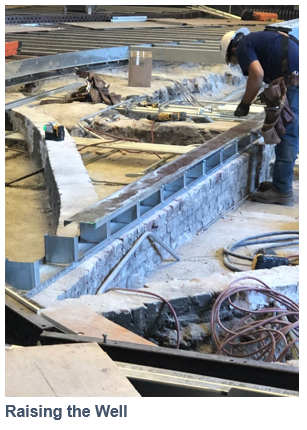
    Raising the well in the Senate Chamber.

    Blending the old with the new in a building as ornate as the Capitol was not without challenges, but the renovations allowed crews to improve upon existing and beloved structures within the Chamber. Highlights included restoring all 35 Senator desks and the Senate Staff front desk, which were all original to the space; polishing and restoring all existing brass fixtures; updating the Senate lobby, including adding a new President’s Marble; carefully replicating the original filigree stenciling on the Chamber walls; sandblasting and painting the metal vents; and preserving a long-forgotten nineteenth-century rug that lay quietly for decades underneath the historic bill safe.
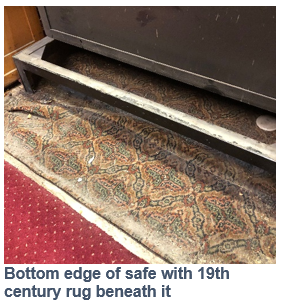
    Bottom edge of Senate safe with 19th century rug beneath it.

    Renovating the Chamber’s Floors

    Arguably, the largest change to the Chamber is one that most visitors will never see: a completely renovated floor and sub-floor. One of the primary motivations behind this round of updates to the Chamber was to make the room more resistant to fire, and construction crews accomplished this through several months of diligent efforts and precise “floor work”.

    Once a team of movers took all the desks out of the Chamber in early July, it became possible to begin the massive task of removing, updating, and reapplying the materials that make up the Senate’s large floor.

    OLLS staff and all who visited the Capitol over the summer will likely remember the extensive scaffolding on the south side of the building that was present throughout the warmer months. Construction crews used this scaffolding to support a “rubbish chute” made of linked trash cans so they could more efficiently remove debris and trash from the Chamber during the project.

    Scaffolding on the south side of the capitol building.

    What, exactly, had to be done? First, contractors carefully removed the original floorboards, made of Douglas fir, as well as the three inches of unexpected concrete they found underneath. These workers then spent approximately the next month reinforcing and rebuilding the sub-floor using steel joists and new concrete panels before carefully replacing the top layer of flooring.

    Workman removing the original floorboards in the Senate Chamber.
    Adding reinforcement to the floors in the Senate Chamber.

    In addition to its reinforced floor and new out-of-sight sub-floor, the Chamber now contains new carpet that very closely resembles the pattern and color of the original carpet. The room is still predominantly red and gold and will feel much like it did prior to the renovation, but those who look closely will notice the beauty in the details brought out by months of hard work over the summer and fall.

    One hidden feature is a time capsule that Senate Staff carefully prepared and that the renovation crew placed in a corner of the Chamber deep below the new carpet. Newspapers and miscellaneous items from 2022 will help freeze time inside the capsule and, decades or even centuries into the future when the Senate floor is renovated once more, crews will discover a new piece of Colorado history.

    The 2022 time capsule before being added underneath the floor to be discovered sometime in the future.

    An Improved Audio Experience

    While the Chamber floor was undergoing renovations, the construction team also made significant updates to the access points for the AV and IT systems that run throughout the new flooring system. Future maintenance and updates should prove much easier than in the past as a result of the renovations, and those using hearing aids will also have an easier time listening to floor proceedings during future sessions.

    A “hearing loop” system now exists within the floor structure in the Senate Chamber, and this loop will provide an improved listening experience for all users with a T-Coil feature on their hearing aid. Going forward, compatible hearing aids will also have the functionality to stream audio during session straight from the Senate using an app.

    Paving the Way for Future Sessions

    As the decade-long series of renovations in the Senate Chamber winds down, Senate staff are excited and hopeful about how the changes will improve time spent in the Chamber for years to come. The space is now more fireproof, more accessible for those with disabilities, and more modern from the inside out.
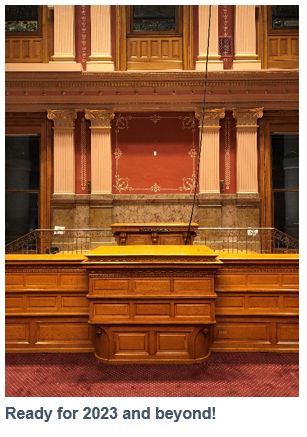
    Finished Front Desk in the Senate Chamber.

    From the more efficient electrical setup and the 2022 time capsule that now both live beneath the floor to the sparkling golden fixtures throughout, the renovated Senate Chamber honors the Colorado Capitol’s architectural history while making room for a smoother, more modern and streamlined user experience during future sessions.
  • Different Roles Under One Dome: An Analysis of Partisan and Nonpartisan Legislative Staff

    by Alana Rosen

    The Colorado Capitol is filled with legislators, partisan legislative staff, nonpartisan legislative staff, executive agency officials, lobbyists, and the public. With so many individuals in the building, you may be asking yourself, “What is the difference between partisan and nonpartisan legislative staff if they all serve the Colorado General Assembly?”

    Partisan legislative staff work for or strongly support one side, party, or legislator. In Colorado, the House of Representatives and the Senate each have a Democratic and Republican caucus staff made up of partisan legislative aides, interns, and staff. Partisan staff work to advance the policy agenda of a legislator or that person’s caucus, as well as assist with requests from constituents. Partisan staff are more likely to discuss political and personal beliefs in the workplace.

    Nonpartisan legislative staff, on the other hand, aim to serve all legislators impartially— regardless of party—ensuring their work is objective, balanced, and accessible. To fulfill this function properly, nonpartisan staff must provide the highest level of service to all members, under all circumstances, so the General Assembly feels confident in their impartiality. When nonpartisan staff participate in partisan political activities, public confidence in the legislative process can be undermined by creating a perception that nonpartisan staff may not provide the unbiased support necessary to enable the General Assembly to make informed decisions that best serve the public interest.

    Nonpartisan legislative staff have a compelling interest to protect both the actual and perceived integrity of the legislative process by placing narrowly tailored restrictions on employees’ political activities. For this reason, nonpartisan staff are prohibited from fundraising for a partisan candidate, making political contributions, actively participating in the campaign of a partisan candidate, actively participating in a political party or organization, or running for political office. Additionally, nonpartisan staff do not discuss politics or personal beliefs with legislators, partisan legislative staff, executive agency officials, lobbyists, or the public.

    During the interview process, prospective staff are often asked extensive questions regarding their ability to be nonpartisan and whether they have any reservations about being nonpartisan. It is a code of conduct that nonpartisan staff adopt in order to serve the legislature fairly and impartially.

    You may now be wondering, “Who are the nonpartisan staff so I can avoid engaging them in political discussions?” In addition to your nonpartisan Senate Services staff and staff of the House of Representative, there are four nonpartisan legislative agencies created in state law that serve the Colorado General Assembly with oversight from a legislative committee : the Office of Legislative Legal Services (OLLS), Legislative Council Staff (LCS), Joint Budget Committee Staff (JBC), and the Office of the State Auditor (OSA).[1]

    The OLLS is the nonpartisan in-house counsel for the General Assembly. Among its many tasks, the OLLS writes laws, produces statutes, reviews administrative rules, comments on initiated measures, and serves as a resource of legislative information for the public.

    The LCS is the permanent research staff of the General Assembly, providing public policy research at the request of the members. The LCS provides support to legislative committees, responds to requests for research and constituent services, prepares fiscal notes, provides economic and revenue forecasts, and performs other centralized legislative support services.

    The JBC is the General Assembly’s permanent fiscal and budget review agency. The JBC writes the annual appropriations bill, also known as the Long Bill, for the operations of state government. The JBC is charged with analyzing the management, operations, programs, and fiscal needs of the departments of state government and makes recommendations to the members of the General Assembly as they build the state’s budget.

    The OSA seeks to hold state government agencies accountable through performance, financial, and information technology audits of all state departments, colleges, and universities. Audits provide solution-based recommendations that focus on reducing costs, increasing efficiency, promoting the achievement of legislative intent, improving effectiveness of programs and the quality of services, ensuring transparency in government, and ensuring the accuracy and integrity of financial information to hold government agencies accountable for the use of public resources.

    With so many new members in the General Assembly this year, a clearer understanding of the differences between the roles of partisan and nonpartisan legislative staff is helpful as we enter the 2023 legislative session. If you’re a new legislator and have questions, please feel free to contact the OLLS at 303-866-2045 or olls.ga@coleg.gov.


    [1] See article 3 of title 2, Colorado Revised Statutes.

  • High School Football Prayer Gets the Ultimate Replay Review

    by Alana Rosen

    In many states, high school football is seen almost as an unofficial religion. On June 27, 2022, the United States Supreme Court brought high school football and religion even closer by announcing its decision in favor of Mr. Joseph Kennedy in Kennedy v. Bremerton School District.

    Mr. Kennedy worked as a football coach for Bremerton High School in Washington State from 2008 to 2015. Since his hiring in 2008, Mr. Kennedy engaged in a practice of “taking a knee at the fifty-yard line to say a quiet prayer at the end of football games for about 30-seconds.” Initially, Mr. Kennedy prayed on his own but, over time, some players asked whether they could pray alongside him. Some players invited opposing players to join too. Mr. Kennedy began giving motivational speeches, with a helmet held aloft, and would deliver speeches with “overtly religious references,” which Mr. Kennedy described as prayers, while players kneeled around him. On September 17, 2015, after learning of the post-game prayers, the Bremerton School District (District) asked Mr. Kennedy to stop the practice of incorporating religious references or prayer in his post-game motivational talks on the field because the District did not want to violate the Establishment Clause. [1]

    On October 14, 2015, Mr. Kennedy sent a letter to school officials through his attorney, stating that he would resume his practice of praying at the 50-yard line because he felt “compelled” by his “sincerely-held religious beliefs” to offer a “post-game personal prayer.” He asked the District to allow him to continue the “private religious expression” alone and stated that he would wait until the game was over and the players had left the field.

    Thereafter, Mr. Kennedy and his attorney had a back-and-forth with the school district. Mr. Kennedy wanted to exercise his sincerely-held religious beliefs to offer a post-game prayer and the school expressed concern that such a prayer would lead a reasonable observer to think that he was endorsing prayer while on duty as a District employee. The District also offered accommodations for religious exercise that would not be perceived as endorsing religion or interfere with his job performance.

    Undeterred, Mr. Kennedy continued to pray at the 50-yard line while post-game activities were still ongoing, and as a result, the District placed him on paid administrative leave for violating its directives by thrice kneeling on the field and praying immediately following games before rejoining the players for post-game talks. On August 9, 2016, Mr. Kennedy filed suit in the Western District of Washington contending that the District violated his rights under the Free Speech and Free Exercise Clauses of the First Amendment.

    In this case, the United States Supreme Court considered whether a public school employee who says a brief, quiet prayer while at school and visible to students is engaged in government speech, which is not protected by the First Amendment. And whether, assuming that such religious expression is private and protected by the Free Speech and Free Exercise Clauses, the Establishment Clause compels public schools to prohibit religious expression.

    Since the founding of this country, the Religion Clauses of the First Amendment—the Establishment Clause and the Free Exercise Clause—have been understood to jointly demand government neutrality towards religion. The Free Exercise Clause recognizes the right to believe and practice a faith, or not. The Establishment Clause prohibits the government from making any law “respecting an establishment of religion.” The Free Speech Clause protects religious speech.

    A plaintiff bears a certain burden to demonstrate an infringement of rights under the Free Exercise and Free Speech Clauses. In this case, the Court held that Mr. Kennedy discharged his burdens under the Free Exercise Clause and the Free Speech Clause, which were “sincerely motivated religious exercises.”

    To determine whether the government violated the Free Exercise Clause, the Court considered whether a government policy is neutral and generally applicable. Justice Gorsuch, writing for the six-member majority, stated that a government policy will not qualify as neutral if it is specifically directed at a religious practice. Additionally, a government policy will fail the general applicability requirement if the policy prohibits religious conduct while permitting secular conduct that undermines the government’s asserted interests in a similar way or if it provides a mechanism for individualized exemptions.

    Here, the Court determined that the District’s challenged policies were neither neutral nor generally applicable. The Court held that the District’s policy was not neutral towards religious conduct. The Court further held that the District’s challenged policy failed the general applicability test because the District had advised against renewing Mr. Kennedy’s contract because he “failed to supervise student-athletes after the game.” The Court noted that any sort of post-game supervision requirement must be applied evenly across the board, and while other coaching staff briefly visited with friends or took personal calls, Mr. Kennedy chose to briefly pray at the 50-yard line.

    The Court then analyzed whether the District violated Mr. Kennedy’s freedom of speech. The Court held that Mr. Kennedy offered his prayers in his capacity as a private citizen, which did not amount to government speech because the prayers were not ordinarily within the scope of Mr. Kennedy’s duties as a coach. To come to this conclusion, the Court applied the Pickering Garcettitwo-step test.[2] The first step of the test is to determine whether a public employee is speaking as a the public employee doing official duties or whether the public employee is speaking as a citizen addressing a matter of public concern. The second step of the test is that the government may seek to prove that its interests as an employer outweigh an employee’s private speech as a matter of public concern.

    In applying the “Pickering-Garcetti” test, the Court first determined Mr. Kennedy was speaking as a private citizen as “Mr. Kennedy’s prayers did not ‘owe [their] existence’ to Mr. Kennedy’s responsibilities as a public employee.” The Court stated that the timing and circumstances of Mr. Kennedy’s prayers confirm this point because the prayer was conducted during the post-game period. Justice Gorsuch stated that “[t]eachers and coaches served as vital role models, but [the District’s] argument commits the error of positing an excessively broad job description by treating everything teachers and coaches say in the workplace as government speech subject to government control.” In the dissent, however, Justice Sotomayor argued that Mr. Kennedy was on the job as a school official on government property when he incorporated a public, demonstrative prayer into government-sponsored school related events as a regularly scheduled feature to those events.

    The District argued that it was essential to suspend Mr. Kennedy to avoid violations of the Establishment Clause and relied on the Lemon test—a three-step test established in Lemon v. Kurtzmann—and its progeny to determine Establishment Clause violations. [3] Justice Gorsuch, however, said that the Court had abandoned Lemon and the related endorsement test. The Court argued that these tests invited chaos and led to differing results in materially identifiable cases. Instead, in place of Lemon, the Court instructed that the Establishment Clause must be interpreted by “reference to historical practices and understandings.” Justice Sotomayor questioned the Court’s new “history and tradition” test because the Court did not provide guidance on how to apply the test, potentially causing confusion to school administrators, faculty, and staff trying to implement it.

    What does Kennedy mean for Colorado?

    Right now, it is unclear how Kennedy will affect Colorado and education law. While teachers or school personnel could bring forth similar arguments for their religious conduct, courts will ultimately have to determine what the “history and tradition” test is in order to answer whether religious conduct violates the Establishment Clause. Because the Court did not provide guidance on how to apply the “history and tradition” test, it will be up to the lower courts to decide.


    [1] The Establishment Clause prohibits the government from making any law “respecting an establishment of religion” and it bars the government from taking sides in religious disputes or favoring or disfavoring anyone based on religion or belief (or lack thereof).

    [2] Garcetti v. Ceballos, 547 U.S. 410 (2006) (holding the First Amendment does not prohibit managerial discipline of public employees for making statements pursuant to employees’ official duties); Pickering v. Bd. of Ed. of Township High Sch. Dist. 205 Will Cty., 391 U.S. 563 (1968) (holding a teacher’s right to speak on issues of public importance may not furnish the basis for his dismissal from public employment).

    [3] Lemon v. Kurtzman, 401 U.S. 602 (1971) (establishing a three-part test to determine First Amendment Establishment Clause violations).

  • Remarks on the “Unremarkable” Carson v. Makin

    by Jacob Baus

    “Unremarkable”

    Is this a judgmental slight from Downton Abbey’s Mr. Carson, or a harsh but fair critique from TV personality Carson Kressley? Neither! This is how U.S. Supreme Court Chief Justice John Roberts described the holding in a recent case, Carson v. Makin.

    The First Amendment of the U.S. Constitution states, in part, “Congress shall make no law respecting an establishment of religion or prohibiting the free exercise thereof; . . .”, and these clauses are commonly referred to as the Establishment Clause and Free Exercise Clause. Carson is the latest case concerning the provision of public money to a religious-affiliated school and how states have attempted to navigate the issue with respect to these clauses.

    Maine is a sparsely populated state, and many of its school districts do not operate a secondary school. Consequently, Maine created a tuition assistance program for families whose resident school district does not provide a secondary school education. An eligible family chooses a school, and the resident school district sends tuition assistance payments to the school, if the school is eligible.

    To be eligible, a school must satisfy certain education-related requirements, may be public or private, and must be nonreligious. Maine excluded religious schools from the program based on a position that the provision of public money to religious schools violated the Establishment Clause of the First Amendment of the U.S. Constitution. Eligible families sued Maine’s Commissioner of Education, arguing the program’s nonreligious requirement violated the Free Exercise, Establishment, and Equal Protection Clauses of the U.S. Constitution.

    Applying principles from the related Trinity Lutheran Church of Columbia, Inc. v. Comer and Espinoza v. Montana Department of Revenue cases, the Court arrived at a similar conclusion in Carson; that is, excluding religious schools from program eligibility because of their religious character violates the Free Exercise Clause. This reliance on consistent and recent precedent may explain why Chief Justice Roberts found the conclusion in this case to be unremarkable. Nevertheless, the Court addressed a few significant considerations and arguments in reaching its conclusion.

    First, the Court noted that the flow of public funds to a religious institution through the independent choice of a benefit recipient does not offend the Establishment Clause. Consequently, excluding religious schools from program eligibility promotes stricter separation between church and state than the Establishment Clause requires. And, the Court continued, a state’s interest in separating church and state further than the Establishment Clause requires is not sufficiently compelling in this case to justify a Free Exercise Clause violation to deny a public benefit because of religious character.

    Second, Maine argued that the benefit at issue was providing the “rough equivalent of a public school education” and therefore must be secular. The Court rejected this argument, citing numerous facts about the program undermining this assertion. The Court ultimately concluded that the only real manner in which an eligible private school is the “equivalent” of a public school under the program is that it must be secular, thereby supporting the Court’s position that the program excludes based upon religious character.

    Third, Maine argued that the nonreligious requirement was not religious character-based, but rather religious use-based. Maine argued that because religion permeates everything a religious school does, the nonreligious requirement was effectively use-based and therefore permissible. Maine argued this distinction because the Court has previously held that a state’s religious use-based exclusion was constitutionally permissible.[1] The Court rejected this argument, concluding that a prohibition on character-based discrimination is not grounds for engaging in use-based discrimination.

    What does Carson mean for Colorado?

    Nothing in the Carson decision requires Colorado to provide public money to support private schools. The Carson decision reaffirms an important point of clarity from the Espinoza decision:

    [A] State need not subsidize private education. But once a State decides to do so, it cannot disqualify some private schools solely because they are religious.

    It is not novel to state that the General Assembly must be cautious if a public program or benefit appears to categorically exclude a religious school or institution. It appears from Carson, Espinoza, and Trinity, that the Court is likely inclined to find that religious exclusions are character-based, and therefore in violation of the Free Exercise Clause, even if a state has a no-aid provision similar to article IX, section 7 of the Colorado Constitution.

    Although it is always difficult to predict what happens next, the Court will likely have future opportunities to examine whether there is a meaningful constitutional distinction between exclusions that are character-based versus use-based in nature and how states should consider issues that fall in an often-found tension between the Free Exercise and Establishment Clauses.


    [1] Locke v. Davey, 540 U.S. 712 (2004) (A publicly funded Washington scholarship excluded the use of the scholarship for a degree in theology. The United States Supreme Court concluded the exclusion was not unconstitutional.)

  • New Water Demand Management Agreement on the Colorado River (Updated)

    by Thomas Morris

    Editor’s note: This article was originally posted September 19, 2019. We are reposting it on September 22, 2022 with updated information.

    What happens when the demand for a commodity exceeds supply? Economic theory predicts that the price for the commodity will increase. We’re all aware that water in Colorado is relatively scarce; in particular, the northern Front Range is highly dependent on water imported from the Colorado River, which is subject to increasing demands and dwindling supply. Are increases in the price of water sufficient to address this deficit?

    As we’ll see, due to multiple layers of state, interstate, and federal law and a combination of climate change effects, prolonged drought, and demand increases, our Colorado River water supply is at risk, and more is required to avoid fairly serious adverse consequences than simply relying on the market to equalize the supply and demand for water.

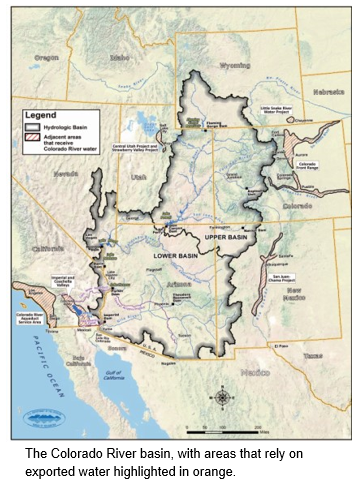
    Map of southwestern United States illustrating the Colorado River basin, with areas that rely on exported water highlighted in orange.

    The law of the river. The use of Colorado River water is strictly governed by the so-called “law of the river,” which is a complex interplay of interstate compacts, federal statutes and regulations, United States Supreme Court decrees, and applicable state law.

    To avoid having California’s rapid growth gobble up available Colorado River supplies, in 1922 the seven states in the Colorado River basin1entered into an interstate compact. The Colorado River Compact (codified in article 61 of title 37, C.R.S.) allocated 7.5 million acre-feet2 (Maf) of water per year to the upper basin states (including Colorado) and 8.5 Maf to the lower basin states, for a total 16 Maf.3 Later, the upper basin states entered into the Upper Colorado River Compact (codified in article 62 of title 37, C.R.S.), pursuant to which 51.75% of the upper basin’s supplies were allocated to Colorado.

    Naturally, the states presumed that the river’s supplies were adequate, even plentiful, to meet these allocations. Indeed, from 1905 to 1921 the flow at the boundary between the upper and lower basins was about 18 Maf. Unfortunately, the 1922 compact was negotiated during a time of relatively high flows: rather than more than 16 Maf of flow per year, actual supplies under current conditions may be as low as 14.8 Maf. Moreover, climate change is likely to reduce this supply even more:

    Colorado River flows decline by about 4 percent per degree Fahrenheit increase . . . . Thus, warming could reduce water flow in the Colorado [River] by 20 percent or more below the 20th-century average by midcentury, and by as much as 40 percent by the end of the century.4

    Despite this somewhat grim outlook, the upper basin’s ability to comply with its delivery obligation to the lower basin is enhanced by two facts:

    • The 1922 compact states the delivery obligation as 75 Maf over 10 years rather than 7.5 Maf each year; and
    • Numerous reservoirs with significant storage capacities are located in the upper basin. These reservoirs, including Lake Powell5 and several reservoirs referred to as the Aspinall Unit, store excess supplies in wet years and release them in dry years to comply with the delivery obligation.

    Staving off a shortage declaration through demand management. The federal Bureau of Reclamation operates the Aspinall Unit as well as Lake Powell and Lake Mead, which is the lower basin’s primary reservoir. Pursuant to an agreement6 between the seven compacting states, the bureau operates the Aspinall Unit and Lakes Powell and Mead to maintain the water level in Lake Mead above 1,075 feet in elevation. If the water drops to that level, the bureau makes a “shortage declaration” that triggers mandatory restrictions on water diversions and usage in the lower basin. A shortage declaration may also be the first step toward a determination that the upper basin has failed to comply with its delivery obligation, which would result in the curtailment of upper basin diversions that postdate the 1922 compact.

    In order to reduce the risk of a shortage declaration occurring, the upper and lower basins have both recently adopted updated drought contingency plans.7 Congress has approved the plans.8

    In particular, the upper basin’s drought contingency plan involves three elements:

    • Augmentation, consisting of weather modification efforts to increase precipitation and the removal of phreatophytes (plants that have deep root systems that draw water from near the water table and often consume an unusually large amount of water);
    • Operating the Aspinall Unit to benefit storage in Lake Powell; and
    • Demand management.

    Demand management in this context means, roughly, a temporary, voluntary, and compensated reduction in consumptive water use by specific water rights owners. In Colorado, demand management could involve a front range metropolitan water provider (whose water rights postdate the 1922 decree and thus whose diversions would be curtailed if the upper basin failed to meet its delivery obligation) paying a senior agricultural user on the western slope to temporarily not divert water from the Colorado River or its tributaries. The metropolitan water provider would then be able to continue to export Colorado River water to its Front Range water users. As the saying goes, water flows uphill toward money.

    The General Assembly recently supported the development of demand management programs by enacting Senate Bill 19-212.9 The bill appropriates $1.7 million from the general fund to the department of natural resources for use by the Colorado Water Conservation Board.  The board will use this money for stakeholder outreach and technical analysis to develop a water resources demand management program.

    The days of hoping that Colorado River supplies will somehow recover or that the lower basin will, by some miracle, substantially reduce its water consumption enough to avoid a shortage declaration are over. Colorado is preparing for a hotter, drier climate in which water demands continue to increase while supplies diminish. Water demand management is one of the primary tools (along with conservation and the development of additional storage) that will be used to adapt to this new normal.

    In the article originally posted in 2019, the author posed the question “Are increases in the price of water sufficient to address this [water] deficit?” Following is an update that suggests the answer to this question is a resounding “no”, as the Colorado River water supply continues to dwindle.

    UPDATE:10 On August 16, 2022, the Bureau of Reclamation within the federal Department of the Interior11 released its “Colorado River Basin August 2022 24-Month Study”,12 which sets the annual operations for Lake Powell and Lake Mead in 2023 in light of critically low reservoir conditions. The key findings include:

    Lake Powell’s water surface elevation on January 1, 2023, is projected to be 3,522 feet, which is 178 feet below full (3,700 feet) and only 32 feet above the minimum level required in order to continue to produce power at Glen Canyon Dam (3,490 feet). The Department of the Interior will limit 2023 releases from Lake Powell in order to protect it from declining below 3,525 feet at the end of December 2023. The Department will also evaluate hydrologic conditions again in April 2023.

    Lake Mead’s water surface elevation on January 1, 2023, is projected to be 1,047.61 feet, which reflects an unprecedented shortage condition that requires shortage reductions and water savings contributions from the Lower Basin States and Mexico, as follows:13

    • Arizona: 592,000 acre-feet, which is approximately 21% of the state’s annual apportionment;
    • Nevada: 25,000 acre-feet, which is 8% of the state’s annual apportionment; and
    • Mexico: 104,000 acre-feet, which is approximately 7% of the country’s annual allotment.

    There is no required water savings contribution for California in 2023 under the current operating condition.

    The Department and the Bureau of Reclamation continue to share and update information concerning the increasing risks impacting Lake Powell and Lake Mead.

    _________________________________________________________________

    1. The seven states of the Colorado River Basin are Wyoming, Colorado, Utah, New Mexico, Arizona, Nevada, and California. The upper basin consists mainly of Wyoming, Colorado, and Utah; New Mexico, Arizona, Nevada, and California are mainly in the lower basin. ↩︎
    2. An acre-foot is the amount of water required to cover one acre to a depth of one foot. An acre is about the size of a football field, including both end zones. ↩︎
    3. For comparison, Colorado consumes about 5.3 Maf per year, but this includes water that has been reused multiple times. See the state water plan – https://cwcb.colorado.gov/colorado-water-plan ↩︎
    4. http://theconversation.com/climate-change-is-shrinking-the-colorado-river-76280 ↩︎
    5. Lake Powell is located directly above the boundary between the upper and lower basins; releases from Lake Powell are the primary method by which the upper basin complies with the 1922 compact. ↩︎
    6. Colorado River Interim Guidelines for Lower Basin Shortages and Coordinated Operations for Lake Powell and Lake Mead”, 72 FR 62272 (11/2/07). ↩︎
    7. Agreement Concerning Colorado River Drought Contingency Management and Operations; https://www.usbr.gov/ColoradoRiverBasin/dcp/finaldocs.html. ↩︎
    8. Colorado River Drought Contingency Plan Authorization Act; https://www.congress.gov/bill/116th-congress/house-bill/2030/text ↩︎
    9. https://leg.colorado.gov/bills/sb19-212 ↩︎
    10. This update was prepared by the LegiSource board, not the original author. ↩︎
    11. https://www.doi.gov/pressreleases/interior-department-announces-actions-protect-colorado-river-system-sets-2023 ↩︎
    12. https://www.usbr.gov/uc/water/crsp/studies/index.html ↩︎
    13. These reductions and contributions are required pursuant to the 2019 Drought Contingency Plans and Minute 323 to the 1944 U.S. Mexico Water Treaty. ↩︎
  • What does it take to get a bill to the Governor?

    What does it take to get a bill to the Governor?

    by Kathy Zambrano and Anja Boyd

    You’d think that once a bill makes it through both houses and the first house concurs with second house changes, if necessary, the bill would land on the Governor’s desk in a day. But in most cases, there’s a lag time of up to five working days – oftentimes more as we move to the end of the legislative session – before an enacted bill gets presented to the Governor for action. So what really happens to a bill before it is delivered to the Governor on act paper?

    First thing to know is that, pursuant to Rule 18 of the Joint Rules of the Senate and House of Representatives,1 “the enrolling clerk of the originating house and the Office of Legislative Legal Services shall coordinate and work together jointly to prepare the bill as passed in final form. The Office of Legislative Legal Services shall prepare the bill in the form in which it shall appear in the session laws. . . “. So over the years, the House and Senate enrolling rooms and the OLLS have developed a process that allows for the efficient preparation of the bills on act paper and the development of the Session Laws.2

    Once the enrolling room receives a bill for enrolling into an act, they verify sponsors before delivering the bill to the Publications Team in the OLLS. But before they can even do that, they typically prioritize their other work to focus on engrossing bills as they pass on second and third reading, since those bills must be made available the same day they pass on the floor, and on preparing preamended bills that are reported out of committees so that those are available to legislators and the public as soon as possible.

    Once the Publications Team receives the bill for enrolling, they begin processing the bill by checking the bill for errors that may be fixed by correction schedule.3 Then they input the bill’s information into the bill disposition tables and the Red Book, which is a tabulation of all C.R.S. sections affected by bills passed during the legislative session. The bill disposition tables and the Red Book4 are mandatory parts of the Session Laws,5 which are prepared by the OLLS following each legislative session as required by statute. By preparing the red book entries at this point, it allows the Publications Team to determine whether new statutory sections added in the bill need to be renumbered to make room for other new statutory sections added by other bills and which provisions need to be harmonized or superseded. This is the beginning of the steps in preparation of the Colorado Revised Statutes.

    Once the Publications Team finishes with the bill, they deliver it to the subject matter team in the OLLS that is responsible for the bill to prepare an advance unofficial copy. The subject matter team reviews the bill attachments for completeness and accuracy as a courtesy to the House and Senate front desks, then they verify which version of the bill should be enrolled, check the sponsors on the bill, input any conference committee report changes that were adopted, make sure all amendments that were passed appear in the bill, and check to ensure that no current law has been dropped and that all new language appears in capital letters. If they find grammatical or punctuation errors, they include those on the correction schedule before making any corrections in the copy. If the subject matter team is enrolling a bill during the legislative session, then other session-related work often takes priority, like bill and amendment preparation, so there could be delays.

    When the unofficial copy of a bill is ready, it is delivered to the enrolling room for proofing. Yep, the bill is proofed yet again even though it has been proofed after each reading during its travels to become a final act. The enrolling room also checks sponsorship of the bill and ensures that any corrections to the bill and any conference committee report that was adopted appear in the copy. Great care is taken to ensure that the bill is correctly enrolled.

    When the enrolling room completes their proofing, they deliver the bill to the Publications Team again; the Publications Team reviews it and determines whether further grammatical or punctuation corrections need to be made. The bill is then put on act paper by the subject matter team, subject to other priorities. The act paper copy, which is the version of the bill the Governor receives for signing, is then delivered to the appropriate enrolling room.

    Now that the enrolling room has the final act copy, they prepare a fancy bill jacket that goes along with the act to the Governor’s office. But before it goes to the Governor, there are a few more stops on a bill’s journey to the Governor’s desk. First, if it’s a House bill, it goes to the Speaker of the House of Representatives and Chief Clerk for their signatures and then to the President of the Senate and the Senate Secretary for their signatures. If it’s a Senate bill, the President and Senate Secretary get to sign first. And, of course, messages are prepared to notify the body that the bill was signed by the Speaker or President, if the legislative session is still in progress.

    So then, after all of that action takes place, the enrolling room contacts the Governor’s office and makes arrangements for someone to be physically present in the Governor’s office to sign for and receive the bill.

    And now you know what really happens before a bill lands on the Governor’s desk.

    ____________________________________________________________________

    1. https://www.leg.state.co.us/inethsr.nsf/Rule.xsp?id=JNTRULES.18&catg=Joint&pg=2.0 ↩︎
    2. https://legisource.net/2011/11/10/what-is-the-difference-between-the-session-laws-and-the-statutes/ ↩︎
    3. The correction schedule is a list of grammatical and punctuation errors that may appear in a bill, along with numbering changes required due to other bills amending the same section, which are automatically corrected when the bill is enrolled into an act. ↩︎
    4. https://content.leg.colorado.gov/agencies/office-legislative-legal-services/red-book ↩︎
    5. https://leg.colorado.gov/laws/session-laws ↩︎
  • Election Year Precautions – Part 2

    by Bob Lackner

    In our previous article1 on election year precautions, we looked at whether legislators may hold another public office. In this article, we’ll look at the use of state resources.

    Use of House and Senate legislative staff, equipment, and resources

    Perennial questions arise concerning the possible use of state equipment or state buildings and the use of staff time for political purposes, namely a member’s reelection efforts and related advocacy activities on behalf of the member’s political party or other candidates for partisan office. These questions naturally tend to be more pressing in election years when legislators are often pulled between their official legislative duties and critical political tasks necessary to ensure reelection for themselves or other candidates of their political party.

    There is not much law that provides clarity on most questions in this area. The most concrete guidance is a statute that prohibits, among other things, a state agency, including the General Assembly, from making any contribution in campaigns involving the nomination, retention, or election of any person to public office.2 A violation of this section subjects the offender to sanctions including an order directing the person making the contribution to reimburse the fund of the state from which the moneys were diverted for the amount of the contribution.3 Over the years, the Office of Legislative Legal Services (Office) has recommended that the wisest default position for legislators, partisan staff, and House and Senate employees is to avoid, to the greatest extent practicable, the use of Capitol office space, public resources, or staff time for political campaign activity of a partisan nature. Following this advice may avoid an ethics complaint being filed. We have come to publicize this advice in terms of the “Three Nos.” Specifically:

    • No Capitol space: With one limited exception as noted below, rooms in the Capitol building, including private offices, should not be used to carry out political campaign activity.
    • No equipment: State-funded equipment and other related resources for the use of members of the General Assembly and their staff in fulfilling their official duties, including desktop and laptop computers, tablets, telephones, fax machines, copier machines, paper products, office supplies, and internet connectivity, should not be used to carry out political campaign activity.
    • No staff: Staff for elected officials should not be using their time for which they are paid to assist the member in carrying out the member’s official legislative duties to carry out political campaign activity. Staff is permitted, however, to engage in political campaign activity in their free time while “off the clock”, outside the Capitol building, and without the use of state resources.

    With respect to the Capitol building, there has been an accepted practice over many years of legislators using photographs of the legislator from inside the building for use in campaign materials. A popular setting for the use of such a photograph is from the House or Senate floor. In more recent years, the photograph is often displayed on the candidate’s website or for use in social media. As long as the photograph does not include the state seal or the seal of either the State Senate or the State House of Representatives, this practice has been permitted as a narrow exception to the general rule against political activity within the state Capitol.

    Some of the other perennial questions in this area include:

    • May House or Senate legislative staff, equipment, or resources be used during regular business hours to arrange “town hall” meetings on behalf of a member of the General Assembly? Legislative staff, equipment, or resources may be used during regular business hours to arrange “town hall” meeting on behalf of a member of the General Assembly as long as the meeting relates exclusively to the legislator’s official duties—that is, legislation, a discussion of state issues, policymaking, etc.,—and the legislator or staff do not engage in political activity relating to the election of a candidate. Similarly, staff may use state equipment during business hours to communicate with constituents on legislative matters on behalf of members as long as the communications are not for campaign or political purposes.
    • May political literature be handed out at a town hall meeting held in connection with a member’s official duties? This practice is not advisable. If the town hall meeting is held for the purpose of communicating with the public about legislative business, it should not be coupled with any activity, such as handing out campaign literature, that suggests a political purpose.
    • May House or Senate legislative staff maintain a legislator’s website that is predominantly devoted to legislative activities but that also contains some content that could be characterized as political or campaign-related? Nevertheless, the member and staff should remain conscious of the fact that the line between what is legislative and what is political in the context of written or electronic communications oftentimes becomes blurred. Accordingly, when staff uses state time or resources to generate materials that appear, or might be construed, to be created or used for a campaign or political activity or purpose, the likelihood of a complaint is greater.

    May House or Senate partisan staff undertake political activity on the weekend or at night when the staff person may also be engaged in work on official legislative business? Yes. The boundary between time that may be spent on official legislative duties and time spent on political activity is essentially governed by the staff person’s official legislative work schedule. The staff person needs to refrain from undertaking political activity while on the legislative clock.


    1. https://legisource.net/2022/03/11/election-year-precautions-part-1/ ↩︎
    2. Section 1-45-117 (1)(a)(I), Colorado Revised Statutes. ↩︎
    3. Section 1-45-117 (4)(a), Colorado Revised Statutes. ↩︎
  • Election Year Precautions – Part 1

    by Bob Lackner

    2022 is an election year, which means that most of the members of the General Assembly will be running for reelection (or sometimes another office). Running for office can become an all-consuming endeavor, which can cause legislators who are also candidates to forget or lose sight of some of the legal restrictions on legislators who may also be candidates. This article, the first in a two-part series, discusses whether legislators may hold another public office. The second part of this series will cover the use of state resources.

    Holding dual offices

    One issue members may confront during their tenure in the General Assembly is the ability to hold another public office at the same time they are serving in the General Assembly. Perhaps they were serving in another office when elected to the General Assembly and would like to continue in that role. Or, maybe an opportunity arises for a sitting member of the General Assembly to seek another state or local office.

    The Colorado Constitution provides that “[n]o senator or representative shall, while serving as such, be appointed to any civil office under this state; and no member of congress, or other person holding any office (except of attorney-at law, notary public, or in the militia) under the United States or this state, shall be a member of either house during his continuance in office.”[1] Colorado court decisions suggest the use of the following general guidelines in applying this constitutional section[2]:

    • During their term of office, no member of the General Assembly can be appointed to a civil office in state government.
    • Because the Colorado courts have not had occasion to specifically address the prohibition against holding other state elective office and because of separation of powers concerns and possible conflicts of interest, perceived or real, it is less clear whether a member of the General Assembly could simultaneously hold another elected office in state government.
    • It is clear that a member of the General Assembly may hold an elected or appointed office in a local government.
    • Legislators may also be employed by the state or a local government. An “appointment,” as contrasted with an “appointment to a civil office,” exists as long as the person is not required to exercise independent decision-making authority and is not entrusted with the sovereign power of the state.

    Although these guidelines indicate that a legislator may serve in certain other civil offices, most electors decide not to serve in other public offices during their tenure in the General Assembly because of the time demands of being a legislator, concerns about the possible appearance of a conflict of interest, and the need to abstain from voting when a conflict exists.[3] The potential exists for many potential conflicts of interest between votes and positions taken as a member of the General Assembly while simultaneously holding another public office. In evaluating whether to hold another public office while serving as a member of the General Assembly, it may be of benefit to consider the degree to which the state affects the other government’s activities and the potential for conflicts between the members’ roles. For example, there may be a higher likelihood of conflict between large cities and counties than for other types of governmental entities such as small (statutory) towns or special districts.

    On a related note, section 1-4-501 (2), C.R.S., prohibits any person from being an eligible candidate for more than one office at one time.[4] Therefore, assuming a member of the General Assembly is also permitted to hold an elected office in a local government, the legislator cannot run for a legislative seat and that other office in the same election.[5]


    [1] Colorado Constitution, Article V,  Section 8.

    [2]Carpenter v. People ex. El. Tilford, 8 Colo. 116, 5 P. 828 (1884) and Hudson v. Annear, 101 Colo. 551, 75 P. 2d 587 (1938). A civil office is an office in which its holder is required to take an official oath or to give bond. Hudson, 101 Colo. at 555-556, 75 P.2d at 588-589.

    [3]See Colorado Constitution Article V, Section 43 and Section 24-18-107, Colorado Revised Statutes, and House Rule No. 21 (c) and Senate Rule No. 17 (c).

    [4] Section 1-4-501 (2), Colorado Revised Statutes.

    [5] The material in this section of the article is taken from a memorandum from the Office of Legislative Legal Services to Interested Persons dated November 29, 2021, entitled “Legislators Holding Other Offices”.

  • Bone-Dry Laws: The Sobering Truth of Colorado’s Prohibition Era

    by Alana Rosen and Nate Carr

    If you have ever tasted a Gin Rickey, a Sidecar, or an Old Fashioned, then you have sampled a popular cocktail created during the Prohibition Era. The Prohibition Era, which lasted as a federal ban from January 17, 1920, until December 5, 1933, is remembered for the underworld nightlife of jazz clubs, flappers, and bootleggers and is now, over 100 years later, often romanticized.1 Recently, the glamorization of the Prohibition Era has even inspired a resurgence of speakeasies, Roaring ’20s costume parties, and the modern-day film interpretation The Great Gatsby with heartthrob Leonardo DiCaprio. Despite the fascination with this era, Prohibition was propelled by more sober reasoning.

    The Temperance Movement was a driving political force to pass prohibition legislation. In Colorado and across the country, the Temperance Movement included a number of diverse organizations, such as the Women’s Christian Temperance Union, religious leaders, itinerant preachers, suffragists, and progressive-minded community members. Temperance reformers believed alcohol was the cause of social problems, and with its eradication, “America would be fully cleansed of sin”.2 In Colorado, women gained the right to vote in statewide elections in 1893, and many women advocated to ban alcohol because of the link between drinking and domestic violence at home. As early as 1907, temperance reformers in Colorado celebrated the passage of anti-saloon legislation.

    Group of Women with the caption "Women's Christian Temperance Union members advocating for Prohibition, 1914. Image from History Colorado.

    In 1907, the Colorado General Assembly passed the first bone-dry law, an act allowing political territories to vote to outlaw the sale of alcohol within the territory.3 By 1910, 20 out of 25 counties that voted on the question of whether to become anti-saloon territories, chose to become anti-saloon territories. Denver was among the five holdouts. Despite fervent efforts, temperance reformers were unsuccessful in convincing the electorate to add a prohibition amendment to the Colorado Constitution. But that all changed in 1914.

    In 1914, Colorado voters passed a constitutional amendment limiting alcohol in the state except for medicinal or sacramental reasons by a vote of 129,589 to 118,017.4 The constitutional amendment, Article XXII, took effect on January 1, 1916. Under Article XXII, no person, association, or corporation could manufacture for sale or gift, or keep for sale or gift, any intoxicating liquor, except in limited situations.5

    The City and County of Denver, however, disagreed with Article XXII and continued to issue licenses to businesses to sell intoxicating liquors under its home-rule authority found in Article XX of the Colorado constitution. This disagreement resulted in the Colorado Supreme Court case, People ex rel. Carlson v. City Council of Denver.6 The Court held that Denver was not exempt from the Article XXII, and the city was required to cancel issued liquor licenses.

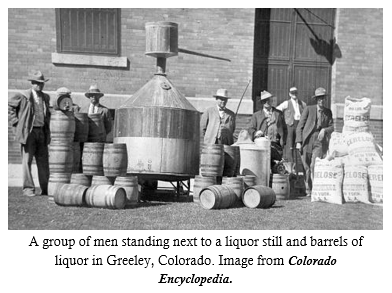
    A group of men standing next to a liquor still and barrels of liquor in Greeley, Colorado. Image from Colorado Encyclopedia.

    In 1915, the Colorado General Assembly went a step further and passed Senate Bill 80, which enacted laws against the possession, distribution, and advertising of intoxicating liquors. Senate Bill 80 also outlined law enforcement’s duty to search, seize, and destroy intoxicating liquors. If an officer had personal knowledge or reasonable information that intoxicating liquors were kept in any place, the officer could search a business with or without a warrant. The law, however, exempted private residences from these searches. It was reported that on the last night of legal alcohol, December 31, 1915, the New Year’s Eve passed quietly, more like a wake than a celebration to ring in a new year.

    Later, in 1917, the Colorado General Assembly passed House Bill 164, which further limited the importation of intoxicating liquors, reduced the amount of alcohol each household could possess, and created a permit system that made enforcement of the law more efficient.7 Under House Bill 164, it was unlawful for any person to receive at any one time more than two quarts of intoxicating liquor other than wine or beer, except in circumstances when the intoxicating liquor was consumed for medicinal or sacramental purposes, six quarts of wine, or 24 quarts of beer.

    Finally, on November 5, 1918, the Colorado General Assembly adopted an all-encompassing prohibition on intoxicating liquors.8 The new law strictly limited possession of intoxicating liquors to druggists and broadened the search and seizure powers of law enforcement, including the ability to seize any device used to carry liquor, including automobiles.

    Meanwhile, despite the goal to reduce public drunkenness, arrests for drunken disorderly conduct increased during this period. Local crime organizations brewed, transported, and distributed intoxicating liquors. Parents even made bootleg liquor at home to ensure their children would not be poisoned by bad liquor made by underground organizations, though improperly brewed homemade distillations could contain highly toxic methanol or traces of lead from the still. Ingesting such impurities could lead to abdominal pain, anemia, renal failure, hypertension, blindness, and death.

    Although Coloradans were imbibing intoxicating liquor behind closed doors, Colorado’s bone-dry laws did not repeal until December 1933. The repeal followed approval of the 21st Amendment to the United States Constitution, which repealed the 18th Amendment, the constitutional provision that prohibited the manufacture, sale, or transportation of intoxicating liquors. There was a final push by temperance reformers to maintain the bone-dry laws, but in 1933 Colorado voters passed Amendment Seven, finally repealing Prohibition in Colorado.

    Group of people at a bar with a sign on the wall saying "Farewell 18th Amendment" with the caption "A celebration following the repeal of the 18th Amendment." Image from Time.

    1. The 18th Amendment to the Constitution prohibited the “manufacture, sale, or transportation of intoxicating liquors…” The states ratified the 18th Amendment on January 16, 1919. On October 28, 1919, Congress passed the Volstead Act, which provided for the enforcement of the 18th Amendment. Prohibition ended on December 5, 1933, with the ratification of the 21st Amendment. ↩︎
    2. PBS, Roots of Prohibition, https://www.pbs.org/kenburns/prohibition/roots-of-prohibition/ (accessed November 2, 2021). ↩︎
    3. 1907 Colorado Session Laws 495. ↩︎
    4. Dick Kreck, High, Dry Times as Prohibition Era Sobered Denver, Denver Post (July 3, 2009). ↩︎
    5. Colorado Constitution of 1915, article XXII, section 1. ↩︎
    6. People ex rel. Carlson v. City Council of Denver, et al, 60 Colo. 370, 153 P. 690 (Colo. 1915). ↩︎
    7. 1917 Colorado Session Laws 280. ↩︎
    8. 1919 Colorado Session Laws 461. ↩︎
  • Santa Claus, Safety Clause, or Petition Clause?

    by Julie Pelegrin

    ‘Tis the season. Children are working on their letters to Santa; legislators are working on their bills, diligently meeting with drafters, lobbyists, and stakeholders, trying to craft effective policy to address the state’s issues. Once the policy is worked out, a legislator may figure, “That’s it; all done drafting. Finally I can get that holiday baking done!” But wait – the bill drafter will be pestering legislators with one last question: “Do you want a safety clause or an act-subject-to-petition clause on your bill?”

    Here’s a little background information to use in making this important decision.

    When first approved in 1876, the Colorado Constitution placed the legislative power of the state solely in the hands of the elected members of the Colorado House and Senate. And that’s where it stayed for almost 35 years. But by the early twentieth century, many people had become disillusioned with government; they no longer trusted elected officials to act solely in the public interest. The progressive movement arose, and the people started demanding a role for themselves in making the laws. They wanted to put the “demo” back in democracy. At the general election held in 1910, Colorado voters adopted an amendment to the Colorado Constitution (Article V, Section 1, Colorado Constitution)—placed on the ballot by the General Assembly—that put the power to make laws directly in the hands of the people through the twin powers of initiative and referendum.

    Using the power of initiative, any individual may propose a change to the constitution or to statute by collecting and submitting to the Secretary of State a sufficient number of signatures on a petition. To place an initiative on the 2022 ballot, an individual must collect at least 124,632 signatures (5% of the total number of votes cast for the office of Secretary of State in the previous general election). The initiative is a positive power, empowering the people to create, change, or repeal law.

    In contrast, the referendum power is a negative power, empowering the people only to rescind all or part of an act passed by the General Assembly. By collecting the same number of signatures required for an initiative and submitting those signatures to the Secretary of State, an individual may place all or part of an act on the ballot for the electorate’s approval or disapproval. But the time for rescinding an act is limited; the signatures must be filed with the Secretary of State within 90 days after the end of the legislative session in which the General Assembly passes the act.

    There are two exceptions to the power of referendum. The people cannot refer an act to the ballot if: 1) The act is “necessary for the immediate preservation of the public peace, health, or safety”; or 2) the act is an appropriation to support a state agency or institution. Deciding whether an act is an appropriation is relatively straightforward. If all it does is appropriate money, and it does not enact any actual changes to the law, it is likely an appropriation and therefore not subject to the referendum power. But who decides whether an act is necessary for the immediate preservation of the public peace, health, or safety?

    The General Assembly does by including what’s called a “safety clause” at the end of the act: “The general assembly hereby finds, determines, and declares that this act is necessary for the immediate preservation of the public peace, health, or safety.”

    The Colorado courts have held that the General Assembly alone is authorized to determine whether that declaration is appropriately included in an act. While legislators may certainly debate whether to use a safety clause in a bill, once the General Assembly decides that question, the decision stands; the court will not overturn it. In Van Kleeck v. Ramer in 1916, the Colorado Supreme Court held that, in deciding whether an act is necessary for the immediate preservation of the public peace, health, or safety, the General Assembly “exercises a constitutional power exclusively vested in it, and hence, such declaration is conclusive upon the courts in so far as it abridges the right to invoke the referendum.”

    Deciding whether to include a safety clause in a bill is often a matter of timing. If an act is subject to the power of referendum, because it does not include a safety clause, that act cannot take effect for at least 90 days after the end of the legislative session in which it is passed. As previously explained, a citizen has 90 days after the session ends to collect enough signatures to place the act on the ballot. During that time, rather than risk implementing a law that the voters may reverse, the act is held in limbo; it cannot take effect until the time for collecting signatures expires. And if someone does collect enough signatures to put the act on the ballot, it cannot take effect until the Governor declares the vote after the next general election. General elections occur only in even-numbered years, so if an act passes in a legislative session held in an odd-numbered year and is referred to the ballot by petition, the act won’t take effect—if it even takes effect—until roughly 18 months after the end of the legislative session.

    The last act referred to the ballot was Senate Bill 19-042, which addressed an agreement among the states to elect the President of the United States by national popular vote. The General Assembly passed the act February 22, 2019, the Governor signed it March 15, 2019, but, because it was referred to the ballot, it did not take effect until December 31, 2020.

    In contrast, an act that passes with a safety clause may take effect as soon as the Governor either signs it or allows it to become law without signature.

    So if the bill sponsor thinks the bill makes a necessary policy change, and it’s important that the change take effect sooner than 90 days after the end of the legislative session, the bill will need a safety clause.