Category: Archive

Archived posts were published before July 1, 2024. They are maintained for historical reference and may not meet current accessibility standards.

  • The Borders of Colorado: From Kansas Territory to Statehood – Part 2

    by Sarah Meisch

    Colorado’s State Lines

    In Part 1 of this series, we explored how the US created its states, prioritizing geometric simplicity over geographical variance. Colorado stands uniquely symmetrical and rectangular among other states, and Part 2 of this series will examine how Colorado’s shape and dimensions were placed – and why its borders have been so controversial.

    Throughout its history, Colorado has been under the control of France, Spain, Mexico, the Republic of Texas, and the US. The Rocky Mountains formed a natural barrier between the American-owned Louisiana Purchase lands and the area belonging to Spanish Mexico. What would become the western and southern parts of Colorado were acquired by the US government through the Treaty of Guadalupe Hidalgo. Before the Anglo population grew in Colorado, the land was occupied by several indigenous tribes, including the Ute, Jicarilla Apache, Arapaho, Anasazi, Navajo, Comanche, Cheyenne, Kiowa, Pueblo, and Shoshone. Many of these tribes were forced to consolidate or give up their land when white settlers moved into the region. When Kansas Territory was created in 1854, most of central Colorado and the eastern plains were absorbed into Kansas; the parts of Colorado that lay west of the Rocky Mountains had become part of Utah Territory in 1850. 

    Following the Pike’s Peak gold rush of 1858-1860, the Front Range and foothills of the Rocky Mountains became more heavily populated, with most of the growth attributed to young and single male miners. The population would diminish over the following years as the spoils of the gold rush faded and the lawlessness of the region made the area unsettling for young families.

    Map showing the four territories with the caption of "In 1859, the area that contains present-day Colorado was split between Utah Territory, Nebraska Territory, Kansas Territory, and New Mexico Territory."

    With Kansas Territory’s capital being in eastern Kansas, inhabitants of present-day Colorado began to wish for a closer form of government, as well as more locally-enforced law enforcement of the region. In November 1858, Denver residents elected a delegate to the US Congress to officially request that Congress create a new territory.

    Colorado’s request was particularly troublesome, as the territorial population was strongly Republican, and Southern Democrats were concerned they would not find support in the area. In the heat of deadlock over the slavery debate, Congress would refuse to act on this request until 1861.

    In 1859, Colorado residents decided to take matters into their own hands and, without congressional approval, formed Jefferson Territory, named after the president who had overseen the Louisiana Purchase. For a year and a half, the territory illegitimately elected officials, created territorial boundaries, and established a legislature that adopted legislation related to personal and civil rights. The enlarged borders of Jefferson Territory would have made Colorado about 70% larger than it is today and would have included areas within Wyoming, Nebraska, Utah, and Kansas. This additional land would have contained much of the gold and silver of the region for mining and would also have brought the territory agricultural land, diversifying the economy of the territory from relying entirely on mineral resources. Geographically centering the Rocky Mountains within Jefferson Territory, rather than placing the mountains at the borders, would also “prevent disputes over profitable mining claims.”[1]

    Creating a provisional territory was not unusual. Other parts of the country had instituted provisional governments until Congress officially recognized territorial governments: Deseret became Utah and the State of Franklin became Tennessee. Jefferson Territory adopted a similar extralegal approach until Congress had established an official territory.
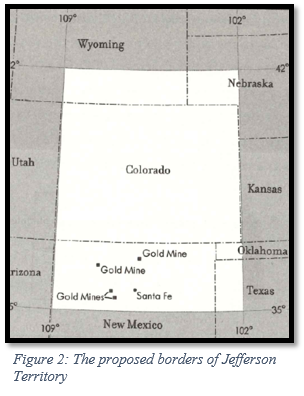
    Map showing the proposed borders of Jefferson Territory.

    A census found that Colorado was occupied by only 34,277 residents in 1860, making it too small to be a state but large enough for another structure of government. And most Colorado voters refused to vote for statehood when they had the opportunity in 1864, due to the higher taxation associated with new statehood. As a territory, the federal government footed the bills; however, this made the extralegal entity of Jefferson Territory unable to collect taxes from residents.

    Jefferson Territory ceased to exist when Congress and President Buchanan created the Colorado Territory on February 28, 1861. Members of Congress opposed naming states and territories after individuals, so the name Jefferson was dropped. Although some legislators favored naming the new territory “Idaho,” the delegate from Colorado successfully convinced legislators that “Colorado” would be a more fitting name, as the Colorado River started within the territory. Jefferson County is the sole remaining county from Jefferson Territory. 

    In the 1860s, there were several attempts by residents to make Colorado a state, but with Civil War and Reconstruction era policies dividing up the political scene in Washington, Colorado was not admitted as a state until 1876.[2] 

    The Borders of Colorado

    The eastern border of Colorado was determined by Kansas’ western border when Kansas achieved statehood in 1861, only a month before Colorado Territory was created. A contentious statehood debate raged over the possibility of a “Big Kansas,” which would have included large swaths of Nebraska and possibly areas of Colorado that had already been part of Kansas Territory. Some Kansans raised concerns over how the population of the mining areas in Colorado would upset the balance of power in Kansas. During the 1859 Wyandotte constitutional convention in Kansas, some local delegates claimed that eastern and western Kansas Territory varied too widely in culture and politics or that the Kansas government was too far away from the mining areas of Colorado to provide much responsiveness; linking these areas permanently in statehood would raise the potential for conflict. Others were concerned with the cost of having such a large state, with Republican delegate and future Kansas congressman M.F. Conway stating, “Had we retained the Pike’s Peak region, the mere mileage of the members of the Legislature and officers going to and returning from the State capital would more than exceed the cost of the whole State government.” Political divisions were clear on the matter, as “many Democrats opposed the exclusion of the western territory, while many Republicans approved of the rejection.”[3]
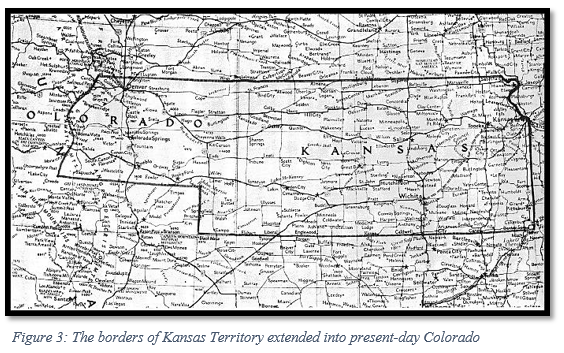
    Map of Colorado and Kansas territory with the caption of "The borders of Kansas Territory extended into present-day Colorado."

    The arguments for keeping part of present-day Colorado with Kansas were resource-driven. Some wanted the wealth of the mining industry in the Rockies to flow to Kansas, and others believed that the railroad builders would look favorably upon investing in Kansas with its connections to Colorado mineral resources. A few members of the convention argued that cutting off the Rockies and their mining settlements would bring the population of Kansas down to a point where statehood would be off the table, as territories needed to cross a certain population threshold to become a state.
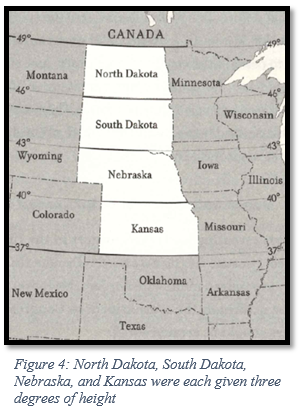
    Map with caption: "North Dakota, South Dakota, Nebraska, and Kansas were each given three degrees of height."

    In 1859, the Wyandotte constitutional convention agreed with the “Little Kansas” proponents, which gave the state of Kansas its current size. Creating a homogenous Kansas and allowing the miners to create a government for their region was well-received in both Colorado and Kansas.

    When Colorado residents, including many miners, drew the boundaries for the extralegal Jefferson Territory, the same line was drawn with Kansas, exemplifying inhabitants’ agreement with Kansas’ proposed boundary line. Kansas became a state in 1861, solidifying the boundaries voted on in the Wyandotte constitution.

    Congress drew Colorado’s western borders according to the equitable principles outlined in Part 1, and with the western landscape largely open, Congress had a chance to make border divisions as equal as possible. The prairie states of North Dakota, South Dakota, Nebraska, and Kansas all have three latitudinal degrees of height. Colorado, Wyoming, and Montana have four latitudinal degrees of height – the extra degree, given out of fairness, allows for the less arable agricultural land these states share. Colorado, Wyoming, the Dakotas, Oregon, and Washington also have nearly seven longitudinal degrees of width per state. This was intentionally done to promote border equality in the western states. Therefore, the western border Colorado shares with Utah was drawn to give the state seven longitudinal degrees of width from the border with Kansas.
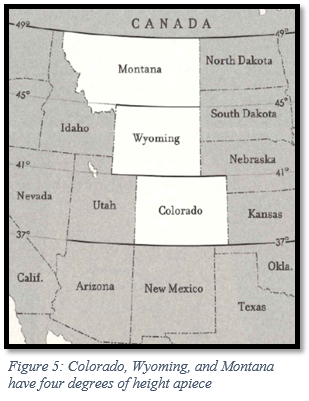
    Map showing Colorado, Wyoming, and Montana having four degrees of height a piece.

    The northern border of Colorado was initially proposed to be drawn at the 42nd parallel, aligning with a 1790 agreement called the Nootka Convention, which was signed between England and Spain as a way of dividing their interests in western North America. This line currently provides borders for Oregon, California, Idaho, Nevada, and Utah.

    However, Congress wanted to ensure that four longitudinal degrees of height in Colorado were observed, so the northern border was lowered by a degree, as the southern border with New Mexico Territory had already been loosely planned in 1850. This allowed Wyoming and Montana to have four longitudinal degrees of height when they became states years later.

    The northern border of Colorado was initially proposed to be drawn at the 42nd parallel, aligning with a 1790 agreement called the Nootka Convention, which was signed between England and Spain as a way of dividing their interests in western North America. This line currently provides borders for Oregon, California, Idaho, Nevada, and Utah. However, Congress wanted to ensure that four longitudinal degrees of height in Colorado were observed, so the northern border was lowered by a degree, as the southern border with New Mexico Territory had already been loosely planned in 1850. This allowed Wyoming and Montana to have four longitudinal degrees of height when they became states years later.

    Colorado’s southern border with New Mexico was largely determined by the territorial acts of Utah and New Mexico in 1850 and has been rooted in controversy and violence. Colorado residents initially lobbied for Jefferson Territory to include northern New Mexico. There were several gold mines in the north central part of New Mexico Territory, and Coloradans wanted access to as much gold as possible to sustain its thriving mining industry. This expansion also unconstitutionally included a corner of Texas. When Congress set the southern border at the 37th parallel, it did so with the same logic that determined Colorado’s northern border – a desire to create a column of states with the same height and width. Simplicity of shape and size were prioritized over geography, and the border setting truncated the Hispano population in the San Luis Valley of New Mexico Territory. This set off animosity at the local level and in Congress. 

    In May of 1862, the House of Representatives debated dividing New Mexico in order to create Arizona Territory, and New Mexico’s delegates voiced anger over Colorado’s border with New Mexico Territory. John S. Watts, the delegate from New Mexico, recalled how residents of the San Luis Valley were betrayed when Colorado Territory was made “merely for the purpose of beautifying the lines of the new Territory of Colorado.” The following year, New Mexico’s legislature expressed resentment at the loss of territory and memorialized Congress about the boundary with Colorado, which had been left unsurveyed. New Mexico claimed that Colorado had taken advantage of the unsurveyed land and had started exercising their authority much further south than they were entitled to. 

    In 1865, New Mexico delegate Francisco Perea spoke before the House Committee on the Territories in favor of bringing the San Luis Valley settlements back into New Mexico Territory. He derided the “evenness and symmetry” of Colorado’s southern boundary, stating that the focus on a straight border cut off a fertile part of New Mexico and betrayed the long-standing interests of people who had always belonged to the rest of the New Mexico Hispano culture. His sentiments were echoed by the Santa Fe Weekly Gazette, which wrote that although clean-cut borders were pleasing to the eye, the border setting between New Mexico and Colorado did a disservice to the local population of Hispanos. In the end, Congress refused to change Colorado’s southern border, beyond addressing small surveying inaccuracies.

    Surveying ambiguities over the exact location of the border were left unresolved by Congress over the years, despite mounting frustration from New Mexico. In 1925, the US Supreme Court deemed that although a more accurate survey of the border existed, the boundary in force took precedence over a later survey. This confirmed that New Mexico would officially lose thousands of acres to Colorado.

    So it is that Colorado stretches from 37 degrees to 41 degrees latitude and 25 degrees to 32 degrees longitude. And you might be surprised to learn that it does not have four sides, but 697 – due to a large amount of small surveying errors. There have been attempts to change Colorado’s borders; as recently as 2013, northeastern Colorado county commissioners encouraged a small movement for the area to become its own state, which would be known as North Colorado or New Colorado. This was mostly a symbolic discussion, as some Colorado counties wanted to make a statement against policies being made at the state level. The boundaries determined by the state constitution in 1876, however, have not changed since Colorado became a state.

    Colorado’s borders were influenced by a desire by the US government to create states of equitable size, placing a priority on geometric design instead of working around or with geographic barriers. Colorado’s four borders are consistent with this policy and have given us a uniquely symmetrical shape and size on the nation’s map.


    [1] Everett, “Creating the American West,” 14.

    [2] To read more about Colorado’s failed attempts at achieving statehood before 1876, please see the following article: https://www.denverpost.com/2006/07/31/civil-rights-role-in-colorado-statehood/

    [3] Gower, “Kansas Territory and Its Boundary Question.”

    References:

    Abbott, Carl, Stephen J Leonard, and Thomas J Noel. Colorado: A History of the Centennial State. Fifth. Boulder, Colorado: University Press of Colorado, 2013.

    American Library Association. “Indigenous Tribes of Colorado.” American Library Association, November 21, 2017. https://www.ala.org/aboutala/offices/denver-colorado-tribes.

    “Articles of Confederation (1777).” National Archives and Records Administration. Accessed August 31, 2023. https://www.archives.gov/milestone-documents/articles-of-confederation#:~:text=The%20Articles%20of%20Confederation%20were,day%20Constitution%20went%20into%20effect

    Berwanger, Eugene H. The Rise of the Centennial State: Colorado Territory, 1861-76. Urbana, Illinois: University Of Illinois Press, 2007.

    Cengage. “Jefferson Territory | Encyclopedia.com.” www.encyclopedia.com. Accessed June 6, 2023. https://www.encyclopedia.com/history/dictionaries-thesauruses-pictures-and-press-releases/jefferson-territory.

    Everett, Derek R. Creating the American West: Boundaries and Borderlands. Norman, Oklahoma: University of Oklahoma Press, 2014.

    Frederic Logan Paxson. History of the American Frontier, 1763-1893. Cambridge, Massachusetts: The Riverside Press, 1924.

    ‌Geurts, Jennie. 2014. “How Rivers Shaped the Shape of Colorado.” Water Education Colorado. July 24, 2014. https://www.watereducationcolorado.org/publications-and-radio/blog/how-rivers-shaped-the-shape-of-colorado/.

    Gower, Calvin. “Kansas Territory and Its Boundary Question, 1: ‘Big Kansas’ or ‘Little Kansas.’” Www.kshs.org 33, no. 1 (1967): 1–12. https://www.kshs.org/p/kansas-historical-quarterly-kansas-territory-and-its-boundary-question/13180.

    History, Art & Archives: United States House of Representatives. “Draft Bill for Colorado Territory | US House of Representatives: History, Art & Archives.” history.house.gov. Accessed June 6, 2023. https://history.house.gov/HouseRecord/Detail/15032436207.

    History Colorado. “Carving up a Continent: State Boundaries in the American West, Feat. Dr. Derek Everett.” www.youtube.com, October 5, 2021. https://www.youtube.com/watch?v=EUit0Mj5QH8.

    History Colorado, and Michael Troyer. “Colorado Territory | Articles | Colorado Encyclopedia.” Coloradoencyclopedia.org, February 25, 2016. https://coloradoencyclopedia.org/article/colorado-territory.

    Humeyumptewa, Aleks, and Tracie Etheredge. “An Inventory of the Records of Arapahoe County, Colorado.” Denver, Colorado: The Colorado Historical Society, 1994.

    “Is Colorado a Square State?” 2016. Denver Public Library History. August 1, 2016. https://history.denverlibrary.org/news/colorado-square-state.

    Jacobs, Frank. “Colorado Is Not a Rectangle—It Has 697 Sides.” Atlas Obscura. Big Think, April 14, 2023. https://www.atlasobscura.com/articles/is-colorado-a-rectangle.

    Library Of Congress, and Sponsoring Body Library Of Congress. Center For The Book. How the States Got Their Shapes. Washington, D.C.: Library of Congress, -07-15, 2008. Video. https://www.loc.gov/item/2021687996/.

    Maness, Jack. “When Colorado Was Kansas, and the Nation Was (Even More?) Divided.” Denver Public Library, January 26, 2017. https://history.denverlibrary.org/news/when-colorado-was-kansas-and-nation-was-even-more-divided.

    Paxson, Frederic. “The Boundaries of Colorado.” The University of Colorado Studies 2, no. 2 (July 1904).

    Stein, Mark. How the States Got Their Shapes. New York: Smithsonian Books/Collins, 2008.

    The U.S. Today, with Dates of Statehood Wall Map. Mapszu. Accessed June 6, 2023. https://cdn.shopify.com/s/files/1/0268/2549/0485/products/maps.com-the-u.s.-today-with-dates-of-statehood-wall-map_2400x.jpg?v=1572562951.

    Trembath, Brian. “Jefferson Territory: The Renegade State That Almost Replaced Colorado.” Denver Public Library, June 24, 2020. https://history.denverlibrary.org/news/jefferson-territory-renegade-state-almost-replaced-colorado.

    www.native-languages.org. “Colorado Indian Tribes and Languages.” Native Languages of the Americas. Accessed June 6, 2023. http://www.native-languages.org/colorado.htm.

    Wikipedia. “Colorado Territory,” June 2, 2023. https://en.wikipedia.org/wiki/Colorado_Territory.

    Wikipedia. “Four Corners,” May 7, 2023. https://en.wikipedia.org/wiki/Four_Corners#:~:text=The%20Four%20Corners%20area%20is.

    Zimmer, Amy. “Jefferson’s Legacy in Colorado.” www.coloradovirtuallibrary.org. Colorado Virtual Library, April 11, 2013. https://www.coloradovirtuallibrary.org/resource-sharing/state-pubs-blog/jeffersons-legacy-in-colorado/.

  • The Borders of Colorado: From Kansas Territory to Statehood – Part 1

    by Sarah Meisch

    How State Lines are Drawn

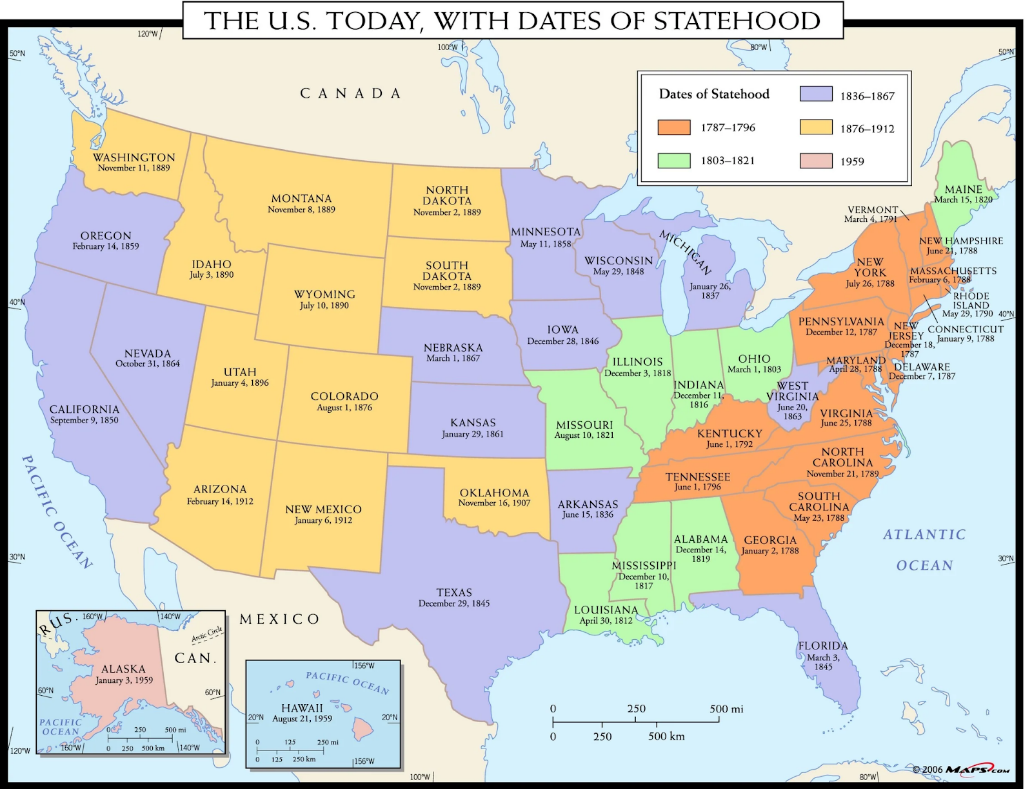
    Looking at a map of the United States, one spots a difference between the symmetrical states in the West and the more irregular borders of the East. At first glance, Colorado seems to have been easily drawn with its four clean borders. But why don’t we have the winding borders the eastern states have? Why are our mountains in the middle of the state, rather than drawn as a border? Is there a reason for the way our state cuts into part of Nebraska? This two-part series will address these questions and more, showing how the placement of Colorado’s state and territorial lines was part of a grander vision for political and cartographical harmony across the United States.

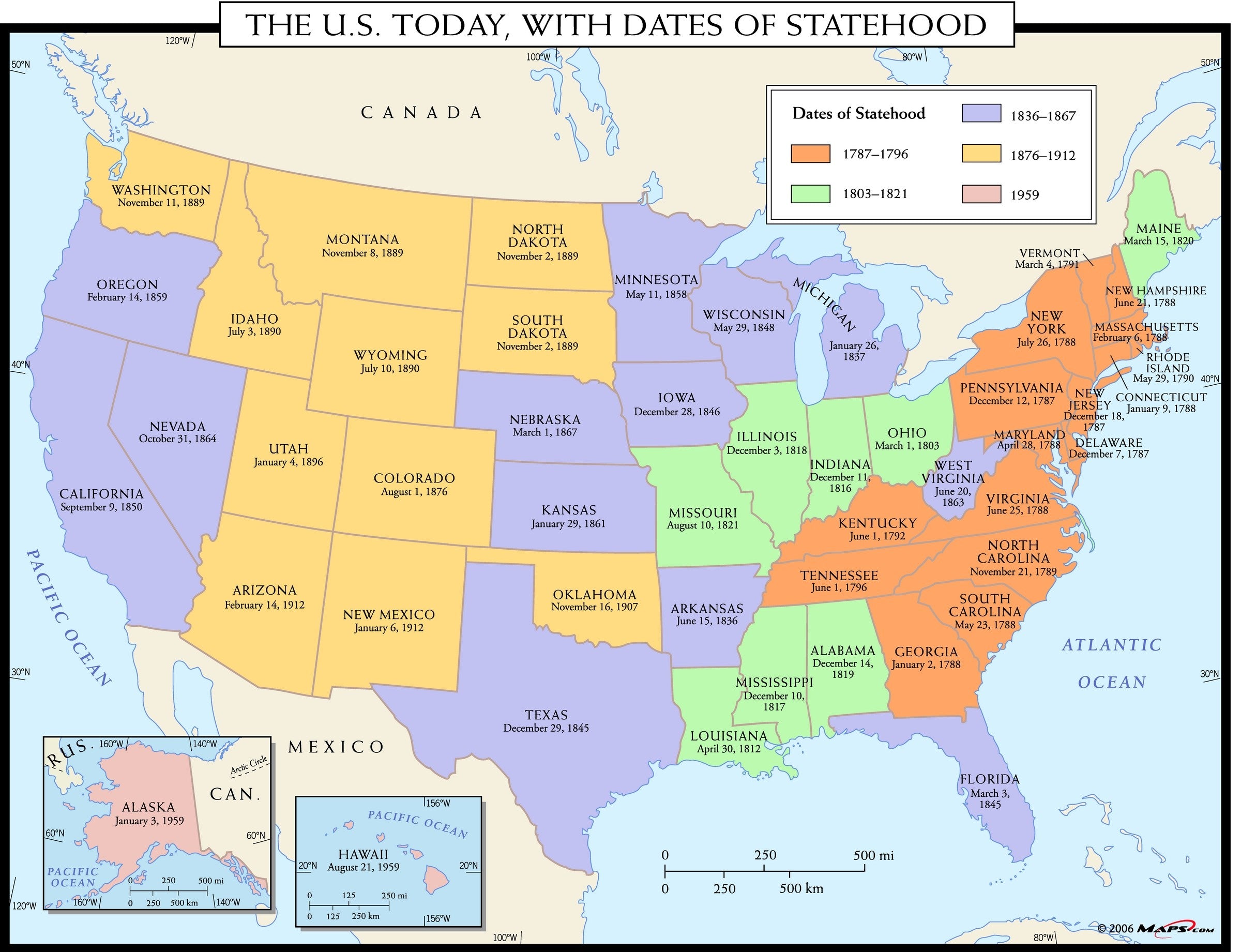
    Map of the United States with color-coded time ranges of statehood from 1787 to 1796. 1803 to 1821, 1836 to 1867, 1876 to 1912, and 1959.

    Throughout its history, the US has drawn its state and territorial borders according to geometry, with a focus on equity between the states and their resources. The Confederation government (1781-1789) solidified the Enlightenment-era precedent of drawing boundaries in straight lines through several ordinances in the 1780s, creating a distinct preference for geometry over geography. Most scholars of boundary-making have expressed disapproval of this approach, with historian James Bryce writing in the 1880s that state lines “are for the most part not natural boundaries fixed by mountain ranges, nor even historical boundaries due to a series of events, but purely artificial boundaries determined by an authority which carved the national territory into strips of convenient size.” 

    In the US, only part of a single state line follows a chain of mountains; this line lies along the Continental Divide dividing Idaho and Montana. Only one-third of states incorporate rivers into their boundaries, and outside of relatively small surveying errors, American states are generally neat and well-defined. It was always the intention of the US government to create cleaner boundaries based on straight lines, rather than borders based on unpredictable natural barriers. This explains the confusion over the state boundaries here in Colorado, as according to historian Derek Everett “geographically, there is no sensible reason for the state of Colorado to exist….[T]he simple rectangle that demarcates Colorado’s boundaries affords practically nothing…capable of bringing this disparate region into a single political entity.”[1]

    However, in spite of the criticism aimed at geometric boundary-making, drawing lines based on geography has its drawbacks. Rivers are unreliable boundaries because they change dramatically over time; there have been several issues with the Missouri River as a boundary-maker over the years, as parts of Nebraska were found on the Missouri side of the river in the 1870s. Only the most entrenched and immovable rivers can realistically be used as boundaries, but these make up a very small portion of rivers. When the western states were being divided, there was a bit of public support for placing major rivers in the center of states instead to encourage riverine city and commercial development, but these petitions ultimately failed to convince Congress. 

    Mountain ranges as natural barriers are also difficult to use as state lines. It would be enormously difficult to survey a mountain range from peak to peak and cleft to cleft in all kinds of weather, even with modern technology. In the 1890s, scientist and explorer John Wesley Powell recommended state and county lines be drawn according to river basins, which are far less changeable over time than rivers, and also prioritize natural boundaries over geometric lines. There were many limitations with his plan for law enforcement and land ownership, and his suggestions came after the continental US had been divided up; therefore, it was too late to practically consider implementing Powell’s proposal.

    Congress attempted to create equality between states, drawing lines in order for states to share access to water, agriculture, and maintain relative equality of size. States that are far larger than others, such as California, Texas, and Alaska, are states that created themselves. When Congress asked California and Texas to readjust their borders after admittance to the Union, few borders were actually altered, and the economic benefit of these states being part of the US outweighed the high risk of alienating them to preserve boundary equality.

    Slavery was another integral piece of boundary making. To maintain an uneasy peace in the years leading up to the Civil War, the North and South would admit a slave-owning state when they would add a free state. This tit-for-tat division influenced the border placement of many states near the 36th and 37th parallels.

    Even as new territories and states were in the offing, the US Congress had an eye on the future. Congress placed an emphasis on intentional planning, allowing for and encouraging the explosive growth in the West. The tapestry of our nation could very well have been checkered with states of different sizes, shapes, and names from what exist today, if it hadn’t been for the vision of equity and symmetry championed by our Enlightenment thinkers.

    Stay tuned for Part 2 of this piece next week, which will explore the reasons behind Colorado’s borders, and how they have changed over time!


    [1] Everett, “Creating the American West,” 11.

    References:

    Abbott, Carl, Stephen J Leonard, and Thomas J Noel. Colorado: A History of the Centennial State. Fifth. Boulder, Colorado: University Press of Colorado, 2013.

    American Library Association. “Indigenous Tribes of Colorado.” American Library Association, November 21, 2017. https://www.ala.org/aboutala/offices/denver-colorado-tribes.

    “Articles of Confederation (1777).” National Archives and Records Administration. Accessed August 31, 2023. https://www.archives.gov/milestone-documents/articles-of-confederation#:~:text=The%20Articles%20of%20Confederation%20were,day%20Constitution%20went%20into%20effect

    Berwanger, Eugene H. The Rise of the Centennial State: Colorado Territory, 1861-76. Urbana, Illinois: University Of Illinois Press, 2007.

    Cengage. “Jefferson Territory | Encyclopedia.com.” www.encyclopedia.com. Accessed June 6, 2023. https://www.encyclopedia.com/history/dictionaries-thesauruses-pictures-and-press-releases/jefferson-territory.

    Everett, Derek R. Creating the American West: Boundaries and Borderlands. Norman, Oklahoma: University of Oklahoma Press, 2014.

    Frederic Logan Paxson. History of the American Frontier, 1763-1893. Cambridge, Massachusetts: The Riverside Press, 1924.

    ‌Geurts, Jennie. 2014. “How Rivers Shaped the Shape of Colorado.” Water Education Colorado. July 24, 2014. https://www.watereducationcolorado.org/publications-and-radio/blog/how-rivers-shaped-the-shape-of-colorado/.

    Gower, Calvin. “Kansas Territory and Its Boundary Question, 1: ‘Big Kansas’ or ‘Little Kansas.’” Www.kshs.org 33, no. 1 (1967): 1–12. https://www.kshs.org/p/kansas-historical-quarterly-kansas-territory-and-its-boundary-question/13180.

    History, Art & Archives: United States House of Representatives. “Draft Bill for Colorado Territory | US House of Representatives: History, Art & Archives.” history.house.gov. Accessed June 6, 2023. https://history.house.gov/HouseRecord/Detail/15032436207.

    History Colorado. “Carving up a Continent: State Boundaries in the American West, Feat. Dr. Derek Everett.” www.youtube.com, October 5, 2021. https://www.youtube.com/watch?v=EUit0Mj5QH8.

    History Colorado, and Michael Troyer. “Colorado Territory | Articles | Colorado Encyclopedia.” Coloradoencyclopedia.org, February 25, 2016. https://coloradoencyclopedia.org/article/colorado-territory.

    Humeyumptewa, Aleks, and Tracie Etheredge. “An Inventory of the Records of Arapahoe County, Colorado.” Denver, Colorado: The Colorado Historical Society, 1994.

    “Is Colorado a Square State?” 2016. Denver Public Library History. August 1, 2016. https://history.denverlibrary.org/news/colorado-square-state.

    Jacobs, Frank. “Colorado Is Not a Rectangle—It Has 697 Sides.” Atlas Obscura. Big Think, April 14, 2023. https://www.atlasobscura.com/articles/is-colorado-a-rectangle.

    Library Of Congress, and Sponsoring Body Library Of Congress. Center For The Book. How the States Got Their Shapes. Washington, D.C.: Library of Congress, -07-15, 2008. Video. https://www.loc.gov/item/2021687996/.

    Maness, Jack. “When Colorado Was Kansas, and the Nation Was (Even More?) Divided.” Denver Public Library, January 26, 2017. https://history.denverlibrary.org/news/when-colorado-was-kansas-and-nation-was-even-more-divided.

    Paxson, Frederic. “The Boundaries of Colorado.” The University of Colorado Studies 2, no. 2 (July 1904).

    Stein, Mark. How the States Got Their Shapes. New York: Smithsonian Books/Collins, 2008.

    The U.S. Today, with Dates of Statehood Wall Map. Mapszu. Accessed June 6, 2023. https://cdn.shopify.com/s/files/1/0268/2549/0485/products/maps.com-the-u.s.-today-with-dates-of-statehood-wall-map_2400x.jpg?v=1572562951.

    Trembath, Brian. “Jefferson Territory: The Renegade State That Almost Replaced Colorado.” Denver Public Library, June 24, 2020. https://history.denverlibrary.org/news/jefferson-territory-renegade-state-almost-replaced-colorado.

    www.native-languages.org. “Colorado Indian Tribes and Languages.” Native Languages of the Americas. Accessed June 6, 2023. http://www.native-languages.org/colorado.htm.

    Wikipedia. “Colorado Territory,” June 2, 2023. https://en.wikipedia.org/wiki/Colorado_Territory.

    Wikipedia. “Four Corners,” May 7, 2023. https://en.wikipedia.org/wiki/Four_Corners#:~:text=The%20Four%20Corners%20area%20is.

    Zimmer, Amy. “Jefferson’s Legacy in Colorado.” www.coloradovirtuallibrary.org. Colorado Virtual Library, April 11, 2013. https://www.coloradovirtuallibrary.org/resource-sharing/state-pubs-blog/jeffersons-legacy-in-colorado/.

  • What Does Your Drafter Need to Know to Start Drafting?

    What Does Your Drafter Need to Know to Start Drafting?

    by Jery Payne and Patti Dahlberg

    It was a great stakeholder meeting. The stakeholders arrived prepared and ready to negotiate. The discussion was respectful, weighing the pros and cons of the policy alternatives. Because the discussion was good and the meeting was ebbing, I looked forward to the legislator and stakeholders settling on a policy. So you can imagine my surprise when the legislator looked over to me and said, “Do you have everything you need to draft this legislation?”

    After I cleaned up the coffee, I replied, “Well, I think you have a few decisions to make.”[1]

    What Are the Basics?

    So what does your drafter need to know to begin drafting your bill? The answer is, “It depends!”

    Helpful? Yep, that’s so helpful. If you’re not convinced, here are a few guidelines to help fill in the necessary details:

    • What problem are you trying to solve or address?
      • Is it a lack of access to a government service? Is someone defrauding the state or businesses? Is it an exploitative business practice? Is it a lack of habitat for wildlife?
    • What is the proposed solution?
      • Is it a grant program? Is it creating an exemption to a current prohibition? Is it a prohibition of a business practice?
    • What are the conditions that make the statute apply?
      •  Who is eligible for the grant? How do you define the prohibited business practice?
    • How does the state know whether these conditions apply?
      • If a grant recipient needs to be low income, how will the agency verify the low income status? If a business is prohibited from vertical integration, how will the state identify that the business is vertically integrating? Should the state require a type of business to be licensed? Or should the state authorize law enforcement to investigate complaints?
    • What happens when the policy isn’t followed?
      • What if a business decides to keep doing the exploitative business practice? Will the state fine the scofflaws? Will the state throw them in jail? Maybe the state will deny them a license? What happens if the grant money isn’t spent appropriately?
    • If you are working with stakeholders on the bill, the drafter will need to know who has drafting authority and who is authorized to give and receive information on the bill.
    • A promissory note to give the drafter a bottle of the drafter’s favorite beverage if you fail to provide this information… I suppose this isn’t absolutely necessary. … Okay, my editor is telling me to cut it out—I was just kidding anyway.

    Now where was I? Oh yeah:

    If you don’t have all these details figured out, it’s okay to give the drafter what you do have and then talk with your drafter to work out the rest. By the way, this is one of the reasons why submitting the bill request a bit earlier is a good idea: It gives you time to have these discussions with the drafter.

    Other Helpful Information to Tell Your Drafter

    In addition to these basic requirements, let your drafter know about any of the following:

    • Are there any no-go zones? In other words, should the bill avoid entangling with any other issues?
    • Background information is helpful, but your drafter doesn’t need all the political information, such as a list of the organizations who will support the policy or your argument for why it is good policy.
    • If your bill is based on an act from another state or if it is based on another Colorado statute, share that with the drafter.

    The drafter usually discovers additional decision points while they are drafting the bill. A great example is when your policy conflicts with something in current statutes. Your drafter will contact you to discuss these issues.

    Procedural Questions You’ll Need to Answer Before Introduction

    Before your bill is introduced, procedural questions need answers, such as:

    • Is it okay to release the bill for fiscal note analysis?
    • If the bill contains reporting requirements, should they expire in three years?
    • Do you prefer a safety clause or a petition clause? The default is a petition clause.
    • Do you want your bill to take effect on a specific date?

    For more detailed information on these questions and potential answers, see How Would You Like Your Bill? Questions a Bill Sponsor Must Decide.


    [1] Although this precise scenario hasn’t happened to me yet, I’ve been in many meetings that aren’t far from this scenario in different ways.

  • Maximizing the Interim: How OLLS Staff Can Help Legislators

    Maximizing the Interim: How OLLS Staff Can Help Legislators

    Editor’s note: This article was originally written by Debbie Haskins and posted on July 6, 2017. It has been updated as appropriate.

    Legislators, especially those serving in their first legislative session, often comment that they wish they had more time to work on their bills. They sometimes learn the hard way that failure to engage in robust stakeholder processes leads to bills that are difficult to pass. Sometimes it takes multiple bill drafts before all sides feel that the concerns they represent are adequately addressed. While the interim is a good time for legislators to take a well-deserved break from the hectic pace of the previous legislative session, many also find that the interim is a great opportunity to prepare for the upcoming legislative session.

    During the interim, legislative staff in the Office of Legislative Legal Services (OLLS) can assist legislators in the following ways:

    • Researching what other states do to combat a particular problem the legislator is interested in addressing via legislation;
    • Researching prior legislative efforts in Colorado to address a particular issue;
    • Researching legal issues that arise in proposed legislation;
    • Facilitating discussions or participating in stakeholder meetings that bring a wide variety of parties together to discuss how to address particular issues; and
    • Drafting and redrafting bills.

    Legislators may ask an OLLS attorney to attend drafting meetings or stakeholder meetings that are held at the State Capitol Building or in the Capitol Complex. While OLLS attorneys cannot attend meetings with or on behalf of a legislator outside of the Capitol Complex, we are happy to meet with legislators and their contacts over Zoom, Google Meet, or any other videoconferencing platform.

    In addition, OLLS staff provides legal research and bill drafting for interim committees and committees that meet year-round, such as the Capital Development Committee, Colorado Commission on Uniform State Laws, Committee on Legal Services, Joint Technology Committee, and Statutory Revision Committee.

    If you are a new legislator—or even if you have a couple of sessions under your belt—you may want to use the interim to brush up on the legislative procedures or learn more about a particular subject area. The OLLS staff are available to help in these areas, as well. Staff attorneys are happy to provide one-on-one review sessions of the legislative rules or to help you drill down in understanding Colorado’s laws on a particular subject. Also, each interim, the OLLS provides in-house continuing legal education (CLE) programs. Legislators, especially those who are attorneys, are welcome to attend many of them. Contact the OLLS to receive notice of these programs. For more information on all of the OLLS’s interim activities, see this LegiSource article.

    Nonpartisan legislative staff at the OLLS are here to help legislators maximize their interim. Let us help you get a jump start on the next legislative session.

  • Freedom of Speech for the New Legislator

    Freedom of Speech for the New Legislator

    by Esther van Mourik and Pierce Lively

    It is a prized American privilege to speak one’s mind, although not always with perfect good taste, on all public institutions.” – Supreme Court Justice Hugo Black

    He has the backbone of a chocolate éclair.” – President Theodore Roosevelt on President William McKinley.

    You’ve just been sworn in to serve as a legislative member of the Colorado General Assembly[1] and you are now a public official. Congratulations! If you would like to know your rights as a legislator when you’re being criticized by the public, when you’re making speeches, or when you’re being threatened, read on!

    It is a foundational principle that the success of a democracy is built on the back of free political discussion. This discussion is a fundamental right protected by the First Amendment of the United States Constitution and article II, section 10 of the Colorado Constitution. But freedom of speech is not absolute. For example, it does not protect a person who shouts “fire!” in a crowded theater and causes a panic. Over the years the judiciary has justified regulating speech when the restriction outweighs the value of the expression. So, where is the line drawn? In particular, when is speech directed toward, or made by, a legislator protected and when is it not?

    Speech directed toward a public official

    Let’s say that a critic has publicly said you are “ripping off taxpayers” by sponsoring a tax credit for businesses. Do you have a complaint against that critic for defamation? Probably not.

    Defamation is a catch-all term for civil, not criminal, damage claims stemming from false statements that hurt someone’s reputation.[2] Defamation laws are an important recourse for those who are harmed by false statements. However, defamation laws are in direct conflict with the constitutional right to free speech, and consequently, courts look at punishing that speech very carefully. This conflict is particularly acute in the case of public officials, such as legislators, because robust political debates and discussions are fundamental to our democratic system and should not be chilled.

    In New York Times v. Sullivan, the United States Supreme Court addressed this conflict by holding that the First Amendment’s right to free speech prohibits a “public official from recovering damages for a defamatory falsehood relating to his official conduct unless he proves that the statement was made with ‘actual malice’ — that is, with knowledge that it was false or with reckless disregard of whether it was false or not.”

    What does this mean for public officials, including legislators, in Colorado? A public official can only recover damages for a statement if he or she can prove that (1) a person published or otherwise communicated the statement to a third party, (2) the statement caused the public official actual damage, and (3) that when the person made the statement, he or she either knew it was false or had a reckless disregard as to whether it was false. This “actual malice” standard imposes a high burden on public officials in a defamation case.

    So, when a critic has publicly said you are “ripping off taxpayers” because you sponsored a tax credit for businesses, this may hurt your reputation, but it is probably not defamation. The critic is entitled to his or her opinion, and opinions are hard to prove true or false.

    Speech made by a legislator

    An “unrestricted debate of public issues” requires protecting not only a public official’s critics, but also protecting the public official. As regular readers of LegiSource will already know, this protection is achieved through “legislative immunity.”[3]

    Let’s say you make a statement during legislative debate that offends someone. Is your speech protected? Yes. The Colorado Constitution includes protections to ensure that you can do your job as a public official without interference or intimidation.

    Under Article V, section 16 of the Colorado Constitution, legislators are immune from civil lawsuits and state criminal prosecution for actions that fall within the “sphere of legitimate legislative activity.”[4] Although Colorado courts have not defined the phrase “sphere of legitimate legislative activity,” in Gravel v. United States, the United States Supreme Court held that activities that are “an integral part of the deliberative and communicative processes by which Members participate in committee and House proceedings with respect to the consideration and passage or rejection of proposed legislation or with respect to other matters which the Constitution places within the jurisdiction of either House” are within the sphere.

    In general, these activities include conducting hearings, preparing and authorizing the publication of reports, delivering floor speeches, and voting but do not include meeting with or influencing executive branch or local government officials or political activities related to campaigning.

    When a constituent is offended by something you said during legislative debate about a particular bill, your speech is protected, and you are immune from any liability related to that speech.

    When speech turns criminal

    Legislative immunity protects legislators and the high burden in defamation cases protects critics of the government, but no one is protected while threatening others. Actions that constitute criminally threatening behavior include:

    • Attempting to influence legislators and other public servants through “deceit or by threat of violence or economic reprisal”;[5]
    • Threatening or using physical action to place another “in fear of imminent serious bodily injury”;[6]
    • A continuous course of conduct where one follows, approaches, contacts, places another under surveillance, or communicates with someone in a manner that causes that person to suffer serious emotional distress;[7] and
    • Harassment.[8]

    If you feel threatened in any way while in the capitol, call state patrol (303-866-3660). If you feel threatened outside of the capitol call local law enforcement. If you think the person threatening you away from the capitol may come to the capitol, please call state patrol.

    Final thoughts

    As you embark on your new careers as members of the General Assembly, it’s important to remember that open and robust discussion of public issues is a fundamental part of our democracy. Our laws strive to protect discussion both by critics of the government and the government itself. Critics of the government are protected by requiring public officials to clear a high bar before they succeed in defamation cases. Legislative immunity protects members of the government in relation to statements they make within “the sphere of legitimate legislative activity.” But expression that improperly influences, threatens, or harasses a person is illegal and unprotected. If you have any further questions about any of these issues, please contact the Office of Legislative Legal Services.


    [1] Or maybe you’re already a legislator and you just want a refresher!

    [2] If defamation is written, it is libel, and if it is spoken, it is slander.

    [3] See Legislative Ethics – Legislative Immunity and A Look at the Limits of Legislative Immunity.

    [4] For an in-depth discussion of how this doctrine applies to subpoenas, see To Testify or Not to Testify: Responding to a Subpoena.

    [5] Section 18-8-306, C.R.S.

    [6]Section 18-3-206, C.R.S.

    [7] Section 18-3-602, C.R.S.

    [8] Section 18-9-111, C.R.S.

  • What happens when multiple bills amend the same provision of law?

    What happens when multiple bills amend the same provision of law?

     by Bethanie Pack

    Editor’s note: This article was originally posted on March 15, 2019. It has been updated where appropriate.

    It’s very common for multiple bills to amend the same provision of law in a given session, because let’s face it, great minds think alike, and there are a lot of great minds in our state legislature. So, when this occurs, one of five things can happen:

    1. The bills are harmonized upon publishing;
    2. Provisions are renumbered;
    3. The bills are amended without need of a conflict letter from the Revisor of Statutes;
    4. The Revisor of Statutes issues a conflict letter to the bill sponsors of both bills notifying them of the conflict and that their drafters can provide guidance to the bill sponsor on how to address it; or
    5. As a last resort, one of the bills supersedes the other.

    So what in the world does all this mean? Let me explain.

    After a bill passes second reading in each house, the publications team (a team in the Office of Legislative Legal Services that works under the direction and supervision of the Revisor of Statutes) performs a database search against all other bills in the current legislative session to ensure no bills change the same provision of law in a conflicting manner.

    Harmonize

    If only Bill A and Bill C are adopted, then the publications team can harmonize the section upon publication, and there is no conflict. In other words, the two bills “play nice together.” The section would appear as:

    45-1-101. Residential watering. A homeowner may water the lawn for a maximum of one hour up to five times per week.

    The changes from both bills can be combined in this section and they can be harmonized.

    Renumber/Reletter

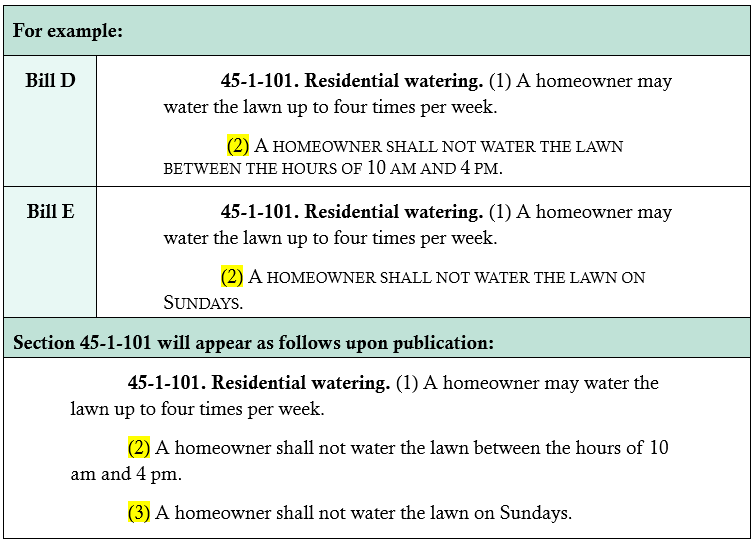
    Now, ignore Bills A, B, and C for a moment, and take as an example two bills that both add a subsection (2) to the current version of 45-1-101. If both bills pass, one of them will be renumbered to add a subsection (3).

     Conflict Letter

    Back to our original example.  If both Bill A and Bill B were to pass, they cannot be harmonized; there is a conflict. The section of law cannot state that a homeowner may water the lawn both three and five times per week. In this scenario, the Revisor of Statutes writes a conflict letter, as directed by Joint Rule 16, to give notice of conflicting provisions to the prime sponsors of the conflicting bills.

    These letters are sent to the prime sponsors and the conflict is noted in the transmittal letter sent to the opposite house after third reading in the first house. A copy of the letter is also stapled to the billback. The letter contains a statement about the conflict and a statement that the bill drafters know about the conflict and can provide guidance on how to address the issue.

    The publications team runs the conflict check after second reading in each house, which sometimes gives the drafter enough time to confer with the prime sponsor and draft a third reading amendment to fix the conflict. This quick action by the drafter would eliminate the need for a conflict letter before the bill is transmitted to the opposite house.

    Typical resolutions to conflicts by amendment include mirroring the language in both bills to make them harmonizable, making the conflicting provision in one bill contingent on the passage of the other bill so that both provisions don’t go into effect, or eliminating the conflicting provision or moving it to a different place in statute. But sometimes, none of these approaches will work because the bill sponsors don’t agree to the amendments that would harmonize the bills or because harmonizing the bills would defeat the purposes of the bills. In these situations, the legislators may decide to allow one bill to supersede the other.

    Supersede

    The goal of the publications team is to give effect to every bill. So, allowing one provision of law to supersede another is the last resort and done only if an amendment to fix the issue was not adopted. If two bills pass that cannot be harmonized, renumbered, or relettered, and they were not amended to “play nice together,” then one bill will supersede the other where the conflicting provision occurs. Which provision takes effect is typically based on the effective dates of the bills—the amendment with the later effective date prevails. Occasionally two conflicting bills will have the same effective date, in which case the provision that prevails is the one in the bill that the Governor signs last. In some cases, however, the bill with the earlier effective date will prevail because it repeals the provision. A bill that repeals a provision will supersede a bill that amends the same provision, even if the amending bill has a later effective date, because the repealed provision is gone by the time the amending provision takes effect, and it cannot be brought back to life to implement the amendment.

    For more information on effective dates, see “When Does an Act become a Law? It depends.”

  • On Ejusdem Generis & Squirrels

    by Jery Payne

    1. Is Adam a Burglar?

    Adam worked at a truck shop. His duties included delivering clothes to the other workers’ lockers. Although it was possible to secure the lockers using a padlock, none of the workers actually used locks. The workers should have used the locks, however, because several workers noticed money missing from their work lockers. Suspecting theft, one of the workers installed a small video camera in the room. The camera recorded Adam looking through the lockers and taking items from them. This led to Adam’s arrest for burglary and theft.

    At trial, Adam was found guilty of the burglary charge. Here’s the law, section 18-4-204, C.R.S., forbidding burglary:

    A person commits third degree burglary if with intent to commit a crime he [sic] enters or breaks into any vault, safe, cash register, coin vending machine, product dispenser, money depository, safety deposit box, coin telephone, coin box, or other apparatus or equipment whether or not coin operated.

    Adam appealed the guilty verdict, but the appeals court affirmed the conviction because he “entered or broke into what is tantamount to a vault.” The Colorado Supreme Court, however, reversed the appeals court because of ejusdem generis.

    Ejusdem generis is a Latin phrase that means “of the same kind or class.” This doctrine of statutory interpretation holds that, when a catchall phrase follows a list, the catchall phrase should be read to apply only to persons or things that are of the same kind as the items on the list. This means that the catchall phrase should not be read to cover everything that it says it covers. Instead, the catchall phrase should be limited to covering persons or things that are similar or in the same class as the things on the list.

    Ejusdem generis is actually a specific application of another rule of statutory interpretation: Every word in a statute must be given effect. When, for example, a statute applies to raspberries, strawberries, or other fruit, the words raspberries and strawberries are redundant with the word fruit. Therefore, reading fruit literally to mean all fruit means that the words raspberries and strawberries don’t do anything, and they don’t have any effect. So courts have decided that, to give every word meaning, we have to use the redundant items on the list to narrow the meaning of the catchall.

    Returning to Adam’s burglary case, the Colorado Supreme Court reasoned that all the items in the statutory list “are almost always used to contain money or valuables exclusively: vaults, safes, cash registers, coin vending machines, product dispensers, money depositories, safety deposit boxes, coin telephones, and coin boxes.” Therefore, the list doesn’t include equipment that holds mere property; the list includes only equipment that holds money and valuables. “Thus, whether any given container falls within the purview of the statute depends on whether the apparatus or equipment is merely a storage receptacle or is of the same kind or class as those items enumerated in the statute, that is, whether the container is designed for the safekeeping of money or valuables[.]” So, the Colorado Supreme Court held that Adam had not committed burglary.

    2. Ejusdem Generis Is Squirrely.

    Imagine that you’re a court interpreting a statute that reads:

    To be imported into Colorado, cherries, tomatoes, cranberries, and other fruit must be inspected by the commissioner of agriculture.

    The statute has three fruits and the catchall of other fruit, so this statute should be read in light of ejusdem generis. The catchall word, fruit, presumably shouldn’t be read to cover all fruit, so you must decide what types of fruit aren’t covered. Here are some options:

    • The listed fruit, cherries, tomatoes, and cranberries, aren’t citrus, so no limes;
    • The listed fruit have skin that is normally eaten, so no pineapples;
    • The listed fruit are red, so no blueberries; or
    • The listed fruit are spherical, so no bananas.

    Which of these options is the right class? Which do you choose? Do you choose all of them?

    Wouldn’t it be better to avoid this guessing game?

    Sutherland’s Statutory Construction explains that ejusdem generis “expresses a meaningful insight about language usage that can be a relevant aid, if not a simple and certain exponent….”[1] When it passes a law, the General Assembly is trying to achieve a goal. Doesn’t this mean that the body wants as much certainty as possible?

    The concern isn’t whether the rule makes sense; the concern is that the rule is a wellspring of uncertainty.

    In Adam’s burglar case, the appeals court believed the statute applied to lockers, but the Colorado Supreme Court held that it didn’t. Regardless of what the General Assembly wanted, two courts came to opposite conclusions. Wouldn’t it be better to draft the statute so that both courts read the statute the same way?

    3. Don’t Shroud the Law in A Mist; Do Away with The List!

    How should we improve the burglary statute? We can avoid the issue by not using a list:

    • If the intention is to make the burglary statute apply to lockers, then forgo the list. Write something like, “A person commits third degree burglary if, with intent to commit a crime, the person enters or breaks into a container used to store property.”
    • If the intention is, as the Colorado Supreme Court held, to apply only to a container that is used to store valuables, write something like, “A person commits third degree burglary if, with intent to commit a crime, the person enters or breaks into a container used to store money or valuable property.”

    The ambiguity is removed by redrafting the provision to get rid of the list.

    4. Sometimes, A Belt and Suspenders Are Necessary.

    I imagine that every drafter at the Capitol has heard from a bill’s proponents that “We need a belt­-and-suspenders” provision. This is legislative shorthand for “we may need some redundancy.” In stakeholder negotiations, it is sometimes necessary to list an item or two in a statute to assuage the concerns of a nervous stakeholder.

    For example, a stakeholder may be worried that the word fruit won’t be read to include tomatoes and peppers. This is frequently what leads to phrases like tomatoes, peppers, and other fruit. Recall that ejusdem generis applies when a catchall follows a list, so the word fruit may be limited in some way to not apply to all fruit. Maybe a court will hold that the phrase tomatoes, peppers, and other fruit applies only to less-sweet fruit or, maybe, only to fruit that’s native to North America. If all fruit is meant to be covered, the phrase should be rewritten.

    This is when it makes sense to use the word including:

    To be imported into Colorado, fruit, including tomatoes and peppers, must be inspected by the commissioner of agriculture.

    This is better than tomatoes, peppers, and other fruit because courts usually hold that the words includes and including enlarge or extend rather than limit the general term. Here are some examples:

    One note of caution: it is possible to find cases where an including phrase has been held to be limiting out of a desire to give every word effect. An example is Shelby Cnty. State Bank v. Van Diest Supply Co. This case dealt with a lien on

    [A]ll inventory, including, but not limited to, agricultural chemicals, fertilizers, and fertilizer materials sold to Debtor ….”[Emphasis added.]

    In this case, the 7th circuit explained that:

    [I]t would be bizarre as a commercial matter to claim a lien in everything, and then to describe in detail only a smaller part of that whole. … But if all goods of any kind are to be included, why mention only a few? A court required to give “reasonable and effective meaning to all terms” must shy away from finding that a significant phrase (like the lengthy description of chemicals and fertilizers we have here) is nothing but surplusage.

    So the court did interpret the word including as limiting, and the judges didn’t care that the contract used the phrase but not limited to. Therefore, it is better to avoid using a list. But if that isn’t an option, then use an including phrase.


    [1] N. Singer, 2A Sutherland Statutory Construction § 47.07 (Seventh Edition)

  • Concerning bill titles, and, in connection therewith, explaining everything you need to know about the single-subject and original purpose rules.

    Concerning bill titles, and, in connection therewith, explaining everything you need to know about the single-subject and original purpose rules.

    by Megan McCall

    “And the coat rule is relaxed.” “The ayes have it and journal from the previous day is adopted.” “Does it fit under the bill title?” These are all frequently uttered phrases under the Dome, although the last might not be spoken with the same enthusiasm as the first two. The question of whether a matter fits under a bill title has undoubtedly come up a time or two for you during session and probably in a variety of contexts. It might have been a conversation with a bill drafter in the initial drafting of your bill, or perhaps the question has arisen in relation to evaluating an amendment request with a lobbyist or with another member of the General Assembly.

    Section 21 of article V of the Colorado Constitution states that “No bill, except general appropriations bills, shall be passed containing more than one subject, which shall be clearly expressed in its title….” Many of your counterparts in other states also have to comply with their state’s single-subject rule, although notably Congress does not. The Colorado courts have specifically identified the desire to prevent “log-rolling” as a core tenet to the single-subject rule, meaning the rule is intended to prevent several unrelated measures that may not pass individually be joined together in order to garner a majority of votes for the combined measure. Courts have also identified an intention to prevent public surprise as another primary purpose for the rule. A bill’s title should sufficiently put the public on notice as to the contents of the legislation.

    To comply with the nuances of the single-subject rule, bill titles may be drafted broadly or narrowly, and the compliance with the rule is a primary consideration for your drafter in the bill’s initial drafting stages. It is the custom of the OLLS to draft narrow or “tight” bill titles unless otherwise instructed by the bill’s sponsor. Sometimes a narrow bill title, however, is not possible based on the content a bill sponsor wants to cover in the bill. The Colorado Supreme Court consistently has held that generality in a title is not objectionable, and the Constitutional requirements are met if the matters contained in the bill are germane to the subject of the title. Thus a general, or a broad, bill title that describes the general subject matter of the bill should withstand scrutiny as long as the substance of the bill is germane to that title.

    A bill with a broad title may include what is called a “trailer,” which is a way of providing additional information to the reader as to its specific contents. This trailer will list and describe the varying components of the bill. Trailers can be lengthy and although they are in bold font just like the bill title, they are not the title of the bill for purposes of the single-subject analysis. If a bill has a trailer, the best way to keep track of the bill title is to remember that the title is everything after the first word “Concerning” and before the phrase “…, and, in connection therewith,”.

    Keeping a handle on the title of a bill is important as it is moving its way through the legislative process and amendments are offered to the bill, whether it is to your own bill or the bill of another member. This is in light of an ancillary constitutional provision in section 17 of article V that states that “No bill shall be so altered or amended on its passage through either house as to change its original purpose.” Meaning, just as the contents of an introduced bill must relate to the single-subject of the bill as evidenced in the title, so too must any amendments offered to the bill. Once a bill is introduced, the bill title cannot be amended to be made broader, as that would suggest the original purpose is being changed, or perhaps, that there is now more than one subject. A bill title can be amended to narrow its scope (although if narrowed, it can later be amended again to revert back to the original title). Bill trailers can always be amended, and frequently are, to add, revise, or remove specific descriptions of provisions impacted by the substance of amendments.

    The drafter of a bill may advise a member that an amendment request may raise a title issue, meaning the substance of the amendment may not fit under the bill’s title. An amendment that falls outside the bill’s title may be challenged, and the question is ultimately decided by the chair of the committee of reference or of the committee of the whole, depending on when the amendment is offered, and is in the chair’s sole discretion.

    Courts have jurisdiction to consider challenges to a bill’s compliance with the single-subject rule, but courts will generally defer to the judgment of the General Assembly when passing the bill. If the court finds a violation, only the portion of the bill that does not fit within the bill title will be held invalid. Additionally, the General Assembly passes a bill every regular session to enact the Colorado Revised Statutes, republished with all changes passed by bill in the preceding session, which has the effect of curing any title defects that may have existed within any bills passed in the prior session. Accordingly, single subjects are infrequently challenged.

    For more information on bill titles and the single-subject rule, see the OLLS memo concerning bill titles.

  • The OLLS Hereby Finds and Declares That You Should Read This Article

    The OLLS Hereby Finds and Declares That You Should Read This Article

    by Asia Merrill

    Drafters of statute have the difficult task of turning complicated ideas into plain and clear legislation. They work closely with legislators to translate the legislators’ ideas into laws that avoid the need for complex interpretation. The intent of the General Assembly must be as clear as possible so that the law can be administered or followed in the manner that the General Assembly intends. If a statute is interpreted by the Colorado courts, then between precedent and the statute itself, everyone should receive a just and consistent interpretation. Despite this, when several interpretations of a law do arise, lawyers and judges may turn to legislative declarations and statements of intent if they are included in the bill that enacted the law in dispute to help interpret the statute.

    Most of the time when legislators decide to include a legislative declaration or a legislative statement of intent, they choose legislative declarations. Per the Colorado Legislative Drafting Manual, legislative declarations are a formal announcement about a bill. They can establish a philosophical reason behind the new statute or deliver context or history regarding the fiscal or social issue driving the law. In general, they encapsulate the “why” and sometimes the “how” of the proposed legislation. Legislative declarations may also provide data and findings by the General Assembly to support the legislature’s claims and associated actions.

    Legislators may choose between nonstatutory or statutory legislative declarations. Both hold the same legal weight, but each serves a different organizational purpose. Usually, if a bill creates a new entire part or article or it only creates a new section, a statutory legislative declaration is the obvious choice. It’s a way to attach the declaration to the language itself in the statute books, where attorneys and citizencan most easily access it. If a drafter creates or amends multiple areas of statute, however, a nonstatutory legislative declaration most effectively gives context to the language without repeating the declaration in each new or amended section. Nonstatutory legislative declarations are only shown in the Session Laws, but they are cross-referenced in editor’s notes after a statute in the Colorado Revised Statutes.

    Legislators will also use a statement of legislative intent, which describes the intended purpose and desired effect of a bill. In general, legislative intents focus on what the outcome of the bill should be. Statements of intent should never be necessary to understand the desired outcome of the statute and should only supplement the bill. A relatively simple example of a statement of legislative intent is section 6-1-401, C.R.S., which establishes that the entire part is intended to:

     [Assure] that assistive technology [is] provided to persons with disabilities, is of quality, and is covered by adequate warranties to maintain their assistive technology in proper working condition; to assure availability of appropriate loaner replacement assistive technology while their own is being repaired; and to encourage manufacturers and dealers to cooperatively pool assistive technology resources for loaner purposes to assure availability without an undue burden.

    While short and sweet, the statement acts to announce the people the law is intended to serve and simply establishes the desired outcome.

    Legislators should use neither declarations nor statements of intent to simply garner support for a bill, although that certainly seems to happen from time to time. On the other hand, legislators should exercise caution when putting too much weight into a legislative declaration or a legislative statement of intent, lest the underlying statute may fail to address the problems they are trying to solve. It goes without saying that a legislator, and in turn, a drafter, should never use a legislative declaration to replace clear, concise statute.

  • Amendment Clerks: Who Are They and What Do They Do?

    by Faith Marcovecchio

    It’s Friday morning, and the Committee of the Whole is hearing the second reading of bills. As you glance at the next bill up, you realize you need an amendment. Quick—to the amendment clerk!

    But what is the amendment clerk?

    You’ll find this helpful person at the front of each chamber, at a small desk to the left of the dais. The amendment clerk is a nonpartisan staff member who can, in consultation with the drafter of the bill, draft quick, nonsubstantial amendments for members during second or third readings.

    House Amendment Clerk Desk.

    In Colorado, the amendment clerk is an employee of the Office of Legislative Legal Services and can be either an attorney or a legislative editor who has other drafting and editing responsibilities. In other states, the position is similarly filled by an attorney from the state legislature’s drafting office, but amendment clerking is that attorney’s primary responsibility during session, not something he or she does in addition to drafting bills. And then there are states where floor amendments are drafted exclusively by the bill’s drafter—there is no amendment clerk at all.

    Senate Amendment Clerk Desk

    The Office of Legislative Legal Services took over staffing the amendment clerk desk in 1999. Previous to that, part-time House and Senate staff filled this role. However, it made sense for year-round staffers who were already drafting and editing legislation to also sit in this hot seat because of their understanding of the Colorado Revised Statutes and the General Assembly’s procedures, drafting style, and software.

    The amendment clerk desk can be a hive of activity during debate of complex or controversial bills, with legislators and staff vying for the amendment clerk’s time to draft member amendments, contact bill drafters, prepare Committee of the Whole amendments, or contact an attorney to clarify rules. It may be necessary, at times, for the amendment clerk to prioritize requests from legislators. For example, during second reading, the amendment clerk must prepare second reading amendments before Committee of the Whole amendments.

    With so many people tugging at the amendment clerk’s sleeve, there are several things legislators can do to get what they need from the amendment clerk in a timely fashion. If at all possible, members should contact the drafter of bill before the bill is on second reading to request and discuss the amendment. When making an amendment request on the floor during debate, members should provide as much time as possible for the drafter of the bill and the amendment clerk to prepare the amendment to ensure that the language and law are accurate. If there isn’t enough time, members may need to request a short recess while the amendment is being prepared. Another option to allow for the proper time to draft floor amendments, especially when multiple floor amendments are in play, is to ask the Majority Leader to lay the bill over until later in the day’s calendar or a later date.

    Beyond drafting short amendments, amendment clerks can assist members in several other ways. Need to speak to your drafter about a more complex amendment to a bill? The amendment clerk can quickly connect you to the attorney in question. Need a copy of one your bills? The clerk can print one for you. Wondering about particular language in existing statute or legislative rule? The clerk has the full Colorado Revised Statutes and legislative rules on hand and can look up what you need, provided it’s not too extensive. And throughout the proceedings, the amendment clerk is communicating what is happening on the floor in emails to the Office of Legislative Legal Services, Legislative Council Staff, and the Joint Budget Committee to help staff members from those agencies assist legislators in the chambers.