Category: Archive

Archived posts were published before July 1, 2024. They are maintained for historical reference and may not meet current accessibility standards.

  • Statutory Powers to Address Epidemics

    by Jery Payne

    It’s a little known fact, but being a smart audience, you may have heard that an epidemic engulfed the nation and the world, which makes the epidemic a pandemic. It’s commonly known as “COVID-19,” which is a shortening of the phrase “Corona Virus Disease of 2019.”

    In 2020, the governor of Colorado declared an emergency and invoked emergency powers to address the spread of the virus. The state required people to stay at home as much as possible, mandated people wear masks, and implemented many other mandates. Local health agencies also issued mandates. This led many people to wonder, “Can they do that?” And like any good lawyer, I’m going to say, “It depends.”

    The Department of Public Health and Environment and local health agencies have many powers to control epidemics. First, the department has many statutory powers to protect public health,1 including the power to:

    • Close theaters, schools, and other public places, and to forbid gatherings of people;
    • Establish and approve laboratories;
    • Conduct laboratory investigations and examinations;
    • Establish and enforce standards for diagnostic tests by laboratories;
    • Purchase and distribute to licensed physicians, with or without charge, vaccines and other therapeutic products as necessary for the protection of public health;
    • Establish and enforce sanitary standards for the operation of just about any place used for public gatherings; and
    • Determine if there is a shortage of drugs critical to the public safety of the people of Colorado and declare an emergency to prevent the practice of unfair drug pricing.

    In addition, the department has several statutory powers specific to addressing epidemics,2 including the power to:

    • Investigate and control the causes of epidemic and communicable diseases affecting public health;
    • Require any person who has epidemic information to report the information to the State Board of Health, without patient consent, of occurrences of the epidemic or disease;
    • Access patient medical, coroner, and laboratory records relating to epidemic and communicable diseases determined to be dangerous to public health;
    • Investigate and monitor the spread of epidemic;
    • Establish and enforce isolation and quarantine, and, for this purpose only, exercise physical control over property and the people necessary for the protection of public health; and
    • When a specific place is a continuing source of an epidemic, make it stop, and if necessary, eliminate it.

    Together, these state statutes give the department broad powers to address epidemics.

    Local public health agencies, including county, municipal, and district agencies, also have statutory powers, granted by state law, to control epidemics within their jurisdictions.3 Local public health agencies have the power to:

    • Carry out the public health laws and rules of the state board;
    • Administer and enforce the orders, rules, and standards of state health agencies;
    • Investigate and control the causes of epidemic or communicable diseases;
    • Establish and enforce isolation and quarantine, and, for this purpose only, exercise the physical control over property and the people necessary for the protection of public health;
    • Close schools and public places and prohibit gatherings of people when necessary to protect public health;
    • When a specific place is a continuing source of an epidemic, make it stop, and if necessary, eliminate it;
    • Establish and approve laboratories;
    • Conduct laboratory investigations and examinations;
    • Purchase and distribute to licensed physicians, with or without charge, approved therapeutic products the agency determines is necessary to protect public health;
    • Initiate and carry out health programs consistent with state law; and
    • Make necessary sanitation and health investigations and inspections for matters affecting public health.

    Local boards of health are the policy-setting bodies4 for local health agencies. They develop policies and procedures to address epidemics and to administer and enforce the powers granted to local health agencies. This includes adopting rules and orders. Specifically, local boards of health have the statutory power5 to:

    • Develop and promote the public policies needed to secure the conditions necessary for a healthy community;
    • Determine general policies to be followed by the public health director;
    • Issue orders and adopt rules necessary for the proper exercise of the powers and duties vested in the local public health agency;
    • Accept and, through the public health director, use, disburse, and administer all aid for purposes that are within the functions of the local agency; and
    • To make agreements that may be required to receive money or other assistance.

    A person who is negatively affected by a decision, which can be a rule or order of a state or local health board, department, or agency, may seek judicial review.6 The person must bring the case within 90 days after the decision is publicly announced. The court may affirm the decision or may reverse or modify it if the rights of the person have been prejudiced because the decision is:

    • Contrary to constitutional rights or privileges;
    • In excess of the statutory authority or jurisdiction of a state or local health board or agency;
    • Affected by any error of law;
    • Made or promulgated upon unlawful procedure;
    • Unsupported by substantial evidence in view of the entire record; or
    • Arbitrary or capricious.

    Except in certain types of cases, judicial review of a board decision is conducted by the court without a jury. Even when statutory authority exists, a decision that violates the Colorado Constitution or the United States Constitution will be struck down if challenged. If a particular mandate is challenged, the court will review the record to determine whether to uphold or overturn the mandate based on whether the mandate is a reasonable use of the authority to protect public health.

    Although my guess is that not many people have flipped through these statute pages for a mighty long spell, you can bet that they have certainly been flipped through a lot lately. These statutes are useful guides as we wend our way through these weird times.

    1. https://codes.findlaw.com/co/title-25-health/co-rev-st-sect-25-1-5-101.html ↩︎
    2. https://codes.findlaw.com/co/title-25-health/co-rev-st-sect-25-1-5-102.html ↩︎
    3. https://codes.findlaw.com/co/title-25-health/co-rev-st-sect-25-1-506.html ↩︎
    4. https://law.justia.com/cases/colorado/supreme-court/1998/97sc667-0.html ↩︎
    5. https://codes.findlaw.com/co/title-25-health/co-rev-st-sect-25-1-508.html ↩︎
    6. https://codes.findlaw.com/co/title-25-health/co-rev-st-sect-25-1-113.html ↩︎
  • A Journey of 14,000 Feet Begins With a Single Step, or “How to (Re)Name a Colorado Mountain”

    by Conrad Imel

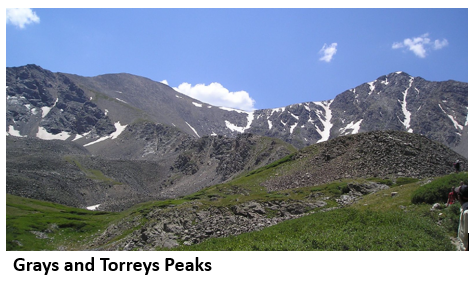
    In 1861, when botanist Dr. Charles C. Parry was on his first botanical exploration of the Rocky Mountain region in Colorado, two tall mountain peaks attracted the doctor’s attention. Following the practice among botanists to name new plants after each other, Dr. Parry named the peaks after two of his colleagues, Asa Gray and John Torrey. Today, Grays Peak1 and Torreys Peak, the two “14ers” that sit just west of Denver, are popular with hikers, in part because their proximity allows a hiker to summit both in one day. If you (or anyone in OLLS… hint, hint) wanted to name a mountain after a colleague, how would you go about it? The answer is a little fuzzy, but let’s see if LegiSource can help make sense of it.

    Grays and Torreys Peaks.

    Neither the state nor the federal government has the exclusive authority to name a mountain, so the General Assembly could take steps to rename a mountain for state purposes. But it’s likely the best approach is to work through the federal board responsible for naming geographic features for federal purposes. The names bestowed by the federal board are used on federal maps and often followed by state and local governments.

    Federal renaming process

    Geographic names, including names of mountains, specifically established by federal law or executive order are official for federal purposes and can only be changed by federal law or subsequent order. But many federally recognized geographic names aren’t established by Congress or the President, they are approved by the U.S. Board on Geographic Names (BGN). Congress established the current BGN in 1947 to promote uniformity within the federal government in naming geographic features. The BGN’s decisions only apply to the federal government; state and local governments generally use the federal names, but there is no law requiring them to do so.

    The BGN does not create names for geographic features; it approves or rejects names proposed by others, based on the BGN’s principles, policies, and procedures. For domestic names, anyone can suggest a name for approval by submitting a proposal online or printing and completing a Domestic Geographic Name Proposal form. After receiving a suggestion, the BGN will conduct an investigation to ensure the suggestion conforms to BGN policies. It will also receive input from the general public; state naming authorities; interested federal, state, and local agencies; and federally recognized Indian tribes.

    You probably haven’t noticed any changes to the names of Colorado landmarks lately, and there’s a reason for that. As part of the name change process, the BGN works with the state naming authority in the state where the geographic feature resides. Colorado’s state naming authority was disbanded in 2013, so the BGN ceased working on name changes for features within the state. But fear not, on July 2, 2020, Governor Polis established a new Colorado Geographic Naming Advisory Board2 that will work with the BGN. BGN staff has met with Colorado’s board to discuss a strategy for addressing the backlog of pending Colorado renaming cases, and the Colorado board recently made its first name change recommendation. On September 16, 2021, the Colorado Geographic Naming Advisory Board recommended changing the name of Squaw Mountain in Clear Creek County to Mestaa’ėhehe Mountain.3

    State Geographic Naming

    Since the federal government does not have exclusive authority to name a geographic feature, states like Colorado can name (or rename) a mountain for state purposes. While there is no formal Colorado process for changing a name, there are historic examples where the General Assembly named a Colorado mountain peak, including some that occurred after the establishment of the modern BGN. The General Assembly adopted joint resolutions to name Mount Evans in 1895; rename Mount Wilson as Mount Franklin Roosevelt in 1937; and, in 1978, rename Lone Eagle Peak (named to honor Charles A. Lindbergh who had been known by the nickname “Lone Eagle”) as Lindbergh Peak. The 1978 Lindbergh Peak resolution directed that a copy of the resolution be sent to the BGN. In 1949, the General Assembly passed a bill to rename Veta Peak as Mount Mestas.

    More recently, in 1995, the Colorado Senate approved a resolution supporting the efforts to name a mountain peak in honor of one of Colorado’s legendary early mountain climbers, Carl Albert Blaurock.4 Eight years later, on October 1, 2003, to honor Blaurock’s legacy of climbing, the BGN approved naming a 13,616-foot peak in Colorado’s Collegiate Peaks range as Mount Blaurock.

    Mount Blaurock.

    Another wrinkle in a state-specific renaming is that some mountains are in similarly named federal lands. For example, Mount Evans sits in the federal Mount Evans National Wilderness Area. Even if Colorado changed the name of the mountain for state purposes, it could not change the name of the national wilderness area, which was designated by Congress.

    Because it would not affect federal maps, signage, documents, or federally named lands, an exclusively state-based solution may not be the best approach for widespread acceptance of a new mountain name. Instead, working through the BGN’s process will get your (or your colleague’s) name on the map. While the federal renaming process can be lengthy, the first step is simple: head to the BGN’s website to review its policies and make a suggestion.5 If you’re a member of the General Assembly who would like to draft a resolution to change a mountain name at the state level, or suggest or support a federal change, please contact OLLS to put in your request.

    Research from Nate Carr and Jacob Baus was used in this post.

    1. https://www.huh.harvard.edu/book/grays-peak ↩︎
    2. https://dnr.colorado.gov/colorado-geographic-naming-advisory-board ↩︎
    3. https://coloradosun.com/2021/09/17/mestaaehehe-mountain-squaw-clear-creek-geographic-naming-advisory/ ↩︎
    4. https://en.wikipedia.org/wiki/Carl_Blaurock ↩︎
    5. https://www.usgs.gov/us-board-on-geographic-names/geographic-names-faqs ↩︎
  • CO Supreme Court Holds that Independent Really Means Independent

    by Julie Pelegrin

    This week, we’re looking at the second set of interrogatories that the General Assembly sent to the Colorado Supreme Court during the 2021 legislative session. House Joint Resolution 21-10081 asked the court to determine whether the changes made in Senate Bill 21-247,2 concerning the procedures of the independent redistricting commissions, would be constitutional if adopted. The court held that the changes in the bill would not be constitutional and clarified a limit on the plenary authority of the General Assembly.

    To understand the questions and the answers, we’ll start with some background on the redistricting process in Colorado.

    Every 10 years, in the year following the U.S. Census, the boundaries for congressional and state legislative districts are redrawn to ensure equal population as required by the federal constitution. In 2018, voters passed Amendments Y and Z, codified in sections 44 to 48.4 of article V of the Colorado Constitution, which create the independent congressional redistricting commission and the independent legislative redistricting commission to draw the congressional and legislative district maps.3 The amendments also provide instructions for how to draw the maps (usually called redistricting plans), including criteria to apply in determining the district boundaries and very specific timelines for proposing the redistricting plans, getting public feedback on the plans, and submitting the plans to the Colorado Supreme Court for final approval.

    These timelines are based on an initial triggering event: Receiving the “necessary census data,” presumably by April 1 of the year following the census. This year, however, due mainly to the COVID-19 pandemic, the states are not receiving the census data until much later. At this point, the anticipated date for receiving the data is August 16, 2021, more than four months late. And the data released by this date won’t be tabulated and user-friendly for data access. That data won’t be available until September 30, 2021.

    Obviously, this delay wreaks havoc with the timelines specified in the constitution, which require:

    • Preliminary redistricting plans to be prepared by early May;
    • The commissions to hold several public hearings on the plans before July 21;
    • The commissions to consider up to three staff plans that are prepared after the public hearings are complete;
    • Each commission to submit an approved plan to the Colorado Supreme Court by September 15;
    • The court to either approve each commission’s plan or sends the plans back for reconsideration by November 15; and
    • The court to finally approve plans for both congressional and legislative districts no later than December 29, 2021.

    If the independent commissions cannot meet this timeline, there’s a strong likelihood that the deadlines for the 2022 election cycle will need to be delayed. To avoid that situation, the General Assembly introduced Senate Bill 21-247 to make it clear that the commissions could begin their work using preliminary census data, but that the final plans must be based on the final census data. Also, to avoid protracted legal challenges to the process that the commissions follow, Senate Bill 21-247 provided that a court, in considering a challenge to the plans on technical grounds, would apply a substantial compliance standard; that is, the plans would not be found to be unconstitutional on technical grounds so long as the commissions substantially complied with the technical constitutional requirements.

    The constitution uses the term “necessary census data” to describe the data the independent commissions must use to create the redistricting plans. That term isn’t defined in the constitution, but it is defined in section 2-2-902 (1)(c), Colorado Revised Statutes, as the federal decennial data published for the state by the United States Census Bureau and adjusted by the General Assembly’s nonpartisan staff to reflect changes concerning the residential addresses of incarcerated persons. This, of course, is the data that the commissions will not receive until August or September this year – much too late to begin the process of preparing plans.

    Senate Bill 21-247 redefined “necessary census data” for this year only, to include population estimates from the census data and other data selected by the independent commissions. The bill also required the final plans to be based on “final census data,” defined as the data the commissions will receive in August and September. The bill also included provisions concerning how and when the commissions will release the plans that are based on the final census data, including the requirement to hold at least one public hearing after receiving the final census data.

    As faithful LegiSource readers will recall, the General Assembly has plenary legislative authority,4 meaning it may enact legislation with regard to any issue or subject, so long as the legislation is not prohibited by or in conflict with the constitution. Amendments Y and Z specifically instruct the General Assembly to set compensation for the persons who assist in selecting the commissioners, appropriate money for commission expenses, and provide a per diem allowance for commissioners. But the amendments do not appear to specifically limit the plenary authority of the General Assembly, and the provisions of Senate Bill 21-247 do not conflict with any provision of the amendments. The General Assembly therefore was arguably acting within the boundaries of its plenary authority in enacting Senate Bill 21-247 to facilitate the work of the independent commissions. However, to avoid any legal challenges to the redistricting plans based on the provisions of Senate Bill 21-247 that would cause delay to the 2022 election cycle, the General Assembly asked the Colorado Supreme Court for its opinion as to whether the provisions of Senate Bill 21-247 are constitutional.

    The court held in a 5-2 opinion that they are not.

    The court reviewed Amendments Y and Z and concluded that by their terms they do not require the independent commissions to use only final census data when creating the preliminary and staff plans. Thus, the commissions can begin their work without waiting to receive the data that are scheduled to be delivered in August and September. However, for the final redistricting plans to comply with the criteria specified in the constitution, those plans likely must be based on the final census data received in August and September.

    The court also concluded that the General Assembly’s grant of plenary authority actually does not extend to legislation concerning Amendments Y and Z; the General Assembly does not have authority to direct the actions or operations of the independent redistricting commissions, except as specifically stated in the amendments. The court held that, in adopting Amendments Y and Z, the voters specifically intended to “divest the legislature” of authority over the redistricting process and especially over the independent commissions. Any authority of the General Assembly over those commissions must be specifically stated within the amendments. And in this case, Amendments Y and Z give the independent redistricting commissions and their staff “sole constitutional authority to conduct all of the key tasks in the redistricting process.” In adopting Amendments Y and Z, the voters put the redistricting process “beyond the power of the legislature.”

    Finally, the court held that the General Assembly cannot define the standard that a court applies when reviewing compliance with constitutional requirements, even if those requirements are purely technical. The General Assembly may establish the standard for determining compliance with statutes that the General Assembly enacts, but it cannot set the standard for determining compliance with constitutional provisions that the people enact. That decision lies solely with the courts.

    While the court was considering the interrogatories, Senate Bill 21-247 rested on the third reading calendar in the House of Representatives. After the court announced its decision on June 1, 2021, the House effectively killed the bill by agreeing to lay it over until July 8, 2021.


    1. https://leg.colorado.gov/bills/hjr21-1008 ↩︎
    2. https://leg.colorado.gov/bills/sb21-247 ↩︎
    3. Before 2018, the General Assembly was charged with congressional redistricting and a redistricting commission appointed by the Governor, the Chief Justice of the Colorado Supreme Court, and legislative leadership created the legislative redistricting plans. ↩︎
    4. https://legisource.net/2012/08/16/plenary-power-how-far-can-the-general-assembly-go/ ↩︎
  • Supreme Court Weighs In on Constitutionality of Two Bills

    by Julie Pelegrin

    For the second session in a row, the General Assembly sent interrogatories to the Colorado Supreme Court to ask whether pending legislation is constitutional. This session, the General Assembly actually sent two request for interrogatories to the Court: One regarding House Bill 21-1164,1 which concerns the number of mills that a school district must levy; and the other regarding Senate Bill 21-247,2 which addresses certain redistricting issues. And for the first time in recent memory—maybe ever—the Court agreed to answer the questions with regard to both bills.

    This article provides some background to House Bill 21-1164 and explains the question asked and the Court’s answer. A future article will cover the request for interrogatories regarding Senate Bill 21-247. In a nutshell, the Court held that the General Assembly can constitutionally require school districts to increase their property tax mill levies over time up to the number of mills that they levied when their voters waived the revenue limits in the Taxpayers’ Bill of Rights (TABOR).3

    Colorado funds its school districts by calculating how much each school district should receive based on a formula that takes several factors into account. The amount that each school district receives is paid for by a dual funding system; the statute specifies how many property tax mills each school district must levy, and if the amount of property tax revenue received from that levy isn’t enough to completely pay for the district’s formula funding, then the state pays the rest.

    In 1994, when the state passed the current school finance act, each school district was required to levy the lesser of: 1) The number of mills required to fully fund the school district’s formula amount; 2) The number of mills that would generate tax revenue within the limits imposed by TABOR; or 3) The number of mills levied in the previous property tax year. So, if a school district’s assessed property value increased in one year, the school district would likely have to reduce its mill levy to stay within TABOR revenue limit. But if the property values went down in next year, the school district could not increase its mill levy back to the previous number of mills because the statute would not allow it to levy more than it levied in the previous year.

    Shortly after the voters approved TABOR, school districts started asking their voters to waive the revenue limits, a request TABOR allows school districts to make. Eventually the voters in 174 of the 178 school districts authorized their districts to continue collecting and spending revenue in excess of the limit. Under the mill levy statute, this should have meant that, once a school district had this approval from its voters, the school district’s mill levy would never have to decrease because the revenue limit imposed by TABOR would never apply. But that’s not what happened.

    The department of education advises school districts concerning the number of mills the school district is required to levy under the statute. If a school district doesn’t levy the required number of mills, then it can affect the amount of money the school district receives from the state to fully fund the school district’s formula amount. The department continued to advise school districts to lower their mill levies to stay within their TABOR revenue limits, even after the school districts’ voters had waived those limits. As explained above, this meant that school district mill levies went down, and the statute would not allow those levies to go back up. The result? The state paid more and the school districts paid less. In 1994, all of the school districts combined paid about 47% of the total formula funding in the whole state, and the state paid about 53%. By 2007, the school districts were paying 36% and the state was paying 64%.

    In 2007, the General Assembly changed the statute to stop the reduction of mill levies for school districts that were no longer subject to the TABOR revenue limits. Starting in the 2007 property tax year, school districts were required to levy the lesser of: 1) The number of mills required to fully fund the school district’s formula funding; 2) The number of mills required to stay within the TABOR revenue limit, but only if the school district was still subject to that limit; 3) The number of mills levied in the preceding property tax year; or 4) 27 mills. With this change, the mill levies stopped going down, but they didn’t go back up.

    In the 2020 legislative session, the General Assembly decided to do something about raising the school district mill levies back to the levels that were in effect when school district voters agreed to waive the TABOR revenue limits. They enacted [House Bill 20-1418] enrolled bill, which reset the school district mill levies for school districts that are no longer subject to the TABOR revenue limits. Starting in the 2020 property tax year, the school districts are required to levy the lesser of: 1) The number of mills required to fully fund the school district’s formula funding; 2) The number of mills the school district would have been levying if not for the reductions required by the department of education; or 3) 27 mills. But when the bill passed, the state was in the middle of a pandemic, so rather than actually require tax payers to pay more in 2020, HB20-1418 also said that each school district that was increasing its mill levy would grant a temporary tax credit for the full amount of the increase. So, even though the mill levies were reset to the previous levels, taxpayers paid the same amounts they paid in 2019.

    That brings us to now. During the 2021 legislative session, the General Assembly introduced HB 21-1164, which directs the department of education to adopt a schedule to reduce the temporary tax credits by no more than one credit per year, until each school district’s tax credit is removed. At this rate, most school districts will have completely removed the tax credits by about 2024.

    There was some question, however, as to whether reducing the tax credits—and thereby increasing the school districts’ mill levies—is constitutional. In addition to imposing revenue limits, TABOR requires a school district to obtain voter approval in advance for “…a mill levy above that for the prior year…”. Even though HB20-1418 and HB21-1164 are together correcting an error and restoring the school district mill levies to the levels that would have been in effect without the error, this restoration does result in school districts assessing mill levies that are higher than those assessed in the previous year. Rather than require the school districts to risk litigation, the General Assembly sent an interrogatory—a question—to the Court. Is it constitutional for the General Assembly to require school districts to eliminate the tax credits and restore the mill levies without seeking voter approval?

    The Court, by a vote of 6-1, said yes, resetting the mill levies without additional voter approval is constitutional. The Court concluded that, when voters waived the revenue limits for their school districts, they essentially approved the mill levies that were in effect at the time of the election, and they expected those mill levies to continue. Since the voters had already approved those mill levies, correcting the error and resetting the mill levies to those levels does not require the voters to approve them for a second time.

    Next, we’ll discuss the Court’s answers to the questions concerning Senate Bill 21-247. Spoiler alert, they were not in the affirmative.

    1. https://leg.colorado.gov/bills/HB21-1164 ↩︎
    2. https://leg.colorado.gov/bills/SB21-247 ↩︎
    3. Link to Taxpayers’ Bill of Rights, Colorado Constitution, Article X, Section 20 ↩︎
  • The Mighty Colorado River – Once Known as Merely Grand

    by Patti Dahlberg

    Today the name “Colorado” runs continuously with the mighty river that originates in Colorado’s Rocky Mountains and runs south and west for 1,450 miles through Utah and Arizona and along the Nevada and California borders before heading into the Gulf of California in northwestern Mexico. But this was not the case before 1921.

    For many years, various explorers wandered through the West naming landmarks as they went along. The river beginning at the Continental Divide in northwest Colorado and flowing south and west out of the state was called the Grand River. The river’s name then changed from “Grand” to “Colorado” where the Green River met it in southeastern Utah continuing on through the Grand Canyon and out to sea. Prior to being called the Grand River around 1836, portions of the river had also been known as the Rio San Rafael River, the Bunkara River, the North Fork of the Grand River, and the Blue River. The “Colorado” in the river’s name is Spanish for the “color red,” referring to the river’s muddy color flowing through the canyons in Arizona and Utah, but “Colorado” was just the final name in the long line of labels for this amazing river over the years. In the 16th century, Spanish explorers called the river Rio del Tizon, which translated to River of Embers or Firebrand River. Later, some portions of the river may have been Rio de Buena Guia, Rio Colorado de los Martyrs, Rio Grande de Buena Esperanza, Rio Grande de los Cosninos, and the El Rio de Cosminas de Rafael as explorers discovered those portions. But by the time John Wesley Powell navigated and mapped the Grand Canyon in 1869, “Colorado” was the accepted name of the river flowing through the canyon.

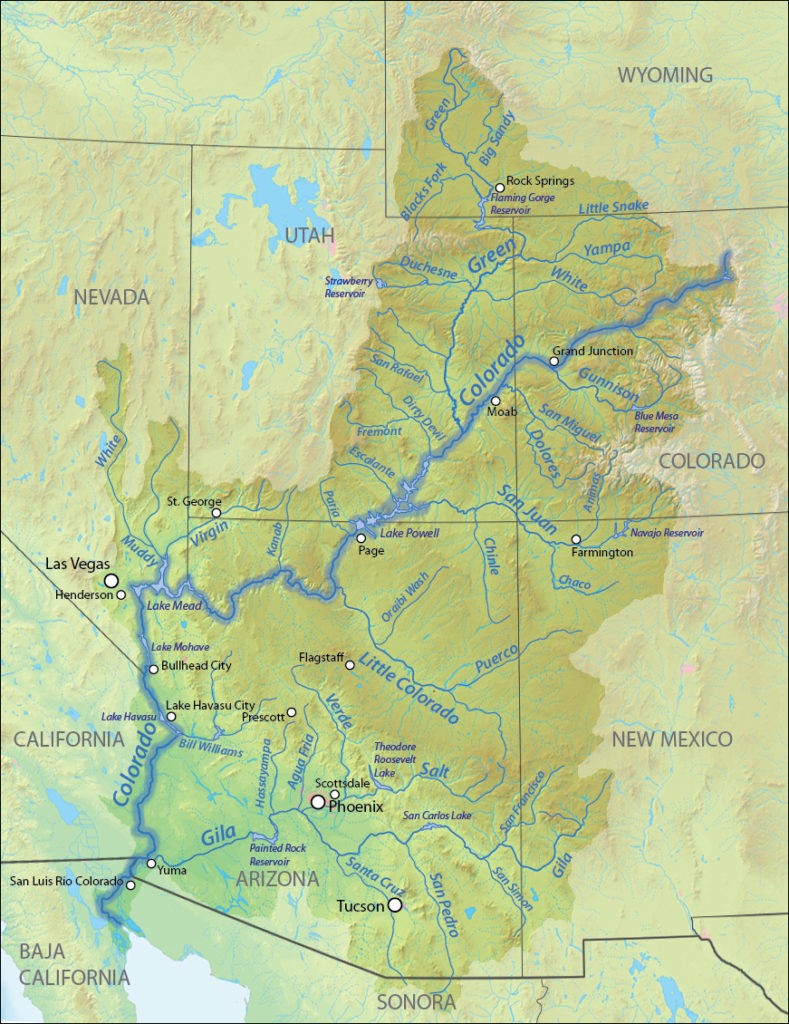
    Map of Colorado River from origin in Colorado to Baja California.

    The Colorado River is known for its dramatic canyons and whitewater rapids, however, the river is not one single channel running from the Continental Divide, slicing through the Grand Canyon, and on to the sea. The river consists of many major tributaries merging together to form the Colorado River Basin. The Basin’s 246,000-square-mile drainage area includes parts of seven states—Wyoming, Colorado, Utah, New Mexico, Arizona, Nevada, and California and forms 17 miles of the international boundary between the United States and Mexico. The river supplies water to more than 40 million people and 90% of the nation’s winter vegetable production and is justifiably considered by many to be the “Lifeline of the Southwest.” Today a system of dams, reservoirs, and aqueducts control much of the Colorado and its tributaries, diverting most of its flow for agricultural irrigation and domestic water supply. The Colorado’s large flow and steep gradient is used for generating hydroelectric power, and dams regulate the water flow to meet power demands in much of the western states. Unfortunately, high water consumption has dried up the lower 100 miles (160 km) of the river, which has rarely reached the sea since the 1960s.

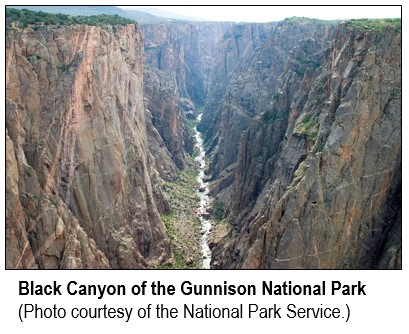
    But for roughly six million years before the dams, the unfettered and free-flowing Colorado River cut deep gorges in the land, and not just through the Grand Canyon. Along the waterways joining the Colorado —the Virgin, Kanab, Paria, Escalante, Dirty Devil, and Green rivers from the west, and the Little Colorado, San Juan, Dolores, and Gunnison from the east — many narrow, winding, deep canyons  were also carved, such as Colorado’s stunning Black Canyon of the Gunnison River. Canyons cut by the rivers in Arizona and Utah include Marble Canyon, Glen Canyon, and Cataract Canyon, with the longest of these unbroken trunk canyons being the spectacular and much loved Grand Canyon. It shouldn’t be surprising that the Colorado and its tributaries flow through or near many national parks, monuments, and recreational areas.

    Black Canyon of the Gunnison National Park. (Photo courtesy of the National Park Service.)

    The Name Change

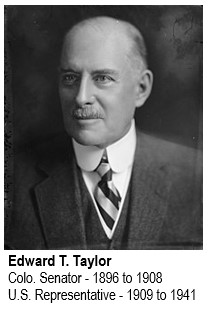
    In 1921, U.S. Representative Edward T. Taylor of Colorado petitioned Congress to rename the Grand River as the Colorado River. The Glenwood Springs resident and former Colorado State Senator could not accept that the Colorado River name started in Utah and not in his beloved state. “It is absurd for one part of any stream to be given one name and the rest of the stream another name.” Congressman Taylor loved Colorado and already had a reputation for getting up on the House floor to make five to ten minute speeches about his beautiful state. He took the renaming of the Grand portion of the river as a personal mission. It was Taylor’s strong sense of state pride and historic knowledge that helped persuade Congress to change the river’s name . . . and maybe a decade of speeches and tenacity helped too.

    Photo of Edward T. Taylor, Colorado Senator from 1896 to 1908 and U.S. Representative from 1909 to 1941.

    On February 18, 1921, Congressman Taylor appeared before the Congressional Committee on Interstate and Foreign Commerce regarding House Joint Resolution 460 “Renaming of the Grand River, Colo.” (See hearing report/transcript,1 House Joint Resolution 460 starts on page 14.) Based on his opening statement and answers to committee questions, Congressman Taylor came prepared to argue why the Colorado River name should flow continuously with the river that originates in Colorado and continues west to the sea. He provided national and regional history, local context, precedent, testimonials, statistics and measurements, and even threw in an international treaty for good measure. In his opening statement, he described the Colorado River as “the Nile of America,” and said it “is by far the most picturesque, scenic, unique, marvelous, and famous river in the world.” As for the state of Colorado, Taylor said, “… for the past 60 years, “Colorado” has meant the heart of the Golden West, the actual top of the world, the land of sunshine, good health, and gorgeous scenery, the summer playground of the Nation, the Switzerland of America, the bright jewel set in the crest of this continent, where it shines as the Kohinoor of all the gems of this Union; the sublime Centennial State.”

    It did not concern Taylor that traditionally the longest tributary is regarded to be a river’s headwater or origin and the Green River—originating in Wyoming—was actually twice as long as and had a larger drainage basin than the Grand River.. Taylor backed up his claim for Colorado state superiority with volume statistics showing that the shorter Grand River (350 miles long) contributed more water to the mighty Colorado. According to information from the Colorado Historical and Natural History Society contained in the hearing report, the Grand River provided 40% of the Colorado River’s water flow, and when combined with water flow from the San Juan, Yampa, White, and other Colorado rivers, water from the state of Colorado provided closer to 60% of the river’s flow. The Natural History Society report also noted that the Green River receives more than a third of its water flow from Colorado’s Yampa and White rivers.

    But Taylor may have found his most persuasive argument in the record of the U.S. Senate’s proceedings from 1861 when the Senate named the Colorado Territory. As introduced and passed by the House, the name in the bill for the proposed new territory was the “Territory of Idaho”, other names reportedly considered were Jefferson and Arcadia. In the Senate, however, the name “Idaho” was stricken and “Colorado” inserted “for the reason that the Colorado River arose in its mountains, hence there was a peculiar fitness in the name.”

    Colorado’s 23rd General Assembly sent its support for renaming the Grand to the Colorado in Senate Bill 1921-792 (later approved on March 24, 1921), the reengrossed version was included, along with various letters of endorsement, in the official Congressional Committee hearing report. After receiving support from governors and state assemblies in Colorado and Utah for the renaming of the Grand, Congress officially renamed the interstate waterway. The Committee on Interstate and Foreign Commerce ended its report to the House of Representatives with this statement: “There being no apparent reason sufficient in the judgment of your committee to counteract the expressed desire of the people of the State of Colorado to have this change made, your committee unanimously recommends the approval of this resolution.” On July 25, 1921, the 66th Congress passed the resolution renaming the Grand River, in spite of some lingering objections from some Wyoming and Utah representatives.

    No worries, Colorado does still have its share of Grand – you only have to look around to see that. But more specifically there’s also the Grand Ditch, which pulls water from the Colorado River to the eastern slope; Grand Junction, at the confluence of the Gunnison and the then “Grand” Rivers; and, of course, Grand County.

    The Colorado River Story Continues

    The Colorado River may be one of the most litigated rivers in the world and, as the demand for Colorado River water continues to rise, the level of development and control of the river continues to generate controversy.

    In 1922, the Colorado River Compact divided the river into the lower compact states—Arizona, California, and Nevada—and the upper compact states—Colorado, New Mexico, Utah, and Wyoming. It was the first time more than three states negotiated an agreement among themselves to allocate the waters of a river. At that time the total annual flow of the Colorado River was estimated to be close to 16.5 million acre-feet ( an “acre foot” is the amount of water required to cover one acre to a depth of one foot) at Lees Ferry, AZ., of which 15 million acre-feet were divided between the lower and the upper compact states. A treaty in 1944 allocated 1.5 million acre-feet of water per year to Mexico. It was later realized that the initial estimate of Colorado River water volume in the 1922 compact was based upon an abnormally wet period and that substantially less water was available than the amounts specified in the agreements. In 2019, after several years of negotiations and in response to ongoing drought conditions and the increased potential for water supply issues, the upper and lower basins began implementing drought contingency plans to manage water demand.3

    1. Link to chrome-extension://efaidnbmnnnibpcajpcglclefindmkaj/https://legisource.net/wp-content/uploads/2021/05/Hearing-Report-Transcript-RenameGrandRiverColorado1921.pdf ↩︎
    2. Colorado General Assembly, “Concerning the Change of the Name of the Grand River to the Colorado
      River.” (1921). Session Laws 1901-1950. 2450.
      https://scholar.law.colorado.edu/session-laws-1901-1950/2450 ↩︎
    3. https://legisource.net/2019/09/19/new-water-demand-management-agreement-on-the-colorado-river/ ↩︎
  • Contracting for the Publication of the Colorado Revised Statutes

    by Jennifer Gilroy

    Have you ever stopped to wonder how those pretty red statute books, the Colorado Revised Statutes, are published? As you can imagine, it’s very important that citizens have access to the law. So important, in fact, that the state constitution1 requires the General Assembly to publish the laws it passes at each legislative session. The General Assembly satisfies this requirement by annually publishing the Session Laws of Colorado, a three-volume set of books in which every bill enacted during a legislative session is published.

    In addition, the statutes that are created, amended, or repealed in each of those bills are then codified by subject matter in the collective body of Colorado law known as the Colorado Revised Statutes (CRS)—the previously mentioned red books on your book shelf and at public libraries and courthouses. There are 26 volumes including a two-volume index and a two-volume publication of the Colorado Court Rules.

    The legislature’s Office of Legislative Legal Services (OLLS) prepares the databases for both the Session Laws and the CRS, by making the necessary changes in the former year’s CRS database to reflect the additions, changes, and repeals resulting from the work of the General Assembly during the legislative session.  The work of the OLLS in preparing the CRS also includes drafting the history (or “source”) notes, the editor’s notes, and the annotations of relevant appellate court opinions for each statutory section of law. Once the OLLS has completed compiling the Session Laws and the CRS—which takes a lot of meticulous work and time (the law needs to be published accurately!)—the OLLS sends the giant databases to the contract printer to format, print, bind, and distribute. But who is the contract printer, how is the contract printer selected, and when?

    Like most things, the actual printing of the Session Laws and CRS are governed by state statute2. The statute requires that the contract must be bid and awarded in a manner directed by the Committee on Legal Services (Committee), a bipartisan committee of ten legislators, five each from the Senate and the House of Representatives. The Committee must employ standard bidding practices to select the contract printer. Historically the Committee has done so through the use of a request for proposals or “RFP” process.

    The governing statute also sets some limits on the contract. For example, the term of the contract may not exceed five years.  The statute allows a contract to be extended once for up to five more years, but requires the contract to be rebid no less frequently than every 10 years.  Since 2002, the Committee has awarded the print contract to LexisNexis out of Charlottesville, Virginia. The contract awarded to LexisNexis in 2002 was for five years, and the Committee extended it in 2007 for an additional five years.  In 2012, the Committee put the print contract out to bid as required by the statute, and the Committee awarded a five-year contract to LexisNexis. That contract was extended for an additional five years in 2017.

    The RFP process is lengthy and requires a significant amount of the Committee’s time. Therefore, meetings for the OLLS to advise the Committee about the RFP process, for the Committee to review the RFP before it is published, and for the Committee to meet with those who submitted proposals and select a contract printer must begin sooner than later. Once the Committee selects a contract printer, the OLLS will negotiate the actual terms of the contract with the successful bidder and draft the contract. The statute requires the state controller and the attorney general to approve the contract, and, ultimately, the contract must be executed by a representative of the selected contract printer and the chair of the Committee.

    It’s a long and time-consuming process but one that is intended to provide fairness, transparency, and reliability in the quality of the final products: The Session Laws and the Colorado Revised Statutes.

    1. Article XVIII, section 8, Colorado Constitution. ↩︎
    2. Section 2-5-105, Colorado Revised Statutes. ↩︎
  • Privacy Laws and the Free Speech Clause of the First Amendment

    by Jery Payne

    Should a state be able to pass laws protecting people’s privacy? Should the constitution protect a person’s right to freedom of speech? If you think the answer to both is “yes,” then you might be surprised to learn that those two goals can conflict.

    In 2007, Vermont passed a prescription­-confidentiality law,1 which forbade pharmacies from gathering and selling, for marketing, information detailing the prescriptions written by doctors. This law didn’t regulate the release of patient information; it was concerned with what prescriptions doctors were writing. This information is valuable because the drug companies can use it to market drugs to the doctors that are actually treating the types of patients the drugs may help.

    This law riled up drug manufacturers and data miners, who filed a lawsuit, Sorrell v. IMS Health Inc.,2 in a United States district court. The lawsuit wended its way to the United State Supreme Court, which struck down the law based on the Free Speech Clause of the First Amendment to the United States Constitution. The Court had two main concerns:

    (1) The law was content-based, which means one has to look at the information to know if the law applies. When a law is content-based, the courts will normally consider it suspect under the First Amendment’s guarantee of freedom of speech, and this means that it’s unlikely to survive a challenge.

    (2) The law discriminated against certain users of the information. The Court was concerned that the law discriminated against people who would use the information to market drugs. That is, the pharmacies could sell the information to any person that wasn’t a drug manufacturer or marketer. Now, drug companies are the primary market for this information, but maybe a company that provides medical alternatives to drugs would be interested in the same information. The Court considered this fatal to Vermont’s claim that it was protecting the doctors’ privacy. If the law allowed broad communication of information except for one group of people, the Court thought that it didn’t really protect privacy. The Court contrasted this with the Health Insurance Portability and Accountability Act of 1996,3 which generally forbids the release of patient information:

    For instance, the State might have advanced its asserted privacy interest by allowing the information’s sale or disclosure in only a few narrow and well-justified circumstances. See, e.g., Health Insurance Portability and Accountability Act of 1996 …. A statute of that type would present quite a different case than the one presented here.

    In the holding, the Court also explained:

    This Court has held that the creation and dissemination of information are speech within the meaning of the First Amendment. … [I]f the acts of ‘disclosing’ and ‘publishing’ information do not constitute speech, it is hard to imagine what does fall within that category….

    This case developed our understanding of the Free Speech Clause; that it not only affects laws that disseminate information, but it also affects laws that forbid creating or gathering information.

    In 2015 and 2016, Wyoming passed and amended a statute that made it illegal for a person to cross “private land to access adjacent or proximate land where he collects resource data”4 without the owner’s permission or other types of legal authority. I expect many of you may be wondering, “What does ‘resource data’ mean?” The statute defined the term as “data relating to land or land use, including … data regarding agriculture, minerals, geology, history, cultural artifacts, archeology, air, water, soil, conservation, habitat, vegetation or animal species.” So the law applied broadly and aimed at protecting the privacy of landowners.

    In a case named Western Watersheds Project v. Michael,5 the 10th Circuit Court of Appeals more or less overturned the Wyoming law for violating the Free Speech Clause of the First Amendment. The appeals court was following Sorrell.

    If the law had merely forbid crossing private land, there wouldn’t have been a problem. The court explained that there is no “First Amendment right to be exempt from an otherwise generally applicable law in order to facilitate speech indirectly limited by the [law].” The state may forbid trespass although it would stop you from having your say on someone else’s land. This is because the law has a legitimate purpose that isn’t directly related to speech.

    But the Wyoming law didn’t merely forbid trespass; the law forbade trespass for the purpose of getting resource information. The law was content-based; you had to know what type of data was collected to know if the law applied. According to the Court, “The challenged statutes apply specifically to the creation of speech,” and thus “are subject to the First Amendment.”

    The lower court had dismissed the lawsuit upon summary judgment, which means that there hadn’t actually been a trial yet. So the appeals court stopped short of striking down the law. But the appeals court ruling made it extremely unlikely that the law would survive. As expected, the district court ended up declaring the law unconstitutional.6

    Colorado and Wyoming are in the same judicial circuit, so this ruling applies in Colorado. So when thinking about a law to protect privacy, we would do well to be careful when (1) the law applies to obtaining only certain types of information or when (2) it’s aimed at one particular group. The first may be considered content-based and the second may be considered forbidden discrimination. It might seem better to narrowly tailor a law to apply only to the information we care about or to the group that wants the information, but either strategy may cause a court to hold that the law violates the Free Speech Clause of the First Amendment.

    1. https://codes.findlaw.com/vt/title-18-health/vt-st-tit-18-sect-4631.html ↩︎
    2. https://supreme.justia.com/cases/federal/us/564/552/ ↩︎
    3. https://www.cdc.gov/phlp/php/resources/health-insurance-portability-and-accountability-act-of-1996-hipaa.html?CDC_AAref_Val=https://www.cdc.gov/phlp/publications/topic/hipaa.html ↩︎
    4. https://codes.findlaw.com/wy/title-6-crimes-and-offenses/wy-st-sect-6-3-414.html ↩︎
    5. https://law.justia.com/cases/federal/appellate-courts/ca10/16-8083/16-8083-2017-09-07.html ↩︎
    6. https://www.leagle.com/decision/infdco20181030e42 ↩︎
  • The FAQs of Responding to CORA Requests

    by Duane Gall and Megan Waples

    Odds are, if you spend any time in the Capitol as a legislator or staff member, you’ll be the recipient of a “Colorado Open Records Act” (CORA)1 request at some point. In fact, given the recent uptick in CORA requests—and no sign that this trend is abating anytime soon—you may even have multiple requests with which to deal (if you haven’t already!).

    This article addresses issues and answers questions that frequently arise for legislators and legislative staff in responding to a CORA request. Specifically, we’ll talk about deadlines associated with requests, tips for finding records, and other considerations you may find helpful. [Note: In addition to CORA, this article refers to the policies of the Colorado General Assembly regarding public records requests. The policies are included in the “Legislative Policies Related to Public Records and E Mail,” (“the Policies”) and are available through the “Open Records Requests & Policy” link at the bottom of the Colorado General Assembly website.]

    Deadlines

    1. I’ve received a CORA request; what do I do and when do I need to do it? The first thing a legislator or legislative staff person should do is contact the Office of Legislative Legal Services, and he or she should do so as soon as possible. As you will see below, time matters in responding to CORA requests. The OLLS staff will work with you to prepare a response.

    LegiSource previously covered the nuts and bolts of being “CORA’d.” Please refer to that article, and the Policies, for a broad overview of the process–and keep in mind that CORA imposes strict deadlines. Generally, upon receiving a CORA request, recipients have three business days to respond in some fashion, although production of all of the requested records may not actually be completed within that time.

    2. This CORA request is dated more than three days ago, but I only just opened the email/got the letter/found out about it from OLLS. What is my deadline to respond? According to subsection II.C.5 of the Policies, the CORA clock starts ticking when the recipient actually receives the request or, in the case of a request to a legislator that is also sent to the Office of Legislative Legal Services (OLLS), the earlier of when the legislator actually receives the request or when the OLLS notifies the legislator of the request and confirms that the legislator is aware of it. So, how does this work in real life?

    • Example 1: If a CORA request arrives on August 1st (i.e., during the interim) via United States mail to a legislator’s office at the Capitol, and the legislator doesn’t open it until he or she is in the office on September 1st, the period of time in which to respond commences on September 1st, and a response is due three business days later on September 4th.
    • Example 2: The same CORA request from Example #1 is also sent to the OLLS, in accordance with the Policies. The OLLS receives its copy on August 1st and promptly leaves a message for the legislator to whom it is addressed. The legislator and the OLLS actually discuss the request on August 4th. In this case, August 4th is the day from which the response deadline is calculated, so the response will be due on August 7th.

    3. Ack! I need some time to get to my records to determine whether I have any to produce. Despite the stringent deadlines that attach to any CORA request, there is some wiggle room (up to seven additional business days) for recipients when “extenuating circumstances” exist. Even so, the recipient must provide written notice to the requestor, within the initial 3-day window, that the recipient is invoking an extension due to extenuating circumstances.

    4. Ok, but what constitutes “extenuating circumstances”? Subsection II.D.3 of the Policies states that extenuating circumstances exist when a request is submitted during the legislative interim and the recipient legislator’s office is closed. CORA itself provides that extenuating circumstances apply when an agency can’t fulfill a broadly stated request encompassing a large volume of records. In the case of the general assembly or its staff or service agencies, this specifically includes the period when the general assembly is in session (section 24-72-203 (3)(b)(II)(B), Colorado Revised Statutes).

    Of course, “extenuating circumstances” do not exist when the CORA request is merely inconvenient. Because someone may file a CORA request at any time and the turnaround period is so short, CORA requests can be very inopportune. Although “[r]esponding to applications for inspection of public records need not take priority over the previously scheduled work activities of the custodian or the custodian’s designee” (Policies, subsection II.D.2.a), CORA recipients must take their duties under the law seriously even when a request comes at a bad time.

    Finding records

    1. How should I assess whether I have responsive records? First, read the language of the request carefully. Many requests are limited to certain dates, names, terms, topics, and types of records. A legislator responding to a CORA request should keep in mind the request’s parameters. Start by using the request itself to identify appropriate search terms. Often, certain records are specified or terms are provided. If not, reassess: Is the request sufficiently specific to enable the legislator to comply? If so, proceed, making reasonably diligent and good faith efforts to devise search terms to unearth any responsive records. If not, the requestor will need to be contacted to clarify his or her submission. Please consider allowing OLLS to handle this on your behalf.

    2. So, do I just need to check through my emails? No, not necessarily. CORA and the Policies broadly define “public records” to include many types of records. Only if the request is explicitly limited to emails should the legislator confine his or her review to emails. If the CORA request seeks records in broad-based categories such as “all correspondence/records/documents” or “any communications,” the type of records covered by those broad categories is not limited to emails but could be any type of correspondence—printed letters or memoranda, hand-written notes, screenshots of text messages or social-media posts, etc.

    3. Reviewing and retrieving my records will take me a few hours because I potentially have quite a few records to produce. In that case, please STOP! If responding to a CORA request will require more than one hour, the requestor must pay a deposit based on the estimated time required (not counting the first hour) to retrieve any potentially relevant records. Therefore, if it appears that you will need more than one hour to respond to a request, please give OLLS an estimate of the time that it will take. (In the case of emails, you can estimate the number of emails that may be responsive to the request, because we apply a standard factor of 2.5 minutes per email to calculate the time required to process emails.) The OLLS will then multiply the estimated time by an hourly rate to calculate the estimated search-and-retrieval fee.

    The requestor must pay a deposit, equal to the estimated search-and-retrieval fee, within 30 days. Only when this payment is received should you proceed with actually assembling the requested records. If payment is not received within the 30-day period, the CORA request is deemed closed and no further action is required.

    The requestor must be notified of the requirement for payment of the deposit within three business days after receiving the request unless extenuating circumstances exist. (See item #3 in Deadlines, above.)

    Because the fee deposit is based on an estimate, the actual number of records located and the corresponding time spent retrieving and reviewing those records in order to respond to the CORA request may vary from the estimate. If it falls below the estimate, the overage paid by the requestor is refunded to him or her. If it exceeds the estimate, the requestor must pay a supplemental fee to cover the amount of time the legislator estimates will be necessary to retrieve the remaining volume of records.

    4. Do I have to produce my personal records that contain a term or otherwise appear to fall within the scope of the CORA request? Not necessarily. It’s the nature of the record, and not the platform on which it is created or stored, that is determinative. The mere fact that a document is created during one’s tenure as a legislator does not render it a public record. CORA defines “public records” as writings “made, maintained, or kept by the state, any agency, … or political subdivision of the state … for use in the exercise of functions required or authorized by law or administrative rule or involving the receipt or expenditure of public funds.” Further, the Colorado Supreme Court has observed that the definition of “public records” in CORA is intended to preserve a balance between private and public interests. Accordingly, the scope of CORA’s “public records” definition limits the type of documents covered by CORA to those that relate to the performance of public functions or the receipt and expenditure of public funds. The Supreme Court has stated that “CORA was not intended to cover information held by a government official in his private capacity.”

    On the other hand, a public record is a public record regardless of the medium. So if a legislator uses a personal email account to conduct public business (e.g., relating to the performance of official functions), the records pertaining to that public business are still “public records” and must be disclosed if requested under CORA.

    5. Is my constituent correspondence subject to disclosure under CORA? Potentially, yes. CORA’s definition of “public records” explicitly exempts a constituent communication that “clearly implies by its nature or content that the constituent expects that it is confidential or is communicated to request assistance or information relating to a personal or private matter that affects the constituent and that is not publicly known.” But any other constituent correspondence (e.g., an email urging that a legislator vote for or against a particular bill) is subject to disclosure. If a legislator has constituent correspondence that falls within the definition of “public records,” the OLLS will assist in redacting the constituent’s personal e-mail address and any extraneous matter such as forwarding headers, etc., before the document is released.

    Any other lifelines I can use? In addition to the OLLS, legislators may want to use their own staff members (aides, interns) for assistance in responding to a CORA request. Aides and interns are often tech-savvy and are familiar with the types, locations, and amount of records in a legislator’s custody. And legislators may want to apprise their caucus’s leaders or staff about CORA requests so that they can track and assist with the responses if desired.

    Other Considerations

    1. The requestor didn’t specify a reason for the request/I suspect the request is ill-intentioned. CORA does not require a requestor to explain why a request is submitted or for what purpose or in what manner any documents produced in response will be used. A record is either subject to inspection or not; the motivation for the request is irrelevant.

    2. The request I’ve received is very, very broad; doesn’t the request need to be limited in some way? There is no requirement that a request contain any parameters; in fact, requests are often couched in expansive terms. For example, requestors can state that they are seeking “all records” that include a certain term (e.g., “energy” or “House Bill xxxx” or “the Jane Doe Lobbying Firm”), and they do not otherwise narrow the scope of the request. This approach can be deliberate (if a requestor isn’t certain what records may exist and thus wants to cast a wide net) or inadvertent (if a requestor doesn’t anticipate the large volume of records that a custodian may have in his or her possession that may contain the sought-after term). So long as the request is “sufficiently specific to enable the custodian to locate the information requested with reasonable effort” (Policies, subsection II.C.1.), that’s all that matters.

    3. Once I’ve been CORA’d, may I continue to discard records in accordance with my usual records retention process? No, at least not with respect to any records that may be included within the scope of the CORA request. You should treat a CORA request the same way you would treat a litigation hold, under which a person is obligated to preserve records for a certain amount of time in anticipation of future potential use at trial. Once the CORA request is completely concluded, you may proceed with document disposal pursuant to your normal retention and disposal policy. (For more information on developing such policies, please refer to Subsection IV of the Policies and consult with the OLLS.)

    4. Whew! Responding to that CORA request seemingly took forever; how can I reduce the amount of time the next one takes? You can mitigate the time spent responding to requests by creating (and abiding by) a written records retention policy that establishes how long you keep various types of records, the frequency with which you dispose of records, etc. The fewer records in existence, the lower the volume of records that you may have to review and therefore potentially less time you will spend searching for, retrieving, and reviewing them. Alternatively, you may feel it necessary, in order to adequately complete your legislative duties, to maintain records for significant lengths of time. The Policies contain a number of guidelines and recommendations regarding records categorization, retention, and deletion; you may also consult with the OLLS. If you decide to establish a written records retention policy that could affect the documents produced in response to a specific CORA request, the policy must be in place before the request was received.

    1. Section 24-72-201, Colorado Revised Statutes. ↩︎
  • Constituent Services: Here to Help!

    by Ashley Athey

    Members of the General Assembly, as elected officials representing their respective districts, often receive a number of phone calls, emails, and, at least during session, in-person requests, questions, comments, and more from their constituents. While office staff help field the initial calls and emails, sometimes constituent requests and questions require a little more research.

    That’s where the Constituent Services Unit of the Legislative Council comes in. They assist members of the General Assembly by providing information to respond to constituent requests. The Constituent Services staff strive to provide quick responses that are short, accurate, objective, and understandable to the constituent. Either a member or the member’s legislative aide, intern, or volunteer may submit a request. Responses may come from the Legislative Council Staff or from an appropriate person in federal, state, or local government.

    Constituent Services staff help with almost any type of constituent request, including requests related to:

    • Current state law or legislation pending before the General Assembly;
    • Operations and services of state government;
    • Federal and local government activity/federal law;
    • State issues, e.g., water, environment, tourism, the economy; and
    • Legislative Council “products” — fiscal notes, economic forecasts, issue briefs.

    The manner in which Constituent Services staff responds varies. They may:

    • Navigate the constituent to the right person in a state agency who can address the constituent’s concern;
    • Connect the constituent with the proper level of government to address the constituent’s concern;
    • Provide information about current law, pending legislation, or state policies;
    • Help someone better understand the law;
    • Directly help resolve the problem (e.g., getting a tax refund or getting a driver’s license ); or
    • Simply listen and acknowledge the concern.

    There are, however, some requests that Constituent Services staff cannot assist with, such as requests for:

    • Voting, attendance, and financial records;
    • Partisan research;
    • Press releases;
    • Legal opinions;
    • Opinion/position papers; or
    • District surveys.

    Only members of the General Assembly or a member’s legislative staff may submit a constituent request to Constituent Services. A request may be initiated by telephone, fax, email, in writing, or in person.

    Requests may be submitted to the constituent services staff through email, by phone call, or in person at the Resource Center located at the foot of the main stairs on the ground floor of the State Capitol.

  • Do-overs in the Legislative Process

    by Julie Pelegrin

    Editor’s note: This article was originally posted April 8, 2016, and has been edited as appropriate.

    A recent LegiSource article1 explained the rules for reconsideration that allow a committee of reference or the House or the Senate to reconsider the vote taken on a motion. But there are other routes a legislator may take to get a committee or the House or the Senate to take a second look at a bill or amendment.

    Amendments to the Committee of the Whole Report. The most commonly used process for changing an action is an amendment to the committee of the whole report. Of course, this process only applies to actions taken on second reading in the House or the Senate.

    The second reading of bills is a two-step process. First, the House or the Senate passes a motion to sit as the committee of the whole. Considering bills as a committee that includes all of the Representatives or Senators allows the legislators to act under different rules than would apply if they were taking action formally as the House or the Senate. For example, while acting as the committee of the whole, debate cannot be limited, motions cannot be reconsidered, a decision of the chair of the committee of the whole cannot be challenged, and votes are not recorded.

    The committee of the whole adopts or rejects committee of reference reports and floor amendments to bills, generally debates the bills, and finally adopts, rejects, or refers each bill on a voice or standing vote. Once the committee of the whole has considered all of the bills on the calendar, or as many as it has time for, the majority leader moves that the committee of the whole “rise and report.”

    At this point, the House goes back to doing business as the House and the Senate goes back to doing business as the Senate, because they cannot complete the second reading process without a formal, recorded vote on the bills. This vote occurs when the House or the Senate votes on the committee of the whole report, which includes all of the amendments the committee adopted and all of the bills the committee considered. And, like any other committee report, the report of the committee of the whole can be amended.

    A legislator may offer an amendment to the committee of the whole report to change any action that the committee took – for example, to say that an amendment or bill that the committee passed, did not pass; or an amendment or bill that the committee rejected, did pass. All votes on amendments to the committee of the whole report are recorded. Once it has considered all amendments to the report, the House or the Senate finishes second reading by adopting or rejecting the entire committee of the whole report, as amended if any amendments passed.

    Under the Senate rules,2 a Senator can offer an amendment to the committee of the whole report to show that an amendment that was not offered in the committee of the whole did pass. Under the House rules, the committee must have actually considered an amendment for it to be the subject of an amendment to the committee of the whole report.

    Why would the House or the Senate adopt an amendment to the committee of the whole report to change something it just did? Since the votes taken in the committee of the whole are not recorded, a legislator may want an official count of the number of legislators voting for or against an amendment or a bill. Also, in the committee of the whole an amendment or bill passes with the approval of a majority of those present and voting. An amendment to the committee of the whole report and final adoption of the report requires the approval of a majority of those elected to the body: 33 in the House and 18 in the Senate.

    Referring bills from 2nd reading back to a committee of reference. Sometimes, while debating a bill in the committee of the whole, a member will argue that a particular amendment under debate is so technical or substantive that it requires consideration by a committee of reference whose members have special expertise in the subject area. Or the committee of the whole may adopt an amendment that changes the fiscal impact of the bill. In this case, a legislator may move to refer the bill back to a committee of reference – usually the committee that originally considered the bill or the appropriations committee.

    Usually, a bill will be referred back to a committee before it is amended by the committee of the whole, but sometimes the committee of the whole will have already adopted the committee of reference report or other amendments. It is up to the legislators to decide whether the bill is referred back to the committee of reference unamended or as amended by the committee of the whole. In either case, the committee of reference may adopt a second committee of reference report that further amends the bill or changes the amendments adopted by the first committee of reference.

    Referring bills from 3rd reading back to 2nd reading in the House or to a committee of reference in the House or the Senate.
    Under House rules, if a member tries to offer a substantive amendment to a bill on third reading, the proper motion is to refer the bill back to second reading for consideration of the substantive amendment. When the committee of the whole considers the bill this time, it will be considering the bill as introduced in the House with any amendments adopted on second reading enrolled into the bill – the engrossed version if it’s a House bill or the revised version if it’s a Senate bill. If the committee of the whole amends the bill on the second consideration, there will be a second engrossed or revised version of the bill.

    At the third reading stage, the House or Senate may also vote to refer the bill back to a committee of reference. In this case, the committee of reference will consider the engrossed or revised version and any amendments that the committee of reference adopts will be to the engrossed or revised version. The committee of reference may then move the bill to the committee of the whole for consideration on second reading – again. But the committee of reference cannot move the bill directly to third reading because House Rule 25 (j)(3)3 and Senate Rule 22 (f)4 only allow a committee of reference to refer a bill to another committee of reference or to the committee of the whole or to postpone the bill indefinitely.

    1. https://legisource.net/2021/01/21/the-four-ws-and-one-h-of-reconsideration-of-a-previous-vote-2/ ↩︎
    2. https://www.leg.state.co.us/inethsr.nsf/Rule.xsp?id=SENRULES.25&catg=Senate&pg=3.0 ↩︎
    3. https://www.leg.state.co.us/inethsr.nsf/Rule.xsp?id=HSERULES.25&catg=House&pg=3.0 ↩︎
    4. https://www.leg.state.co.us/inethsr.nsf/Rule.xsp?id=SENRULES.22&catg=Senate&pg=2.0 ↩︎