Category: Archive

Archived posts were published before July 1, 2024. They are maintained for historical reference and may not meet current accessibility standards.

  • Presidential Electors Must Keep the Faith

    by Julie Pelegrin

    The U.S. Supreme Court recently held in Chiafalo v. Washington1 that not only can a state require a presidential elector to vote for the candidate nominated by the elector’s political party, the state can also punish an elector who fails to do so—a so-called “faithless elector.” The case was based on the removal of faithless electors in both Washington State and Colorado. The Washington Supreme Court looked to the legal precedent interpreting the U.S. Constitution and upheld the constitutionality of punishing faithless electors. The Tenth Circuit Court of Appeals, in Baca v. Colo. Dept. of State,2 looked more to the plain language of the U.S. Constitution and how it had historically been applied and found that removing a faithless elector was unconstitutional.

    The U.S. Supreme Court resolved the issue by taking the same approach as the Tenth Circuit—looking to the plain language and the historical application—but coming to the opposite conclusion. Looking at the same language and interpreting many of the same facts, the Supreme Court reversed the Tenth Circuit with an 8-0 decision (Justice Sotomayor recused herself).  A brief comparison of the two opinions illustrates how easy it is for lawyers to reach opposite conclusions.

    First, a primer on how we really elect presidents and vice presidents. Article II, section 1(2) of the U.S. Constitution3 directs each state to appoint, “in such manner as the legislature thereof may direct,” electors to elect the president and vice president. These electors make up the Electoral College. In Colorado, when we vote for candidates for president and vice president, we are actually voting for a slate of electors nominated by the candidates’ political parties. In every state except Maine and Nebraska,4 the winner of the statewide popular vote receives all of the state’s electoral votes. For example, if the Democratic Party’s candidates win the popular vote in a state, then the Democratic Party’s electors will participate in the Electoral College for that state.

    The Twelfth Amendment to the U.S. Constitution5 specifies the process the electors must follow in electing the president and vice president. Each elector casts a vote for president and a vote for vice president. The Electoral College votes from each state are tallied, and the candidates for president and vice president who receive the most votes win, so long as they receive a majority of all the votes cast by the Electoral College. If no presidential or vice presidential candidate receives a majority, the House of Representatives chooses the president from among the top three vote getters, and the Senate chooses the vice president from among the top two vote getters.

    Colorado is one of 32 states that, by statute, require electors to vote for their respective parties’ presidential and vice presidential candidates. After the 2016 election, however, some of the Democratic Party electors decided to vote for someone other than Hillary Clinton, hoping to entice some of the Republican Party electors to vote for someone other than Donald Trump and ensure that no one received a majority of the Electoral College votes. If they had been successful, the House of Representatives would have chosen the president. Obviously, this strategy didn’t work. Instead, in Colorado, when an elector—Mr. Baca—voted for John Kasich instead of Clinton, the Secretary of State replaced him. And in Washington State, three faithless electors who voted for Colin Powell instead of Clinton were removed and fined $1,000.

    In both states, statutes authorized removal of the electors. In Washington, the three electors sued in state court, claiming the statutes were unconstitutional and their removal violated their federal constitutional rights as electors. The Washington Supreme Court held that the Washington statute was constitutional and nothing prevented the state from requiring electors to vote for their party’s candidate and punishing them when they failed to do so. The Washington electors appealed to the U.S. Supreme Court.

    In Colorado, Mr. Baca filed a civil action in federal court, claiming that the Secretary of State violated his constitutional rights by removing him. The Tenth Circuit agreed with Mr. Baca, holding that, even if the state could require electors to vote for their party’s nominee, it could not enforce the requirement by removing a faithless elector and nullifying the elector’s vote. The Secretary of State appealed to the U.S. Supreme Court, which agreed to hear both cases to resolve the disagreement.

    Both the Supreme Court and the Tenth Circuit recognized that states may require presidential electors to support the presidential and vice presidential nominees of their parties.6 The issue was, whether a state could enforce that requirement. Both courts also agreed that the U.S. Constitution is silent on whether a state may remove a faithless elector. But that’s pretty much where the agreement ended.

    The Tenth Circuit found there is no implied power for a state to remove an elector because the elector isn’t fulfilling a state duty; the elector is fulfilling a federal duty. But the Supreme Court looked at the state’s unfettered power to appoint electors, which includes the power to impose conditions on the appointment—like who the elector has to vote for. The Supreme Court concluded that removing an elector who fails to meet those conditions is just a natural extension of the power to impose the condition itself.

    The Tenth Circuit looked to the “plain language” of Art. II, Section 1(2) and the Twelfth Amendment. Using contemporaneous definitions, it determined that the terms “elector,” “vote,” and “ballot” clearly imply that electors are to have discretion and exercise individual choices in voting for candidates.

    The Supreme Court, however, noted that the “plain language” doesn’t specify that electors must make their own choice when voting, like some state constitutions did when the constitution was written. The federal constitution could have said that, but it didn’t. The Court also noted that the terms “elector,” “vote,” and “ballot” don’t have to connote independence. Electors had been pledging to vote their parties’ tickets for years before the Twelfth Amendment was written, and those votes were counted even though they were not the result of an independent choice.

    Finally, the Tenth Circuit looked at history and original intent. Citing the Federalist Papers and former Supreme Court Justice Joseph Story’s commentary on the constitution, it found that the authors of the constitution intended electors to exercise their independent judgment; Justice Story had complained that electors had been pledging their votes for years, which was never the authors’ intent. The Tenth Circuit also found 165 instances of faithless electors, and all of those votes were counted even though the electors broke their pledges.

    The Supreme Court countered all of these findings. The Court refused to allow the Federalist Papers to override or add to the actual language in the constitution. The Court noted that as early as 1796, voters expected electors to vote the party ticket and, citing Justice Story and others, recognized that electors did just what they were told to do. And finally, the Court identified 180 instances of faithless electors—out of 23,000. As such, those instances were mere anomalies, only one of which was even contested. That elector’s faithless vote was challenged and was upheld, but the elector came from a state that did not have a pledge statute. The Court observed that one instance in 200 years “hardly constitutes an historical tradition.”

    Based on its reading of history and the law, the Supreme Court found that states, for much of the last 220 years or so, have been requiring presidential electors to keep faith with their parties and the voters, and there’s no constitutional requirement to change that now.


    1. https://www.congress.gov/crs_external_products/LSB/HTML/LSB10515.html ↩︎
    2. https://law.justia.com/cases/federal/appellate-courts/ca10/18-1173/18-1173-2019-08-20.html ↩︎
    3. https://www.law.cornell.edu/constitution/articleii#section1 ↩︎
    4. In these states, the candidate who wins the popular vote in each congressional district gets the electoral vote for that district and the two remaining electoral votes go to the candidate who wins the statewide popular vote. So both Republican and Democratic Party electors may participate in the Electoral College for these states. ↩︎
    5. https://www.law.cornell.edu/constitution/amendmentxii ↩︎
    6. In the earlier case of Ray v. Blair, the U.S. Supreme Court had upheld the states’ ability to require presidential electors to vote for their parties’ candidates. ↩︎
  • Colorado Supreme Court Prohibits Electronic Initiative Signature Petition Collection

    by Jason Gelender

    The Colorado constitution1 requires a petition for a proposed ballot initiative to be signed by registered electors “in an amount equal to at least five percent of the total number of votes cast for all candidates for the office of the secretary of state at the previous general election” before the initiative can be placed on the ballot.2 If the proposed ballot initiative amends the Colorado constitution, the petition must also be signed by at least two percent of the registered electors residing in each of the state’s 35 Senate districts.3

    The Colorado constitution also imposes requirements regarding the manner in which an initiative petition must be signed, stating that a petition “shall be signed by registered electors in their own proper persons only,” and that each petition must include “an affidavit of some registered elector that each signature thereon is the signature of the person whose name it purports to be and that, to the best of the knowledge and belief of the affiant, each of the persons signing said petition was, at the time of signing, a registered elector.”4

    Accordingly, the implementing statutes5 that govern the qualification of proposed initiatives for the ballot require initiative petitions to be signed in person by registered electors while in the physical presence of a petition circulator. In 2020, government, business, and individual efforts to reduce the spread of COVID-19 through mandatory and voluntary social distancing have made in-person ballot petition signature gathering considerably more challenging for proponents of proposed ballot initiatives than it typically is.

    The Colorado Disaster Emergency Act, Sections 24-33.5-701 to 24-33.5-717, Colorado Revised Statutes, (CDEA), authorizes the Governor to declare a disaster emergency during which the Governor may “suspend the provisions of any regulatory statute prescribing the procedures for conduct of state business or the orders, rules, or regulations of any state agency….”6 On March 10, 2020, the Governor declared a disaster emergency as a result of the COVID-19 global pandemic. On May 15, 2020, recognizing the challenges to in-person ballot petition signature gathering posed by social distancing resulting from the disaster emergency, the Governor issued Executive Order D 2020 065 (EO 65), which, among other things: (1) suspended the requirement of section 1-40-111, Colorado Revised Statutes, that initiative petition signature collection take place in person; and (2) authorized the Secretary of State to create temporary rules to permit signature gathering by mail and email.

    On May 18, 2020, petitioners Colorado Concern, a self-described “alliance of top executives with a common interest in enhancing and protecting the Centennial State’s business climate,” and Colorado Concern board member Daniel Ritchie filed a lawsuit in Denver District Court against the Governor and the Secretary of State seeking a preliminary injunction to stop the enforcement of EO 65 and a declaratory judgment finding EO 65 unconstitutional under the Colorado constitution and unauthorized under the CDEA. On May 27, 2020, after ordering expedited briefing and holding a hearing, the district court issued an order7 denying the injunction and declaratory judgment. The petitioners appealed to the Colorado Supreme Court.

    On July 1, 2020, the supreme court reversed8 the district court, unanimously holding that article V, section 1 (6) of the Colorado constitution requires initiative petition signatures to be executed in person in the presence of a petition circulator and that the Governor cannot issue an executive order that suspends that requirement. The supreme court concluded that, by adopting the phrase “in their own proper persons,” the voters who approved article V, section 1 (6) intended that petition signatories sign for themselves rather than permitting someone else to sign for them. The supreme court further concluded that this requirement, read together with the additional article V section 1 (6) requirement that a registered elector attest to the validity of petition signatures, also requires that the in-person signing occur in the presence of the person circulating the petition. The supreme court supported these conclusions by observing, as the U.S. Supreme Court in Meyer v. Grant, 486 U.S. 414 (1988),9 had observed, that Colorado’s initiative process is interactive and involves direct engagement.

    In light of its holding that article V, section 1 (6) requires in-person collection of initiative petition signatures, the supreme court did not determine whether EO 65 complied with the requirements of the CDEA. Instead it simply concluded that while the CDEA authorizes the Governor to suspend certain types of statutes, rules, and regulations during a declared disaster emergency, it does not authorize the Governor to suspend constitutional provisions.

    The supreme court’s decision that initiative petitions must be signed in person and in the presence of a petition circulator dissuaded the proponents of at least one proposed initiative from even attempting to qualify the initiative for the 2020 ballot. Before the court issued its decision, the Secretary of State had authorized email and mail signature collection for six of the sixteen initiatives that had been approved for circulation: initiatives numbers 174, 271, 283, 292, 300, and 301. On July 2, 2020, the day after the supreme court announced the decision, the proponents of initiative #174 (“Setback Requirement for Oil and Gas Development”) announced that they would end their signature collection efforts because they were left with no safe way to proceed.

    The proponents of at least one other proposed initiative also cited the decision as a factor in their inability to collect the required number of signatures. On July 31, 2020, three days before the August 3, 2020, deadline for turning in signatures, the backers of initiative #271 (“Policy Changes Pertaining to State Income Taxes”) announced that they had been unable to collect the required signatures because “we could not overcome the effects of a global pandemic and a Supreme Court decision that did away with a viable alternative to traditional signature collection.” However, despite these challenges, three initiatives have qualified for the ballot and four others have turned in enough signatures for the Secretary of State to review them for signature sufficiency.


    1. Colorado Constitution Article V, Section 1. ↩︎
    2. Colorado Constitution Article V, Section 1 (2). For the 2020 general election, 124,632 verified signatures must be collected to qualify a proposed initiative for the ballot. ↩︎
    3. Colorado Constitution Article V, Section 1 (2.5). ↩︎
    4. Colorado Constitution Article V, Section 1 (6). ↩︎
    5. Section 1-40-111 Colorado Revised Statutes. ↩︎
    6. Section 24-33.5-704 Colorado Revised Statutes. ↩︎
    7. https://www.courts.state.co.us/Media/Opinion_Docs/20cv31708%20-%20Ritchie%20v%20Polis%20-%20FINAL%20as%20filed. ↩︎
    8. https://www.courts.state.co.us/userfiles/file/Court_Probation/Supreme_Court/Opinions/2020/20SC453. ↩︎
    9. https://supreme.justia.com/cases/federal/us/486/414/ ↩︎
  • Legislative Ethics – Public Disclosure and Reporting Requirements

    Part 2 of article 6 of title 24, Colorado Revised Statutes, otherwise known as the “Public Official Disclosure Law”, outlines requirements for the disclosure and reporting by public officials, including members of the General Assembly, of certain types of information. Section 24-6-202, Colorado Revised Statutes, largely concerns the disclosure of financial information, such as sources of income; businesses in which the legislator holds a financial interest; interests in property; the identification of all offices, directorships, and fiduciary relationships the legislator holds; and significant creditors of the legislator. Disclosure extends to the legislator’s immediate family. Financial disclosure must be made within 30 days after the legislator’s election or reelection, and each legislator must file an amended statement on or before January 10 of each calendar year.

    The reporting of gifts, honoraria, and other benefits that an incumbent or a candidate elected to public office receives in connection with his or her public service is the subject of section 24-6-203, Colorado Revised Statutes. Section 24-6-203 (3), Colorado Revised Statutes, lists certain items that the legislator must report, and section 24-6-203 (4), Colorado Revised Statutes, lists other items that the legislator need not include in his or her report. Gift and honoraria must be reported quarterly. If a legislator does not receive any of the covered items, he or she need not file a report. Legislators must file reports under both statutory sections with the secretary of state’s office.

    The subject of disclosure of reimbursement for travel expenses is addressed in section 24-6-203 (3)(f) and (4)(d), Colorado Revised Statutes.  Legislators must disclose reimbursements for travel if the reimbursement comes from a financial source other than public funds of a state or local government or from the funds of an association of public officials or public entities whose membership includes the member’s office or the General Assembly.

    Seems easy enough. Here are some hypothetical situations for your consideration:

    Situation #1. You are a member of the General Assembly. Following a very stressful session of the General Assembly, you had to endure painful foot surgery, which you postponed during the session. Your doctor has instructed you to stay off your feet for 3 weeks to let your foot properly heal. A longtime friend who has known you since long before you commenced your political career has offered the use of her condominium in a mountain town for your extended use. The offer comes with the assistance of a housekeeper who will prepare your meals. The relationship you enjoy with the donor is strictly personal, and the donor has never expressed any interest in the public business that you address as a legislator.

    Are you required to disclose the gift of the use of the condominium?

    1. There is no need for disclosure because you cannot accept your friend’s offer. Now that you are elected to the General Assembly, you should never accept a gift from anyone at any time for any purpose.
    2. Since you probably can’t accept the gift under Amendment 41, there is no gift to accept and, therefore, to disclose under the Public Official Disclosure Law (“PODL”).
    3. Since the donor is a long-time friend, no one would think anything improper about receiving a gift from that person and therefore there is no need to disclose such gift.
    4. A gift from a long-time friend of the use of a condominium to assist in one’s recovery from surgery is not given in connection with the member’s public service. Accordingly, the member is not required to disclose the gift.

    The correct answer is 4. Section 24-6-203 (2), Colorado Revised Statutes, requires disclosure of gifts given in connection with the member’s public service. In this case, the donor was a long-time friend who gave you the use of the condominium while you were recovering from surgery. The relationship you enjoy with the donor is strictly personal, and the donor has never expressed any interest in the public business that you address as a legislator. For these reasons, it does not appear the gift was given in connection with public service, which means you have no obligation to disclose it under section 24-6-203 (2), Colorado Revised Statutes.

    Situation #2. You are the chair of an interim legislative committee formed to study the conversion of outdated shopping malls to alternate uses. A private non-profit foundation promoting this type of development by the name of STOP (for “Start Transferring Open Parcels”) has put together a trip for legislators from across the nation to study successful conversion projects in a dozen different cities. STOP wants to reimburse you for your reasonable travel expenses involved in participating on the trip. STOP receives less than 5% of its revenue from for-profit entities.

    Are you required under the Public Official Disclosure Law (“PODL”) to disclose the reimbursement you will receive for these travel-related expenditures?

    1. As it doesn’t look like you would be able to accept reimbursement for the trip under Amendment 41, you shouldn’t go, making disclosure of this reimbursement a moot point.
    2. Since the reimbursement is coming from the funds of a nonprofit entity that is not an entity whose membership includes your office or the General Assembly, you are required to disclose your acceptance of it.
    3. This trip sounds like one of those “junkets” that is the source of much criticism. Accordingly, if you go, you should disclose it if only for the sake of preventing an appearance of impropriety.
    4. The work STOP does is really important to your constituents. There are three old and decaying shopping malls in your district alone. You feel a strong need to join the trip to learn how to generate the process of conversion in Colorado. This is such a boring issue and the sights are so depressing — why would anyone think a member would be going on this trip if he or she didn’t feel the issue was so important?

    The correct answer is 2. Under section 24-6-203 (3)(f) and (3)(d), Colorado Revised Statutes, reimbursement for travel must be disclosed if payment of the reimbursement comes from a financial source other than public funds of a state or local government or from the funds of an association of public officials or public entities whose membership includes your office or the General Assembly. In this case, because STOP, the nonprofit organization making payment to you for your travel expenses, does not meet these criteria, the reimbursement must be disclosed under the PODL.

  • Sunset Review: When the Regulatory Day is Done

    by Julie Pelegrin

    Consistently throughout the history of the world, two events have never failed to occur on a daily basis: sunrise and sunset. Having covered regulatory “sunrise” last week, it’s only fitting that we now discuss regulatory “sunset.” Before the General Assembly begins regulating a profession or occupation, it requires a study to ensure that the regulation will be in the public interest. Similarly, once regulatory bodies and functions are created, the General Assembly requires periodic review to ensure that they continue to serve the public interest.

    The law requires all advisory boards1 and the regulatory divisions, boards, and agencies, and some functions,2 in the Department of Regulatory Agencies (DORA) to repeal based on a schedule specified in the statute. In the common vernacular, this schedule of repeals is called a “sunset” provision, i.e., the sun sets on the agency, board, or function, and it ceases operating. According to DORA’s website,3 the term “sunset” in reference to this process was actually coined in Colorado in the 1970s. The Colorado Office of Policy, Research and Regulator Reform (COPRRR) within DORA handles the sunset process.

    How does it work?

    When a new advisory board is created in any department or a new division, board, agency, or function is created within DORA, the new entity or function is scheduled for repeal within 10 years. Approximately two years before that repeal date, COPRRR begins the review process, which includes research, writing, legislation, and rule-making.

    Generally, the review process focuses on two issues: 1) Is there a public need for the entity or function; and 2) Is the regulation that the entity or function imposes the least restrictive, consistent with the public interest?

    COPRRR must consider several factors in answering these questions. In addition to specifically looking at public safety and interest protections and the necessary level of regulation, the factors include:

    • The entity’s efficiency;
    • The degree to which the entity actually works with and represents the interests of the public and not just the regulated occupation;
    • How the regulations impact the economy and competition within the regulated occupation;
    • Whether the requirements for entering the occupation encourage affirmative action;
    • Whether the regulation takes into account prior criminal history and whether it uses this information to protect the public or to protect the occupation; and
    • Whether administrative and statutory changes are necessary to improve the entity’s operations and better serve the public interest.

    In completing the research, COPRRR will collect data; review the pertinent literature, statutes, and rules; and solicit information from and meet one-on-one or in small groups with a wide variety of public and private interested persons. The COPRRR website includes an online comment form that anyone can use to provide input.

    When the research is completed, the reviewer writes a sunset report, which must be submitted to the Office of Legislative Legal Services by October 15 of the year before the entity or function is scheduled to repeal. The report generally consists of background information and recommendations for statutory and regulatory changes. The report also recommends whether the entity or function should continue or be allowed to repeal. A division, board, agency or function may be continued for up to 15 years before the next review; an advisory board may be continued indefinitely. If the COPRRR recommends significant statutory or administrative changes, it is more likely to recommend a shorter continuation time to review whether the changes are effective.

    The OLLS drafts a bill to implement the statutory recommendations made in the sunset report. The Speaker of the House, in even-numbered years, or the President of the Senate, in odd-numbered years, selects a committee of reference to review the sunset report and the bill draft.

    The committee of reference holds a public hearing on the drafted—but not yet introduced—bill and the COPRRR’s report. These hearings usually occur in January soon after the legislative session starts, but may occur before session starts. At the hearing, personnel from the COPRRR present, and the committee typically takes public testimony on, the report and the bill draft. The committee may adopt amendments to the bill draft before deciding whether to approve the bill draft for introduction. The committee must base its decisions concerning the bill on the same factors that the COPRRR considered in making its recommendations.

    If the committee approves the bill draft for introduction, the committee chair assigns at least one legislator—who may or may not be a member of the committee—to sponsor the bill. If it’s a House committee of reference that approves introduction of the bill, the bill starts in the House, and the Senate President assigns one or two Senators to be Senate sponsors. If a Senate committee of reference approves introduction of the bill, the bill starts in the Senate, and the Speaker of the House assigns one or two Representatives to be House sponsors. Sunset bills do not count against a legislator’s five-bill limit, but a legislator cannot be the prime sponsor of more than two sunset bills regarding divisions, boards, agencies or functions in a single legislative session.

    When a sunset bill is introduced, it must be assigned to the same committee of reference that held the initial sunset hearing on the bill draft. After introduction, sunset bills are like any other bill; they may be amended and they must pass both houses and be approved by the Governor before they can become law. While the bill as drafted must reflect the recommendations in the sunset report, the General Assembly may amend the bill in any manner that fits within the single subject stated in the bill title.

    If the committee does not approve introduction of the bill or the sunset bill does not pass, then the repeal takes effect in July or September of the year after the COPRRR issues its report. An advisory board ceases operations immediately upon the repeal date. But the repeal of a division, board, agency, or function actually starts a one-year wind-up period. The entity or function continues to operate just to finish its business until the following July or September when the entity ceases to exist or the function ceases to operate. A license issued or renewed during this wind-up year, and any other outstanding licenses, expire when the entity or function actually ceases.

    Think of the wind-up year as the twilight. At the end of the year, the regulatory sun finally drops below the horizon, and everything goes dark. After that, only the General Assembly can make the sun rise again on that piece of government.

    1. Section 2-3-1203 Colorado Revised Statutes. ↩︎
    2. Section 24-34-104 Colorado Revised Statutes. ↩︎
    3. https://coprrr.colorado.gov/how-reviews-work/sunset-reviews ↩︎
  • Good Morning Sunrise!

    by Jery Payne

    You’re sitting in your office with your cup of joe or grande ristretto caffe latte—depending on your style—reading the newspaper when in walks a lobbyist, who says “I want to talk to you about bank robbing.” As you take a drink, she continues, “The bank­-robbers association believe their occupation needs to be licensed.”

    After the coffee is wiped up, you manage to ask her, “They have an association?”

    “Yes,” she replies, “they play an important part in the economy, and licensing is very important to avoid poor quality, which can be dangerous. The banks support licensing.”

    “The banks?”

    “Yes,” she adds, “The banks suffer the most from poor­-quality testing of bank security.”

    “Ah, I thought you meant actual thieves.”

    “No, silly. Legal bank robbers: the people who try to circumvent physical and electronic security measures.”

    After a long talk, you agree that licensing legal bank robbers may be the best way to help Colorado banks. Before you put in a bill request, however, you may want to find out if the proponents have obtained a sunrise report from the Department of Regulatory Agencies. It might save you some trouble.

    Section 24‑34‑104.1 Colorado Revised Statutes sets the basic requirements necessary to propose “the regulation of any unregulated professional or occupational group.” This section requires such a proposal to be submitted by December 1 to the Department of Regulatory Agencies for analysis. The proposal must be signed either by ten members of the occupation or by ten other people. The proposal must contain the following:

    • A description of the group proposed for regulation, including a list of organizations representing practitioners in Colorado, and an estimate of the number of practitioners;
    • A description of the problem and why regulation is necessary;
    • The reasons why the specific form of regulation is proposed;
    • The public benefit of the regulation;
    • The cost of the regulation; and
    • If the proposal seeks to disqualify a person based on criminal history, a description of the disqualifications and how the disqualifications serve public safety or commercial or consumer interests.

    If the proposal is in order, the department should analyze the proposed regulation and send the analysis to the proponents and the General Assembly by October 15 of the following year. If the department finds that the lack of regulation “poses an imminent threat to public health, safety, or welfare,” the department will promptly notify the proponents and the Legislative Council, which will hold a hearing on the matter. If the Legislative Council at the hearing agrees there is an imminent threat, the department may forego the analysis, and a legislator may introduce legislation without having the report.

    If the matter is not so dire, the department will evaluate and analyze the proposal and make a recommendation in a report based on whether:

    • Unregulated practice concretely harms or risks public health, safety, or welfare;
    • Regulating occupational competence is needed and beneficial;
    • The public can be protected in a more cost‑effective manner; and
    • Disqualifications based on criminal history serve public safety or commercial or consumer interests.

    Once you have the report, you may introduce the bill within two regular legislative sessions.

    The department may decline to conduct the analysis if it already did the analysis within the last three years and no new information has been submitted that would change the department’s mind.

    If the department doesn’t do a new analysis, it will reissue the previous report. This means you have a report and may introduce a bill within the next two regular legislative session.

    Now I bet I know what a lot of you are thinking: “What exactly does ‘regulating’ mean?” The Office of Legislative Legal Services thinks it means legislation concerning a job that hasn’t previously been the specific subject of legislation. The Governor’s Office, however, has said that it means only licensing, registration, and certification. The Governor’s Office reasoned that most occupations are subject to some laws; therefore, the sunrise statute cannot apply to all laws specific to an occupation. Yet this reading is hard to square with the actual language of the statutory section, which requires proponents of the regulation to state “the reasons why certification, registration, licensure, or other type of regulation is being proposed …” So “regulation” appears to be more than certification, registration, or licensure.

    Another problem with the interpretation of the Governor’s Office is that it conflates the regulation of an occupation with general‑purpose laws. For example, the law forbids bankers to steal, but the law doesn’t actually mention bankers. It applies to everybody regardless of whether they are a banker, so it is a general‑purpose law that incidentally a banker must obey when doing business. But a law that specifically requires bankers to keep a log of transactions is a law regulating bankers. A law that sets a standard or requirement for someone because of the person’s occupation is the regulation of an occupation. The mere fact that an occupation is subject to a general‑purpose law does not mean it is a regulated occupation; but a new law that would create a requirement specific to the occupation should be subject to the sunrise process.

    Nevertheless, the governor may veto the bill because it does not follow his office’s interpretation. Ignore the reading of the Governor’s Office at your own risk.

    So before using a bill request to help bankers get better security testing, it makes sense to ask if the proponents have followed the sunrise process.

  • Do You Really Need to Say “But Not Limited To”?

    by Jery Payne

    Many of the residents of the town of Bow Mar were mad. They were mad at the town’s trustees, who had raised taxes to bury electric and telephone cables. To do this, the trustees had used a statute to create a special district. The citizens got lawyered up and sued the trustees. Among other claims, they argued that the special-district statute didn’t apply to the cables because the cables were owned by private, not public, companies. They got this idea from the statute’s definition of public utility:

    …one or more persons or corporations that provide electric or communication service to the public by means of electric or communication facilities and shall include any city, county, special district, or public corporation that provides electric or communication service to the public ….1

    The residents argued that the phrase and shall include meant that the list, city, county, special district… was exhaustive. That is, by naming specific things the legislature meant to exclude others. A maxim of statutory interpretation is that to express one is to exclude others. So the special-district statute didn’t authorize the burial of a private corporation’s cables.

    The court wasn’t persuaded. The residents appealed all the way up to the Colorado Supreme Court, who agreed with the lower court:

    [T]he word include is ordinarily used as a word of extension or enlargement, and we find that it was so used in this definition. To hold otherwise here would transmogrify the word include into the word mean. [Emphasis Added]

    The United States Supreme Court has also interpreted shall include. In this case, they were construing this statute:

    ‘[C]reditor’ shall include anyone who owns a demand or claim provable in bankruptcy, and may include his duly authorized agent, attorney, or proxy.

    The court held that “It is plain that ‘shall include’ … cannot reasonably be read to be the equivalent of ‘shall mean….’”

    How did these cases arise? It was because sometimes drafters need to add examples to a statute. For example, they may want a statute to apply to fruit, so they write:

    Fruit means the edible part of a plant developed from a flower.

    Then someone becomes concerned that a court won’t include peas or tomatoes. To address this concern, they add a comma and “including peas or tomatoes.” Yet the inclusion–exclusion maxim makes drafters fear that listing peas and tomatoes will make a court think they mean only peas and tomatoes. So they add but not limited to and end up with this:  “Fruit means the edible part of a plant developed from a flower, including, but not limited to, peas and tomatoes.”

    But Sutherland’s Statutes and Statutory Construction has a different take:

    The word ‘includes’ is usually a term of enlargement, and not of limitation….2

    And a review of Colorado cases suggests that the phrase “but not limited to” isn’t necessary:

    • Colorado Common Cause v. Meyer3: “The word ‘includes’ has been found by the overwhelming majority of jurisdictions to be a term of extension or enlargement when used in a statutory definition”
    • Cherry Creek School Dist. #5 v. Voelker4: “A statutory definition of a term as ‘including’ certain things does not restrict the meaning to those items included.”
    • Arnold v. Colorado Dept. of Corrections5: “The word ‘including’ is ordinarily used as a word of extension or enlargement and is not definitionally equivalent to the word ‘mean.’”
    • DirecTV v. Crespin6: “Nothing in §605(d)(6) indicates that Congress intended to depart from the normal use of “include” as introducing an illustrative—and non-exclusive—list of entities ….”
    • Southern Ute Indian Tribe v. King Consol. Ditch Co7: “A statutory definition of a term as ‘including’ certain things does not restrict the meaning to those items included. The word ‘include is ordinarily used as a word of extension or enlargement.”

    It turns out that judges speak the same English as you and I do; they understand the meaning of includes and including.

    I didn’t find any Colorado cases that went the other way. So I cast the net a little wider and found Shelby Cnty. State Bank v. Van Diest Supply Co.8 This case dealt with a lien on “all inventory, including, but not limited to, agricultural chemicals, fertilizers, and fertilizer materials sold to Debtor ….”[Emphasis added.] In this case the 7th circuit explained that:

    [I]t would be bizarre as a commercial matter to claim a lien in everything, and then to describe in detail only a smaller part of that whole. … But if all goods of any kind are to be included, why mention only a few? A court required to give “reasonable and effective meaning to all terms” must shy away from finding that a significant phrase (like the lengthy description of chemicals and fertilizers we have here) is nothing but surplusage.

    So the court did interpret the word including as limiting, and the judges didn’t care that the contract used the phrase but not limited to. So this phrase isn’t a guarantee. And I have found several similar cases, so we probably shouldn’t get much comfort from the phrase but not limited to.

    Think of how many trees your Colorado could save by cutting out this unnecessary bit of legalese.


    1. https://www.casemine.com/judgement/us/5914c66dadd7b049347db14b ↩︎
    2. N. Singer, 2A Sutherland Statutory Construction section 47.07 (Seventh Edition) ↩︎
    3. https://www.casemine.com/judgement/us/5914c146add7b049347b890c#p_34 ↩︎
    4. https://www.casemine.com/judgement/us/5914c146add7b049347b890c#p_34 ↩︎
    5. https://www.casemine.com/judgement/us/59147fb1add7b04934465ff0 ↩︎
    6. https://www.casemine.com/judgement/us/5914b455add7b0493476bb08 ↩︎
    7. https://www.casemine.com/judgement/us/5914af63add7b0493474c85a ↩︎
    8. https://www.casemine.com/judgement/us/5914b88cadd7b04934785c8b ↩︎
  • Too Many Bills! When and How to Delay

    by Darren Thornberry & Patti Dahlberg

    Now that you’ve met most of the bill deadlines set by rule, it’s time to consider taking care of a few pesky bill limits and deadlines that aren’t quite working for you this year. The five-bill limit and the filing date deadlines imposed by Joint Rules 23 and 24 were implemented to keep bills and other legislative work moving through the legislative process in a timely manner. But these rules also allow some bills to be exempted from these bill limits and deadlines. In a perfect session, a legislator might need only five bills to accomplish what he or she wants to see done in a session; and, of course, these bills would sail through all readings and committees and meet all deadlines with ease. The Governor’s desk would groan under the weight of so much gleaming legislation so early in session!

    We can dream!

    However, sometimes five bills just aren’t enough. Or a bill is submitted after a request deadline. Or a bill is more complex than expected. Or, after introduction, a bill simply needs more time to meet the remaining deadlines. When any of these situations occur, a legislator needs to obtain delayed bill authorization for the bill to be drafted or to continue through the legislative process. Delayed authorization is needed when:

    • A legislator submits a bill request after the bill request deadline, the bill request exceeds the legislator’s five-bill limit, or the legislator is being added as a joint prime sponsor to a bill in the first house. Any of these circumstances will cause the legislator to exceed the five bill-limit. This requires a waiver of one or more “bill limits” (and possibly bill deadline dates).
    • A bill request requires additional time for drafting, necessitating a waiver of one or more “bill deadlines”.
    • An introduced bill is not scheduled for a hearing or final vote in time to meet the committee or final passage deadline. This requires a waiver of one or more “bill deadlines”.

    The process for obtaining “delayed” or “late” bill authorization starts with the Speaker’s or the President’s office.  A legislator must request permission for delayed status for a bill from the House or Senate Committee on Delayed Bills (i.e., Leadership).  At the beginning of the legislative session, House and Senate Leadership designate a specific process for legislators to follow when requesting delayed bill authorization and the leadership staff who will be able to answer questions on the process. The Speaker or President’s staff should be able to provide this information.

    Leadership reviews all requests for delayed bill authorization and may request additional information from sponsors before deciding whether to grant approval. In both the House and the Senate, the approval process has two steps. If, as step one, Leadership initially grants approval, leadership staff notifies the Office of Legislative Services (OLLS) that Leadership has granted approval. This gives preliminary approval on the request to add a legislator as a joint-prime sponsor, to draft a new bill, to continue to draft a bill that is already being drafted but is unable to meet its introduction deadline, or, for bills that have been introduced and now need additional deadlines waived, to allow the bill to remain on the calendar in its current position. The OLLS creates an official delayed bill letter according to Leadership’s directions regarding the limits and deadlines waived, including any specified deadline dates, for signature by the applicable Committee on Delayed Bills. To complete the second step of the process, at least two of the three members of the applicable Committee on Delayed Bills must sign the official delayed bill letter before delayed status is considered approved and the bill can be introduced or, if already introduced, continue through the legislative process.

    Bills that need any type of delayed bill authorization can’t move to the next step in the legislative process until official delayed bill authorization is granted. Once Leadership signs the official letter, the letter is attached to the bill so that it is easily ascertained that the bill has delayed bill approval.

  • Statutory Annotations Take Center Stage Before the U.S. Supreme Court

    By Jennifer Gilroy

    To listen to the news you would think the U.S. Supreme Court was concerned only with Second Amendment rights in hearing oral arguments last Monday. But they actually saved some energy for a vigorous discussion about copyrighting the annotations to state statutes.

    As we explained in LegiSource in April of 20171 (it takes a while for a case to wend its way from the trial court to the U.S. Supreme Court), while the text of the statutes is not copyrightable, most parts of the federal and state codes are accompanied by “ancillary works” such as editor’s notes, source notes, and, most substantively, annotations that summarize appellate court cases interpreting the statutes. Up to now, most states have routinely filed a copyright on these writings, recognizing them as original, individual expressions that have a “modicum of creativity” (the general standard for copyrighting material). But now, the assumption that these writings are copyrightable is called into question.

    Our earlier article explained that the State of Georgia sued Public.resource.org (PRO) after it purchased a copy of the Official Code of Georgia Annotated (OCGA) and posted it, in its entirety, online. Georgia claimed this posting infringed on Georgia’s copyright of the annotations.2 As explained in the earlier article, Georgia successfully defended against PRO’s motion for summary judgment in the case pending before the District Court for the Northern District of Georgia. The District Court determined that the Georgia statutory annotations are, in fact, original works entitled to broad copyright protection.

    PRO, an organization whose mission is to increase access to government materials, appealed that ruling to the U.S. Court of Appeals for the Eleventh Circuit (Eleventh Circuit). The question before the Eleventh Circuit was whether it should treat the annotations in the OCGA in the same manner under copyright law as a legislative enactment or a judicial opinion. It is uncontested that legislative enactments and judicial opinions are not copyrightable because they represent the exercise of sovereign power. Because they are written by the People’s representatives, they are in effect written by the People and are therefore part of the public domain. This policy is referred to as the government edicts doctrine.

    In October of 2018, the Eleventh Circuit observed that the issue before it was a “close one,” acknowledging that there were important considerations of public policy at stake on both sides. Ultimately, however, it concluded that the annotations in the OCGA were sufficiently “law-like” to be regarded as a sovereign work and therefore not copyrightable. In reaching this conclusion, the Eleventh Circuit stated that: The annotations clearly had authoritative weight in explicating and establishing the meaning and effect of Georgia’s law; the procedures by which the annotations were incorporated in the OCGA bore the hallmarks of legislative process, namely bicameralism and presentment; and Lexis, with which the Georgia Code Revision Commission contracted to draft the annotations, did so pursuant to highly detailed instructions set out in the contract.

    Last March, the state of Georgia petitioned the United States Supreme Court (the Court) for a writ of certiorari, posing the question whether the government edicts doctrine extends to, and thus renders uncopyrightable, works that lack the force of law such as the annotations in the OCGA. The Court granted Georgia’s petition. Over the spring, summer, and fall, there were 33 amicus briefs filed. The amicus brief filed by Lexis even included a citation to the April 2017 LegiSource article. After the briefing schedule concluded, the Court heard oral arguments on December 2nd. We anxiously await the Court’s ruling likely sometime before June next year.

    However, as explained in the previous article, the outcome of the case will not directly affect Colorado. In 2016, the Committee on Legal Services suspended the practice of copyrighting the annotations to the Colorado Revised Statutes. The Committee recognized that, unlike most states, Colorado’s nonpartisan staff in the Office of Legislative Legal Services writes the annotations. Because the annotations are the product of state-paid legislative staff and are made freely available on the Colorado General Assembly’s public access website, the Committee decided a copyright was not appropriate.


    1. https://legisource.net/2017/04/06/who-owns-the-law-the-colorado-perspective-on-copyright-and-state-statutes/ ↩︎
    2. For purposes of this case, “annotations” includes “history lines, repeal lines, cross references, commentaries, case notations, editor’s notes, excerpts from law review articles, summaries of opinions of the Attorney General of Georgia, summaries of advisory opinions of the State Bar, and other research references.” ↩︎
  • Spooky Oddities at the State Capitol

    by Ashley Athey

    In honor of All Hallows’ Eve, we’re reposting our article on the spooky tales and apparitions that haunt the gold dome. Have you encountered one of these spirits? Let us know!

    As with many old, historical buildings, a number of ghost stories haunt the Colorado State Capitol. Officially, there are no ghosts to be found in the building. However, those of us who have smelled an odd perfume, seen an odd figure, or heard an odd hoof beat know better. In honor of Halloween, we present to you a few of the most notable ghosts that unofficially haunt our halls.

    Black and white photo of a spooky floating face.

    The Bloody Espinosas1

    Perhaps the most well-known story of the capitol, this tale begins in 1863. Back then, the Colorado settlement was four years young, and the Gold Rush had brought a curious crowd to the territory. Denver was less a big city and more a town full of tents and temporary occupants hoping to make it rich. A few smaller mining towns were popping up throughout the state as gold was discovered, including Breckenridge, Colorado City, and Black Hawk, but these developments upset many people who already lived in the area. Two brothers from New Mexico, Felipe and Vivian Espinosa, were especially irate at the pioneers moving onto their land in the San Luis Valley and, for the better part of 1863, were intent on killing as many of the new residents as they could. Numbers of the murdered vary, but it’s believed they killed between a dozen and 30 people in just a few months.

    Accounts of how the brothers’ bloody careers ended differ, but eventually the brothers were killed, likely by a volunteer group of citizens from Park County. Their heads were brought to the capitol to collect the bounty set by the governor, but the governor refused to pay and no one knew what to do with the heads. They were first kept in the Treasurer’s Office in the capitol building but were later moved to the sub-basement beneath the capitol. Eventually, the heads were destroyed in the furnace.

    Since then, it’s been said that the heads of the Espinosa brothers can be seen floating through the building after dark. And if you’ve ever heard the sound of horses galloping up and down the main staircase, well, that’s just the Bloody Espinosas…looking for their heads!

    The Victorian Apparition

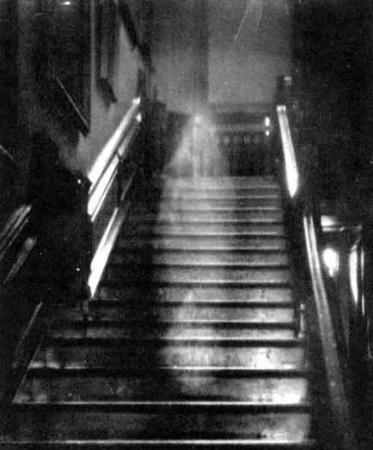
    On the third floor of the capitol building, rumor has it that you can see the ghostly visage of a woman wearing Victorian-era garments. She appears out of a mist near the entrance to the senate chambers and then floats off to either side of the chamber before disappearing.

    Black and white photo of translucent female figure on a staircase.

    The Woman in a Long Dress

    A female spirit, appearing in a long, turn-of-the-century dress, is said to wander the steam tunnels beneath the capitol, as well as the capitol building and all the buildings connected to the tunnels in the Capitol Hill area. She’s been seen reading over the shoulders of employees in each of the buildings.

    The Mysterious Tunnels

    Certainly the steam tunnels under the capitol building lend themselves to spooky stories and an overall heightened awareness. In addition to The Woman in a Long Dress, there have been reports of odd cold spells, during which keys, ID badges, and other items are pulled away from the body of the owner and lifted into the air by an unseen force.

    General Spookiness

    While the above stories illustrate a few of the known spirits, there are still a few more spooky happenings in the capitol building that don’t have a known explanation:

    • In the early hours before business gets going, and in the late hours well after business is done for the day, it’s said that the temperature in many areas of the capitol suddenly drops and a vintage, rose-scented perfume permeates the air before disappearing without a trace as the temperature returns to normal.
    • When business is done for the day, voices, conversations, and footsteps can be heard in and around empty meeting rooms and offices.
    1. https://www.legendsofamerica.com/outlaw-espinosagang/ ↩︎
  • Parsing Powers: Legislative Review of State Department Rules

    by Julie Pelegrin

    Each year, executive branch agencies in Colorado adopt between 400 and 500 sets of rules creating many thousands of pages of rules and accompanying materials. Specifically, in 2018 alone there were 457 sets of rules adopted. Counting the rules and corresponding materials, that totals up to 26,971 pages. That’s a lot of rules! And every one of those rules, along with the corresponding materials, was read and analyzed by a staff member of the Office of Legislative Legal Services (OLLS).

    This rule review function provides an instructive example of how the vague constitutional concept of separation of powers actually works between the legislative and executive branches. The legislature has the authority to make the laws. But in some instances, it makes more sense for the persons working directly with a program to decide the implementing details. In those situations, the legislature delegates some of its legislative authority to an executive branch department, allowing it to adopt rules. However, in adopting rules, the department must comply with statutes and cannot go beyond the authority that the legislature delegated to it. To ensure this does not happen, the legislature retains the ability to review the executive branch department’s rules and approve only those rules that are within the department’s rule-making authority and do not conflict with state or federal law.

    This process for reviewing and approving executive branch department rules is found in the State Administrative Procedure Act (APA). The APA requires each department to submit every rule that it adopts or revises within a one-year period to the OLLS for review under the supervision of the Committee on Legal Services (Committee)1. The standard of review is based on language in section 24-4-103 (8)(a), Colorado Revised Statutes, which states, “No rule shall be issued except within the power delegated to the agency and as authorized by law.” The vast majority of rules meet these requirements. But sometimes a rule conflicts with a statute or the constitution or does not fit within the limits of the department’s rule-making authority. At that point, the Committee and the General Assembly turn to the process laid out in the APA.

    The APA establishes a year-round cycle for reviewing rules.  Under section 24-4-103 (8), Colorado Revised Statutes, rules adopted during the one-year period from November 1 through October 31 automatically expire on the next May 15, unless the General Assembly extends the rules by passing a bill.  This annual bill is called the Rule Review Bill and is sponsored by the Committee. The Rule Review Bill postpones the automatic expiration of all of the adopted department rules, except for those rules listed in the bill that the Committee has decided should expire because the rules: 1) lack statutory authority, 2) exceed statutory authority, or 3) conflict with a state or federal statute or constitutional provision.

    During the process of reviewing the rules, if the OLLS staff finds one of those three grounds for challenging a rule, the staff contacts the department to discuss the issues with the rule. If the department disagrees with the analysis or is unable to fix the problems identified with the rule, the staff schedules the rule issue for a hearing before the Committee. The OLLS staff writes a memo for the Committee explaining its analysis, and the department may also submit a responsive memo to the Committee.

    At the hearing, the OLLS staff and if, they choose to appear at the hearing and make a presentation, the department staff or the department of law staff representing the department explain their positions to the Committee, and the Committee takes public testimony.  At the end of the hearing, the Committee votes to either extend the rule through the Rule Review Bill or allow the rule to expire. The Committee bases its decision on the legal question of the authority of the rule—not on whether the rule in question is good or bad policy for the state.  After the Rule Review Bill passes, the OLLS staff transmits the bill to the Secretary of State’s office, which removes any expired rules from the Colorado Code of Regulations.

    Sometimes a department will seek a change to a statute to provide authority for a rule. The Committee will not carry a bill to do this, but if an individual legislator introduces and passes such a bill, the Committee will amend the Rule Review Bill so that the newly authorized rule does not expire.

    Another legislative oversight function that the OLLS carries out relates to tracking legislation that requires or authorizes departments to adopt rules. Many legislators, after passing bills that create new programs, later ask, “Did the department ever adopt rules to implement my bill?”  Section 24-4-103 (8)(e), Colorado Revised Statutes, requires the OLLS to identify rules related to newly enacted bills and notify prime sponsors and cosponsors when the department adopts rules required or authorized by the new legislation. The OLLS sends out e-mail notices to prime sponsors and co-sponsors when the rules are adopted.

    But what if you want to know whether a department ever adopted rules to implement a bill you heard in a committee of reference?  Or what if you’re a legislator and you no longer have the e-mail notice?  Anyone can look up rule implementation information at any time on the OLLS’s homepage2 under “Rule Review”. The OLLS maintains a page with tables of rules related to newly adopted legislation3.  The chart also provides a link to the rule information that each department files during the rule adoption process.

    Section 24-4-103 (8)(e), Colorado Revised Statutes, also requires the OLLS to notify the current members of the applicable committees of reference when these rules are adopted.  Each January, the OLLS sends an email notice to the committees of reference with the chart of rules that the OLLS has compiled.

    So, while the legislature is willing, when appropriate, to delegate some of its authority to the executive branch by authorizing a department to adopt rules, the legislature keeps a close eye on how that authority is exercised, ensuring that the department stays within the lines.

    1. https://leg.colorado.gov/committees ↩︎
    2. https://content.leg.colorado.gov/agencies/office-of-legislative-legal-services ↩︎
    3. https://content.leg.colorado.gov/agencies/office-legislative-legal-services/rule-review ↩︎