Author: olls

  • Why submit bill requests now?

    by Patti Dahlberg

    Although the Colorado General Assembly is only in session from January to May each year, General Assembly members know that being a bill-clipartlegislator requires year-round attention to legislative responsibilities. The first bill request deadline is still almost three months away (Thursday, December 1), but there are significant benefits to starting the bill drafting process as early as possible during the interim. (See Ask OLLS posting “The start of the legislative session is over 4 months away. Why should I bother to get my bill requests in now?”)

    Submitting bill requests early allows legislators, legislative staff, and stakeholders more time to research, consider, develop, and draft bills. And there are other benefits for legislators who can invest a little more time on bill drafting earlier in the fall.

    Time Management:
    There’s no way around it – bill request deadlines require legislators and staff to complete the bulk of the bill drafting before the convening date of the next session. A legislator can wait until the deadline to submit his or her bill requests and spend the four to five weeks immediately before session – including the holidays – in heavy drafting mode or try to shift a portion of the pre-session drafting demands to earlier in the interim and:

    • Reduce the time demands of drafting in December and January, allowing more time to prepare for session, meet with constituents and stakeholders, and tie up other personal matters before the session starts.
    • Save big on time and enjoy bill request flexibility by having a solid draft of a bill completed by November. (There is no need to finalize a bill until closer to the desired introduction date.)
    • Have the luxury of focusing on one or two bill requests at a time. Once a bill draft is close to being finished, the request can be set aside and the legislator and drafter can start work on another bill. This way, a legislator isn’t just trading a busy December for a busy September or October, but instead leveling the time demands of bill drafting over four to five months.
    • Allow legislative staff more time to assist in developing and drafting the legislation. Staff is more readily available to attend meetings, consult on drafting language, and, if needed, provide in-depth research before December.

    A lot can change between now and January and it may seem that drafting in September and October could be a waste of time. After all, a legislator may need to significantly change, update, or even withdraw a bill draft before introduction. But that’s okay, because it’s usually easier and faster to revise or rewrite an existing bill draft than to create it from scratch at the last minute. Even if a legislator finds that he or she must withdraw a bill request, he or she doesn’t lose the benefits of early drafting efforts.

    Decision-making:

    • Early interim bill drafting allows a legislator and the bill’s stakeholders more time to make informed decisions about the bill’s content. Early interim drafting may require legislators to set some internal production deadlines to keep the bill draft moving along, especially when working with larger groups of stakeholders and constituents.
    • With a bill draft in hand, even if it’s only an initial draft, a legislator is better equipped to know whether to introduce the bill, who to approach for second house sponsorship, and where the bill fits best in his or her bill introduction order.
    • Often it is impossible to determine if a bill request is identical or substantially similar to another legislator’s bill request until draft language is available. By having drafts completed earlier in the interim, staff can more easily identify duplicate bills and the legislator can decide whether to proceed or replace the request sooner. (See Ask OLLS posting “What happens if I make the same bill request as another legislator?”)
    • If a legislator has his or her bill drafted in the fall, he or she may authorize a fiscal analyst to provide an early estimate of how much the bill may cost. Knowing how expensive a bill may be before it’s introduced enables the legislator to consider changes before the bill is introduced and becomes public.
    • The ability to review drafts of bills before the December 1 deadline is one of the best reasons to use more of the interim to develop and draft bills. If a legislator must decide whether to withdraw and replace one or more bill requests, then it’s best to make that decision before the first bill request deadline when the rules allow greater flexibility in making and replacing bills.

    Bill Requests 2

  • VA Governor’s Bribery Conviction Turns on a Definition of Official Action

    by Bob Lackner

    During his four-year term in office, the former Governor of Virginia tried to assist a constituent who had bestowed extensive loans and gifts on the official, his wife, and their family. At what point does such assistance qualify as an “official act” necessary to sustain a conviction for violating federal law prohibiting bribery? This was the issue before the United States Supreme Court in the case of McDonnell v. United States, 579 U.S. ___ (2016).

    Background/Issues
    In November 2009, Robert McDonnell was elected Governor of Virginia. While in office, McDonnell and his wife Maureen and other family members received $175,000 in loans, gifts, and other benefits from Virginia businessman Jonnie Williams. Williams was chief executive officer of Star Scientific, a Virginia-based company that had developed and marketed a nutritional supplement named Anatabloc that was made from a compound found in tobacco. Star Scientific hoped to obtain federal approval of Anatabloc as an anti-inflammatory drug. An important step in that approval was initiating independent research studies on Anatabloc’s health benefits. Williams sought McDonnell’s assistance in obtaining these studies from Virginia’s public universities.

    The gifts and loans that Williams gave to the Governor and his family included $20,000 worth of designer clothing for Mrs. McDonnell, personal loans totaling $70,000, a $15,000 gift towards their daughter’s wedding, a Rolex watch for the Governor, and a $10,000 wedding gift to one of their daughters.

    In 2014, the federal government indicted Robert and Maureen McDonnell (by then out-of-office) on various bribery charges. To convict the McDonnells of bribery, the government was required to show that Governor McDonnell committed (or agreed to commit) an “official act” in exchange for the loans and gifts from Williams. After a trial, the jury convicted McDonnell of accepting bribes from Williams. Mrs. McDonnell was also convicted of most of the similar criminal charges against her.

    Governor McDonnell appealed his conviction to the United States Fourth Circuit Court of Appeals. He challenged the definition of “official action” in the jury instructions used at his trial on the ground that it deemed “virtually all of a public servant’s activities ‘official’, no matter how minor or innocuous.” The Fourth Circuit affirmed the conviction. McDonnell appealed to the United States Supreme Court.

    The Supreme Court’s Analysis
    The issue before the Supreme Court was the proper interpretation of the term “official act” as used in the federal bribery statute, 18 USC §201. That statute makes it a federal crime for “a public official…directly or indirectly, corruptly” to demand, accept, or agree to accept “anything of value” in return for being “influenced in the performance of any official act.” An “official act” is defined as

    any decision, or action on any question, matter, cause, suit, proceeding or controversy, which at any time may be pending, or which may by law be brought before any public official, in such official’s official capacity, or in such official’s place of trust or profit. [Sec. 201 (a) (3).]


    The government argued that the term “official act” encompasses nearly any activity by a public official. The term specifically includes, therefore, arranging meetings, hosting events, and merely contacting other government officials concerning any subject, including a broad public policy issue such as Virginia economic development. The Governor had undertaken these acts on behalf of Williams.

    By contrast, the thrust of Governor McDonnell’s appeal was that the statutory context compels a more circumscribed reading of the statutory text, limiting “official acts” to those acts that “direct[] a particular resolution of a specific government decision” or that pressure another official to do so. Taking into account the statutory text, its precedents, and constitutional concerns raised by Governor McDonnell, the Supreme Court unanimously rejected the government’s reading of the federal bribery statute and, in an opinion authored by Chief Justice Roberts, adopted a more restricted interpretation of “official act.”

    The Court held that an “official act” is a decision or action on a “question, matter, cause, suit, proceeding, or controversy.” The “question or controversy” must involve a formal exercise of governmental power that is similar in nature to a lawsuit before a court, a determination before an agency, or a hearing before a committee. It must also be something specific and focused that is “pending” or “may by law be brought” before a public official. To qualify as an “official act,” the public official must make a decision or take an action on that “question or controversy” or agree to do so. That decision or action may include using his or her official position to exert pressure on another official to perform an “official act,” or to advise another official knowing or intending that the advice will form the basis for an “official act” by another official. Setting up a meeting, calling another public official, or organizing an event (or agreeing to do so)—without more—does not fit the definition of “official act.”

    In addition, the Supreme Court expressed concern that the government’s expansive interpretation of “official act” would raise significant constitutional concerns. The basic compact underlying representative government assumes that public officials will hear from their constituents and act appropriately on those constituents’ concerns. The Court found that the Government’s position would likely pose a chilling effect on the interactions of public officials with the people they serve and thus damage the ability of public officials to effectively perform their duties. The Court expressed a related concern that, under the government’s interpretation, the term “official act” is not defined with “sufficient definitiveness that ordinary people can understand what conduct is prohibited” or in a manner that does not encourage arbitrary and discriminatory enforcement.

    The Supreme Court agreed with McDonnell’s contention that his convictions must be vacated because the jury was improperly instructed on the meaning of “official act” as used in the governing statute. Because the jury was not correctly instructed on the meaning of this term, it may have convicted McDonnell for conduct that is actually lawful. These errors were not harmless. The Court noted that a more limited interpretation of the term “official act” would leave ample room for prosecuting corruption while comporting with the statutory text and its precedents in this area.
    Governor McDonnell’s conviction spurred some reforms to Virginia’s ethics laws in the next legislative session. Among the changes was the creation of a $100 annual limit on gifts lawmakers can accept from lobbyists, their clients, or others seeking to do business with the state.

    As with the Governor of Virginia, a Colorado public official could engage in conduct that results in a bribery conviction under federal law, and the McDonnell case would apply. Also, in Colorado the statutory standards of conduct forbid a member of the General Assembly from accepting a gift primarily given to reward the legislator for official action he or she has taken. See section 24-18-104 (1)(b)(II), C.R.S. The Colorado courts could apply the McDonnell case to augment the meaning of the key term “official action” as used in Colorado’s statutory standards of conduct in weighing the appropriateness by a legislator of accepting gifts.

  • Colorado LegiSource: Happily Blogging Since September 1, 2011!

    Five years ago today, Colorado LegiSource made its debut as the only known blog written by nonpartisan legislative staff for their legislators and the public. In the years since, we have posted at least one article almost weekly (okay – there have been a few weeks during the legislative sessions that we just couldn’t pull an article together). At this point we have about 172 subscribers and 819 twitter followers. For the last year, we averaged 1,937 views a month and for our entire five-year lifetime, we’ve racked up a total of 78,774 views. We may not have made eBiz’s top 15 most popular blogs list, but we’ve done okay!AwardOLLS

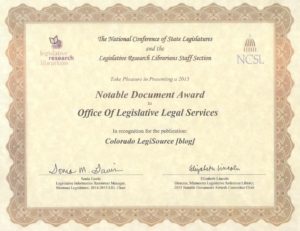
    We have also achieved some recognition along the way. In August 2015, the Colorado LegiSource received an NCSL Notable Documents Award. The Legislative Research Librarians staff section presents these awards annually to recognize excellence in documents that explore topics of interest to legislators and staff and present substantive material in an outstanding format. Also in 2015, the LegiSource article on “Educator Effectiveness and Senate Bill 10-191” was cited in an article on employment law issues published in the October edition of the Colorado Lawyer, a Colorado Bar Association publication.

    That first day we were anxious to get started. We posted three articles: “The Director’s Welcome,” by Dan Cartin; “The Legislature’s Role in the Review of Administrative Rules,” by Chuck Brackney; and “Bill Requests – Making and keeping the five allowed by rule,” by Patti Dahlberg.

    Our top five most viewed articles present an interesting mix.

    The most popular article in the last five years – with 14,893 views – is “Does Colorado Have a ‘Stand Your Ground’ Law?” In this article, Richard Sweetman explained that Colorado does not actually have a “stand your ground law” but it does have a “make my day law.” The difference? Both allow a person to use deadly force to protect himself or herself in certain situations, but Colorado’s law is generally limited to protecting against home invasions and does not include some of the presumptions that are common in “stand your ground” laws. You should read the article.

    The top five list also includes:

    When Can a Local Government Override State Law? Home Rule Cities in Colorado,” also by Richard Sweetman, in second place with 7,283 views;

    A New Look for the Colorado Revised Statutes On-Line,” by Revisor of Statutes Jennifer Gilroy, in third place with 1,676 views;

    What is the difference between the session laws and the statutes?“, posted in “Ask OLLS”, in fourth place with 1,331 views; and

    Powers, Duties, and Functions of Executive Branch Agencies (Type 1, type 2, and type 3 transfers),” by Rebecca Hausmann, rounding out the top five with 1,243 views.

    In the first article we published, Dan Cartin, director of the OLLS, described the LegiSource’s purposes as both informational and educational, applying the experience and expertise of the OLLS staff to help legislators and the public understand the issues in many areas, including:

    To this list, we’ve added fun and informative articles about the history of Colorado’s state government and of the state capitol.

    birthday cakeWe hope we’ve lived up to our purpose in the last five years; we hope that our readers have gained as much knowledge, understanding, and enjoyment in the reading as we have in the writing.

    Happy Birthday, Colorado LegiSource – here’s to the next five years!

  • NCSL Report: States Need World-class Education Systems to Compete Globally

    by Julie Pelegrin

    Based on the most recent results from the Program for International Student Assessment (PISA), the United States ranks 24th in reading scores, 36th in math scores, and 28th in science scores out of 65 participating countries. The PISA is an international comparative test that 15-year-old students take to demonstrate their knowledge in math, reading, and science. The Organisation for Economic Cooperation and Development (OECD) administers the PISA every four years to a sample of 15-year-old students in each participating country.

    The OECD also administers the Survey of Adult Skills as part of its Programme for the International Assessment of Adult Competencies (PIAAC). This instrument assesses persons from 16 to 65 years of age in numeracy, literacy, and problem-solving. The most recent survey involved 33 countries. Persons in the workforce from teens to early 30s – the millennials – in the United States scored in last place or tied for last place in numeracy and problem-solving. They scored third from last (ahead of only Spain and Italy) in reading.

    Scoring in the middle to low end of the global pack is more than just a blow to our American egos. According to the report, with this level of performance in reading, math, and science, the United States “will struggle to compete economically against even developing nations, and our children will struggle to find jobs in the global economy.”

    Based on the level of concern generated by a presentation on the 2012 PISA results, the National Conference of State Legislatures (NCSL) formed a study group to look at the educational systems in the top-performing countries. The study group’s goal was to identify the common design elements in world-class education systems. For the last two years, 28 veteran legislators and legislative staff, with the assistance of NCSL staff and other national and international education experts, have studied the education systems in ten of the top-performing provinces and countries: Alberta and Ontario, Canada; Hong Kong and Shanghai, China; Estonia; Finland; Japan; Poland; Singapore; and Taiwan.

    Last week at the NCSL 2016 Legislative Summit, the study group released its report: “No Time to Lose – How to Build a World-Class Education System State by State.”

    As is obvious in the title, the report has a clear sense of urgency. The executive summary starts with the bad news: Most state education systems are falling behind other countries’ educational achievement and failing to make progress on the United States’ National Assessment of Educational Progress. But it also gives the good news: There are common elements in the educational systems of high-performing countries that states can adapt and adopt for their own systems.

    The report identifies these common elements:

    1. Children come to school ready to learn, and struggling students receive extra support so that all have the opportunity to achieve high standards.
    2. A world-class teaching profession supports a world-class instructional system in which every student has access to highly effective teachers and is expected to succeed.
    3. A highly effective, intellectually rigorous system of career and technical education is available to students who prefer an applied education.
    4. Individual education system reforms are connected and aligned as parts of a clearly planned and carefully designed comprehensive system.

    The report then sets out steps that a state can immediately take to further improve and develop its education system:

    • Build an inclusive team and set priorities
    • Study and learn from top-performing countries and states
    • Create a shared statewide vision for public education
    • Benchmark the state’s education policies against those of high-performing countries and states
    • Get started on changes to one piece of the system
    • Work through the “messiness” of the process of designing system-wide reform
    • Invest the time that it will take to implement system-wide reform

    In looking at the high-performing countries, the study group recognized that most had developed a plan for public education and had implemented the plan over the course of 10 to 20 years. The group also noted that the high-performing countries did not adopt “silver bullet” strategies. Their plans for their public education systems were integrated, each element coordinated with and supporting the other elements.

    The report addresses some of the objections that are typically raised in comparing the education systems in the United States with those of other countries. One of the main criticisms is the assertion that the United States is more diverse than other countries and therefore faces challenges that other countries do not. But both Europe and Asia have experienced increases in immigration in the past several decades, and some of these countries have overcome the educational challenges that stem from a student population with multiple ethnicities, languages, and religions. And the proportion of Canadian students who were born outside Canada is actually greater than the proportion of U.S. students born outside the U.S.

    The report recognizes that each state is responsible for the quality of its educational system. And while each system may include the elements identified in the report, each state must modify and adapt each element to fit the uniqueness of the state’s educational system and needs.

    Finally, the report concludes:

    If we assemble the best minds in policy and practice, implement what we know works, and commit ourselves to the time, effort, and resources needed to make monumental changes, we can once again be among the best education systems in the world. If [the high-performing countries] can do it, so can we. But there’s no time to lose.
  • Columbia Beckons from the Pediment, But How Did She Get There? Exploring Colorado Capitol Architecture

    by Darren Thornberry

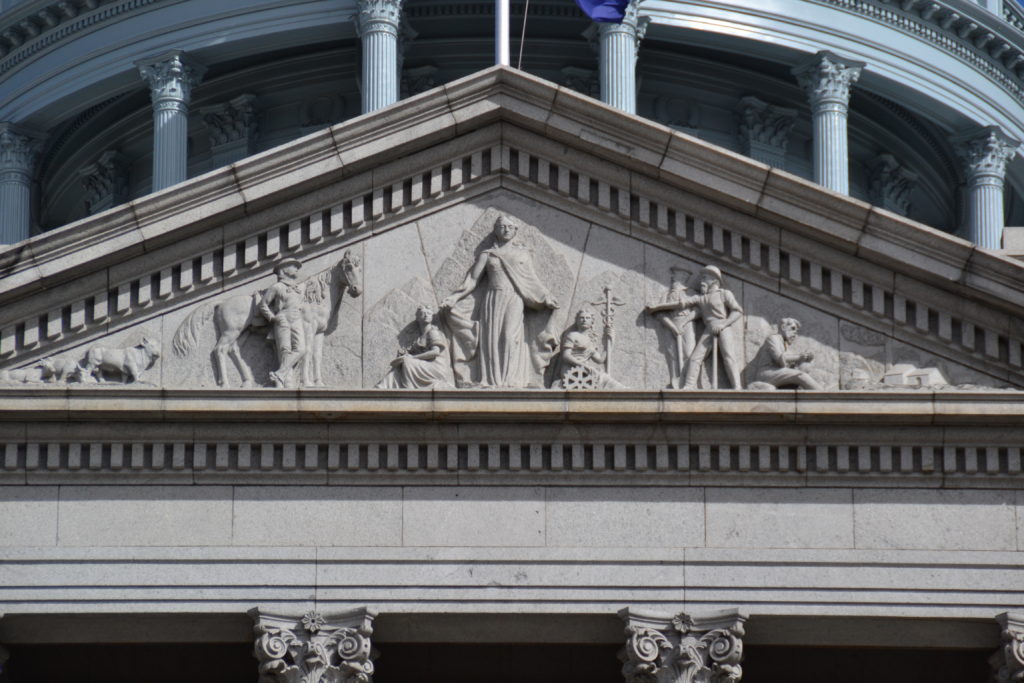
    Our state capitol is bursting with wonderful architectural nuance, and some of it is not readily apparent as one wanders the halls or the grounds. In fact, I discovered the pediment statuary above the House chamber windows, on the building’s west side, completely by accident. I was standing out there in a crowd of people, waiting for a fancy jet fly-by that was due to happen, and it just caught my eye. It’s fascinating to me how much detail is there, despite the sculptor’s understanding that very few people would ever have a clear view of it. Squinting to see the shapes and forms, I wondered what they represented.

    pedimentBPhoto courtesy of Dr. Derek Everett

    Dr. Derek Everett, former capitol tour guide and author of “The Colorado State Capitol: History, Politics, Preservation,” provided the following information via email about the pediment and the accompanying photo.

    “The pediment statuary was originally designed, as with every other element of the building from floor plans to banister posts, by architect Elijah E. Myers, who’d already won commissions for the capitols in Michigan and Texas. He produced an extensive, complicated description for his vision of an appropriate collection of statuary reflecting Colorado’s experience to the Board of Capitol Managers (BoCM), the body responsible for erecting the building. Here’s his vision from an undated letter, but likely written between 1886-88:


    ‘On the extreme right of the sketch is represented the prairie schooner drawn by oxen, representing emigrants coming to the new Territory, while in the roadway partly concealed behind the rocks is the skulking indians [sic] evidently bent on his deadly intent to prevent the advance of civilization. As the emigrants proceeds [sic] on their way he meets the happy greetings of plenty with the outstretched cornucopia. She conveys to him that here is a new home that by his industry and skill that the land will produce for him and his family his horses and cattle abundance, and in obedience to the law greets him with a hearty welcome to the settlement. The next figure is a representation of a statue recording the law of the people, representing legislation, with the open tablet in her hands conveys to him the rights and priviledges [sic] under the law he has granted to him in the protection of himself his family and his property. The centre [sic] figure represents Justice the right hand resting on the book of law, at the left of this statue is the globe, representing the universality of law and benefits of civilization and law affords, the protection of property. On the left of the centre [sic] figure is represented the Mechanical arts. And still further to the left is a representation of the happy home.’


    As you can imagine, the cost and complication of creating something so intricate, especially since it would be so crowded and small up in the pediment that few people would be able to appreciate it, dissuaded the BoCM from carrying it out. By 1889, Myers had left the project anyway, and the board made their own call. In September 1890, a few months after the cornerstone ceremony and at a point where little more than the first floor granite walls and the sandstone rotunda core were in place, the BoCM viewed a plaster model of the pioneer family pediment statuary based upon Myers’ work. They revised and simplified it dramatically, and worked with California sculptor Ludwig Oehlmann to make a new plaster model and ultimately carve the sculpture they approved. It consists of a figure representing Columbia (an allegorical stand-in for the United States popular at the time) flanked by figures representing agriculture and mining/commerce. The simplified work was carved early in the 1890s and installed no later than 1892, by which time the granite walls of the building were complete.”


    What’s your favorite thing about the capitol building? Let us know on Twitter @LegiSource.

  • Statutory Revision Committee: A Legislative Revival

    by Kate Meyer

    The ’80s are, indeed, making a comeback.  While popular culture sees the resurgence of shoulder pads, My Little Pony, and Ghostbusters, the state legislature is experiencing its own blast from the past. House Bill 16-1077, recently signed into law by Governor Hickenlooper, revives the Statutory Revision Committee (SRC), an entity repealed in 1985.

    Creation and composition. The SRC, created in part 9 of article 3 of title 2, Colorado Revised Statutes, consists of 10 members: Eight legislators (two each appointed by the Speaker and the Minority Leader of the House of Representatives and by the President and the Minority Leader of the Senate); and two nonvoting attorneys 2016 SRC Membershipappointed by the Committee on Legal Services. The legislators currently appointed to the SRC are Representatives Moreno (temporary chair), Arndt, Dore, and Thurlow and Senators Holbert, Kerr, Steadman, and Tate. The Committee on Legal Services is expected to appoint the nonvoting members at its September 29, 2016, meeting.

    Duties. A year-round committee, the SRC is staffed by the Office of Legislative Legal Services. The SRC’s statutory duties are to:

    • Make an ongoing examination of the statutes of the state and current judicial decisions to discover defects and anachronisms in the statutes and recommend needed reforms;
    • Receive, solicit, and consider proposed changes in the statutes recommended by the American Law Institute, any bar association, or other learned bodies;
    • Receive, solicit, and consider suggestions from justices, judges, legislators, and other public officials and lawyers and from the public generally as to defects and anachronisms in the statutes;
    • Recommend legislation annually to effect such changes in the statutes as it deems necessary to modify or eliminate antiquated, redundant, or contradictory rules of law and to bring the statutes of this state into harmony with modern conditions; and
    • Report its findings and recommendations on or before November 15 of each year to the legislature.

    Legislation and limitations. The SRC may recommend bills by a majority vote. Although there is no limit on the number of bills that the SRC may propose annually, and such bills do not count against an SRC sponsor’s 5-bill limit, there are a few constraints on the legislation the committee may introduce. First, the SRC may not consider matters that are currently pending or appealable before any court. And the SRC must “propose legislation only to streamline, reduce, or repeal provisions of the Colorado Revised Statutes” and “endeavor to recommend legislation that cumulatively has, in each legislative session, no net increase in the number of laws or pages of laws.” This directive did not exist in the statutes that created the former SRC.

    While the SRC must adhere to these mandates, it is not limited to any particular substantive areas of law when considering legislation. The former SRC typically examined a wide array of topics for potential legislation. In 1985, for example, the SRC received 80 bill ideas from various sources and ultimately sponsored 12 bills. The bills’ subjects ranged from curing internal inconsistencies within the “Uniform Commercial Code” to restoring the ability of judicial clerks to collect a certain filing fee (which authority had been inadvertently deleted from the Colorado Revised Statutes) to removing mention of gender in certain correctional facility names to reflect that the facilities were not limited to any particular gender.

    First meeting. The SRC is conducting its first public meeting, at 9 a.m. on Wednesday, August 17, 2016, in House Committee Room 0112 at the state Capitol. When available, the agenda and minutes, for this and future meetings, will be posted here and the live and archived broadcast of meetings can be accessed here.

    Submissions and suggestions? Finally, to fulfill its statutory charges, the SRC will rely on its ongoing dialogue with the legal community and the public. To notify the SRC of possible defects or anachronisms in the law or possible antiquated, redundant, or contradictory law, please send an email to SRC staff at StatutoryRevision.ga@coleg.gov.

  • What Do White Teeth Have to Do with Federal Preemption?

    by Jery Payne

    In the 1990s, dentists in North Carolina started whitening teeth. And they made lots of money. But in the early 2000s, other people started whitening teeth. And they charged a lot less.

    North Carolina’s dentists began to complain about the competition. Soon the board of dentistry got involved. Eight out of ten members of the board of dentistry were dentists. And although the statute did not specifically say that whitening teeth is dentistry, the board decided to it would go “forth to do battle.” The board issued over 40 cease-and-desist letters. These letters warned that whitening teeth is the practice of dentistry and practicing dentistry without a license is a crime.

    winking toothThe letters worked. In North Carolina, soon only dentists were whitening teeth.

    But there was a problem: The Federal Sherman Act prohibits “every contract, combination, or conspiracy in restraint of trade”. It is well-settled law that trade is restrained by forcing your competitors out of the market so you can charge more. And the members of the board had agreed to force these folks out of the market, so there was a combination or conspiracy. The board’s letters appear to violate the act.

    Now I bet that some of you are thinking, “So what?” The board acted under the color of law. After all, don’t all laws regulating professions restrain trade? If nothing else, these laws stop unqualified people from competing with qualified people. Do all the laws that regulate professions violate this act? What gives?

    Yes, technically, laws that regulate professions restrain trade. And although the act of passing a state law doesn’t violate the Sherman Act, the actions of people are a different matter. People can’t violate federal law merely because the state has a law allowing it. So there is a potential conflict between the actions taken under state programs and federal law. And this, as you can imagine, is a bit of a problem for business regulation in a federal system of government. So the U.S. Supreme Court has created the state-action exception.

    If a regulatory program falls under the state-action exception, then the program and any incidental restraint of trade by the program do not violate the Sherman Act. But this raises the question of how “state action” is defined. To the degree that a regulatory program looks like a legitimate exercise of state power to protect the common good, the courts will defer to the state. But if it looks like the state has merely blessed a restraint in trade, the courts won’t defer to the state.

    An example can be found in California Retail Liquor Dealers Assn. v. Midcal Aluminum, Inc. In this case, California passed a law creating a framework for its wine companies to fix prices. The United States Supreme Court ruled that a state can’t pass a law excepting its citizens from federal law.

    In this case, the court set down a two-part test to decide whether a “state action” qualifies as an exception to the Sherman Act: “[F]irst, the State has articulated a clear policy to allow the anticompetitive conduct, and second, the State provides active supervision of the anticompetitive conduct.”

    The heart of this test is two basic questions: The first asks who set the policy. Is the policy the act of a sovereign? Or is it the act of people who would be tempted to restrain trade? The second asks who enforces the policy. Is the policy enforced by state officials? Or is it enforced by people who would be tempted to restrain trade?

    The court explained: “Limits on state-action immunity are most essential when the State seeks to delegate its regulatory power to active market participants, for established ethical standards may blend with private anticompetitive motives in a way difficult even for market participants to discern.”

    Returning to North Carolina, a statute did not actually declare whitening teeth to be the practice of dentistry. And it was pretty convenient that eight out of the ten members of the board of dentistry are dentists. So when the U.S. Supreme Court decided this issue, in North Carolina Board of Dental Examiners v. Federal Trade Commission, what do you think was the outcome?

    You would be right if you said that the cease-and-desist letters violated the Sherman Act.

    Although the reasoning of the decision follows the reasoning of prior decisions, this is the first time the Court has ruled that the actions of a state regulatory board violate the Sherman Act. Boards that include market participants are common in professional regulatory programs. Some states are concerned that many of their boards are affected by the ruling.

    If so, a state board should be careful to stay within the bounds of its statutory authority. And a state should make sure that each board with market participants is actively supervised by a governmental agency. The Court didn’t give very specific advice about what kind of supervision is needed. It did say that supervision should ensure that “a private party’s anticompetitive conduct promotes state policy, rather than merely the party’s individual interests.”

    Although the decision has caused some concern for the states, one point to remember is that the Court didn’t strike down the whole program; it merely stopped the dental board from issuing cease-and-desist letters. Under the ruling, the board is still regulating dentistry.

  • When Does a Legislator have Standing to Sue?

    By Sharon Eubanks

    In the last two LegiSource articles, we’ve talked about what a citizen must do to show that he or she has standing to sue someone to enforce a statute or to sue the government to enforce a statute or the constitution. What if the person who wants to sue is a legislator? Does a legislator have standing to sue in his or her capacity as a legislator to challenge language in the constitution? There is a case in federal court right now that is trying to answer that question.

    In May of 2011, a group of legislators, school board members, and other taxpayers filed a lawsuit in federal court claiming that the Taxpayer’s Bill of Rights (TABOR) violates several clauses of the United States Constitution – including the clause that guarantees to every state a republican form of government – as well as certain federal statutes. This group asserts that, by removing the taxing power of the Colorado General Assembly, TABOR renders the General Assembly unable to effectively fulfill its legislative obligations in a representative democracy and a republican form of government. In July of 2015, we posted an article that more fully explains the Kerr v. Hickenlooper lawsuit.

    Although Kerr v. Hickenlooper is over five years old, a court has yet to consider any of the claims raised in the case. The case has been stuck on the issue of whether the legislators have standing to bring the lawsuit. As you may recall, to have standing to sue, a person must demonstrate that she has been harmed by the person she’s suing and that she has a right to sue for that harm. In this case, the legislators must show that TABOR has harmed an interest that they have the authority to protect. If they can’t show that, the lawsuit will be dismissed.

    In July of 2012, the federal district court held that the legislators did have standing to bring the lawsuit, and the Tenth Circuit Court of Appeals agreed. The matter then was appealed to the United States Supreme Court.

    About a year ago, the Supreme Court issued a grant, vacate, and remand (GVR) order in the case. The order basically sent the case back to the Tenth Circuit Court of Appeals to reconsider whether the legislators have standing based on the Supreme Court’s decision in a case called Arizona State Legislature v. Arizona Independent Redistricting Commission et al, 576 U.S. ___ (2015). The Arizona decision considered whether the Arizona State Legislature had standing to challenge the constitutionality of a redistricting commission that was created by a ballot initiative to draw congressional districts. In that case, the Court held that the Legislature did have standing because the Legislature, as an institution, had an interest in redrawing the congressional districts for Arizona that the legislature could sue to protect. In this case, the Legislature, as an institution, brought the suit as the plaintiff.

    On June 3, 2016, the Tenth Circuit Court of Appeals ruled that the legislators in Kerr v. Hickenlooper do not have standing to bring the lawsuit.

    Based on the Arizona decision, the court of appeals determined that the first question in deciding whether a group of legislators has standing is to decide whether the legislators are claiming an institutional injury. This is an injury to the power of the legislature as a whole rather than an injury to an individual legislator’s interest. The court of appeals concluded that individual legislators do not have standing if they are alleging an institutional injury and not an individual injury.

    The court of appeals then looked to see whether the legislators in Kerr v. Hickenlooper alleged injury to an institutional interest. The court found that they did because the legislators’ claim is based on the loss of legislative power to raise taxes, which impacts all members of the General Assembly equally.

    The court of appeals then asked whether the legislators who are suing have authority to represent the Colorado General Assembly as an institution and found that they do not. The legislators are pursuing their claims in their individual capacities and not as representatives of the General Assembly. By contrast, in Arizona, the Arizona Legislature as an institution filed the suit. Since they are not authorized to represent the General Assembly or either the House of Representatives or the Senate, the court of appeals determined that the legislators are not institutional plaintiffs. And that means they do not have authority to sue for an injury to an institutional interest.

    As a result, the court concluded that it must reverse its previous decision and found that the individual legislators in Kerr v. Hickenlooper do not have standing because they are trying to protect an institutional interest but they do not have authority to represent the entire institution. The court then sent the case back to the federal district court.

    The group of legislators, school board members, and other taxpayers filed a petition for rehearing with the Tenth Circuit Court of Appeals on July 8, asking the court to reconsider its decision based on additional arguments made by the group. The court denied the petition. At this point, it appears the school board members and other taxpayers who brought the suit will now try to establish standing to sue on remand to the federal district court. Stay tuned for further updates.

  • Suing the Government: Taxpayer Standing

    by Julie Pelegrin

    In addition to telling people what they can and cannot do, the statutes may tell a state agency or a local government what it must do. If the state agency, or a local government, or a government official does not comply with the statute, can a citizen sue the government or the official?

    Only if the citizen has standing to sue.

    As discussed in last week’s article, to bring a civil suit, a person must be able to demonstrate actual injury to a legally protected interest. If a citizen thinks the state or a local government has failed to follow the statutes or the constitution, the citizen must demonstrate that the statute or constitutional provision creates a legally protected interest for the citizen and that the citizen is harmed by the state’s or the local government’s violation of that interest.

    In these types of cases, the most important question is whether the citizen is suing to enforce a statute or a constitutional provision.

    If the citizen is suing to enforce a statute, the test for standing is the same as when the citizen is suing another person. As you may recall, to sue Mr. Adams, Mr. Jefferson had to show actual injury to a legally protected interest (in our example last week, he got sick eating Mr. Adams’ eggs). If the statute did not say Mr. Jefferson had a private right of action, Mr. Jefferson had to meet a three-part test: He had to show that he was within the class of people who were intended to benefit from the  statute (the general public, who should be warned that Mr. Adams’ eggs could be contaminated); that the legislature intended to create a private right of action (in our case, the act requiring notice of possible contamination didn’t specifically grant a private right of action); and that an implied right of action was consistent with the purposes of the statute. The same test would apply if Mr. Jefferson wanted to sue the Commissioner of Agriculture for failing to inspect Mr. Adams’ farm.

    A recent Colorado Supreme Court case, Taxpayers for Public Education v. Douglas County School District, considers whether a citizen has standing to enforce a statute. In this case, parents living in the Douglas County School District claimed that the school district violated the “Public School Finance Act of 1994” by allowing parents to use the school district’s public money to pay for private school. The Court held, however, that the parents did not have standing to sue to enforce the Act. The Act does not specify how it is enforced, so the Court applied the test explained above.

    The Court found that the parents were within the class of persons that the Act is supposed to benefit, but the Court did not find that the General Assembly intended to create a private right of action. Also, because the Act authorizes the State Board of Education to adopt rules, the Court concluded that the General Assembly actually decided not to create a private right of action because the State Board can enforce the Act through rules. Finally, the Court held that a private right of action is not consistent with the purpose of the Act, which is to fund public education. The Court said that, to accomplish this purpose, the State Board and the Department of Education need flexibility to calculate, administer, and distribute the funding under the Act. Allowing citizens to sue every time they disagree with an agency’s decisions would impede the Department’s ability to administer the Act.

    The analysis would be different if the parents had sued to enforce a constitutional provision. When it comes to enforcing the state constitution, the courts in Colorado recognize the doctrine of “taxpayer standing.” This is a broader doctrine of standing, which essentially says that a taxpayer is injured whenever the government – state or local – fails to comply with the state constitution. The Court assumes there is always a private right of action to enforce the constitution, and it does not apply the test explained above.

    For example, the Colorado Supreme Court held that a real estate broker, a paint company, and an oil company had taxpayer standing to challenge the state’s transfer of money from cash funds to the general fund and its use of that money for general government purposes. The plaintiffs alleged that these actions violated the provisions of section 20 of article X of the state constitution (TABOR). The Court held that every taxpayer has a legally protected interest in ensuring that the government complies with the constitution. The government’s alleged violation of the constitution is an injury to the taxpayer’s interest, so the plaintiffs had standing.

    Similarly, when Mr. Conrad sued the City and County of Denver for placing a nativity scene on the steps of the city and county building at Christmas, he claimed a violation of section 4 of article II of the state constitution, which prohibits governmental preference of a religion and prohibits the government from forcing a citizen to support a particular religion. The Court held that Mr. Conrad had standing because, as a taxpayer, he was directly injured by Denver’s alleged failure to comply with the constitution.

    So why does a court assume a taxpayer is harmed by a violation of the constitution and can always sue the government, but if a taxpayer is harmed by the government’s violation of a statute, she can sue the government only if the statute says she can? Don’t citizens have a right to require the government to comply with the law, whether it’s statutory or constitutional?

    It’s a separation of powers issue. The General Assembly controls the language of the statute, and the General Assembly’s intent controls the application of the statute. If the statute doesn’t give a citizen a private right of action to enforce the statute, it’s because the General Assembly did not intend to give it. And the courts, in interpreting a statute, are bound by the General Assembly’s intent.

    The constitution, however, is approved by the people, not the General Assembly, and the General Assembly does not control how it is applied. The court will therefore use broader latitude in allowing citizens the opportunity to sue for alleged violations of their constitution.

  • Who Enforces the Statutes?

    by Julie Pelegrin

    Statutes often tell people, businesses, and organizations what they must or cannot do. But many statutes do not include an enforcement mechanism. Criminal statutes carry a penalty for a violation, and some civil statutes include a fine structure for violations. But in many cases, the law doesn’t explain what happens if someone does not follow the law. So the question arises, “Can an individual sue someone who violates this law?”

    The answer lies in the issue of standing. If Mr. Jefferson wants to sue Mr. Adams – for anything – he must have standing to sue, which means he must have actually suffered an injury to a legally protected interest. In plain English: Mr. Jefferson must show that he suffered an injury that he is entitled to sue Mr. Adams for.

    Standing Text Box 1

    If Mr. Adams fails to comply with a statute and this results in an injury to Mr. Jefferson, then Mr. Jefferson may have standing to enforce the statute by suing Mr. Adams and forcing him to comply with the statute.

    Proving standing is a preliminary requirement for Mr. Jefferson’s lawsuit. If he cannot prove actual injury to an interest that the statute says he can protect, the court will dismiss the case without considering whether Mr. Adams actually did or did not injure Mr. Jefferson. This is necessary to protect the separation of powers. When the court exercises its authority, it often means the court is disapproving or annulling an action taken by the legislative or executive branch. So the court must be careful to take action only when there is a specific person making a claim based on a direct harm or interest that the person is entitled to protect.

    For Mr. Jefferson to enforce a statute, he must demonstrate that the statute authorizes him to sue Mr. Adams to protect an interest created in the statute. Some statutes can be enforced by private citizens and some cannot. It depends on whether the statute creates or implies a private right of action — a lawsuit filed by a person — to enforce the statute.

    Standing Text Box 2

    Some statutes specify that an executive branch agency will enforce the requirements of a statute, and a private person cannot enforce the statute. For example, only the Department of Labor and Employment can enforce the statute that requires a public works project funded by public money to use Colorado labor. And an individual cannot sue a hospital to enforce the statute that requires a hospital to provide information and training for a designated caregiver.

    Other statutes specifically create a private right of action for enforcement. For example, a citizen can file a complaint with the Secretary of State alleging a violation of the voter registration statutes, and the Secretary of State and the Attorney General may act on the complaint. But if the Attorney General does not sue on the complaint within 120 days, the citizen may file a civil action.

    But in most cases, the statute is silent as to whether an individual can enforce the statute. If the statute that Mr. Adams violated doesn’t say Mr. Jefferson can sue to enforce the statute, how will the court decide whether Mr. Jefferson really has a legally protected interest in the statute?

    The court will ask three questions:

    1. Is Mr. Jefferson within the group of persons who are intended to benefit from the statute?
    2. Did the legislature intend to create, even though it’s only implicit, a private right of action?
    3. Is an implied private right of action consistent with the purposes of the legislative scheme?

    Let’s suppose that Mr. Adams is a farmer who sells milk, eggs, and butter. The Warnings Against Contaminated Dairy (WACD) Act requires a farmer who sells milk, eggs, or butter to warn the buyer that the products could be contaminated. The WACD act is silent as to who enforces this requirement. Mr. Adams sells milk, eggs, and butter to Mr. Jefferson without mentioning possible contamination. After eating breakfast the next morning, Mr. Jefferson suffers a bad case of food poisoning.

    As we stated earlier, Mr. Jefferson wants to sue Mr. Adams. The court will first ask, “Is there injury?” Clearly. Next, “Is there a legally protected interest?” Well…the WACD act requires Mr. Adams to issue a warning, but it doesn’t specifically say that Mr. Jefferson can sue him if he doesn’t. So, the court will consider the three questions.

    Arguably, the act is intended to benefit persons who buy milk, eggs, and butter. As a buyer, Mr. Jefferson should be benefited by the act. The legislature could have intended to create a private right of action because the likelihood that a buyer would sic his lawyers on the seller every time the seller failed to give the warning is a strong incentive for the seller to comply with the act. Finally, assuming the act is intended to protect the public from accidentally buying contaminated food, allowing someone to sue to enforce the act is completely consistent with the purpose of the act.

    So Mr. Jefferson probably has standing to sue Mr. Adams to enforce the WACD act. That doesn’t mean Mr. Jefferson will win the suit; he may have gotten sick from the oysters he ate at the tavern the night before. But he has standing to bring the suit.

    What if a person wants to bring a suit to require the state or a local government or a public official to follow a statute? Or to comply with the constitution?

    We’ll answer those questions in next week’s post.