Month: December 2016

  • Statutory Revision Committee to Introduce 15 Bills

    by Kate Meyer

    In August, Legisource told you about the Statutory Revision Committee (SRC), a recently rebooted entity that examines the Colorado Revised Statutes to develop legislation that will modify or eliminate antiquated, redundant, or contradictory rules of law and to bring the statutes of this state into harmony with modern conditions. Since that article was published, the SRC has been hard at work, meeting three times and ultimately approving 15 bills for introduction in the 2017 legislative session.

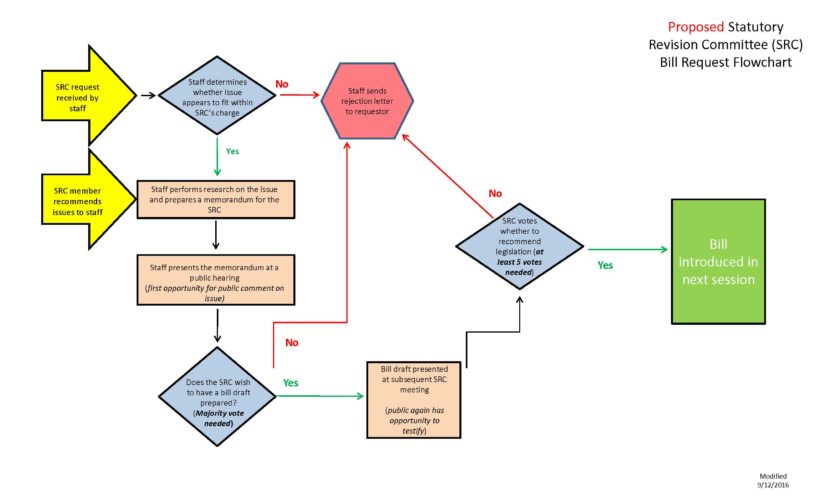
    Committee process. Bill ideas can originate from any number of sources: Committee members or other legislators; legislative staff; jurists, attorneys, and other legal professionals; executive agencies; lobbyists; the public; etc. In its first meeting, the SRC adopted the following basic process for considering potential bills:

    final-src-request-flowchart

    (Click image to enlarge)

    The process starts when the SRC’s staff from the Office of Legislative Legal Services receives or creates a bill proposal and initially decides whether the proposal fits within the committee’s charge. Persons may submit bill proposals identifying possible defects or anachronisms in the law or possible antiquated, redundant, or contradictory laws by contacting a committee member or sending an e-mail to SRC staff at StatutoryRevision.ga@coleg.gov

    If staff finds that a bill proposal fits within the committee’s charge, they schedule it for committee discussion. The SRC’s process affords interested persons two opportunities to comment publicly on potential legislation:

    • First the public may testify at an initial meeting when the SRC receives a memorandum describing the genesis, scope, and intent of the proposed bill. The SRC then votes whether to have a draft bill prepared.
    • Second, for proposals for which the staff writes drafts, the public may testify at a subsequent meeting when the SRC votes whether to recommend bills for introduction. An affirmative vote from at least five members of the SRC is required for a bill to be introduced, ensuring that every bill has bipartisan support.

    The staff includes memoranda and bill drafts with the SRC agendas, which are posted on the SRC’s website one week in advance of a meeting date. And of course, the chance to weigh in on bills doesn’t end with the committee. Each introduced bill is debated and vetted through normal how-a-bill-becomes-a-law legislative procedures.

    Bills approved in 2016. Every bill recommended for introduction from the 2016 SRC proceedings received unanimous committee approval. The breadth of bill subjects typifies the SRC’s ability to consider a wide range of topics, including:

    • Repealing obsolete congressional and state legislative district laws;
    • Aligning statutory reporting requirements with section 24-1-136 (11), C.R.S.;
    • Updating certain outdated references to standards promulgated by the American National Standards Institute;
    • Removing “ghost statutes” inadvertently left on the books in 2016; and
    • Implementing recommendations received from the Department of Education and the Office of the State Auditor to modernize and correct various statutes related to those entities.

    To read the full text of the approved bills, please see the SRC’s 2016 Annual Report and the upcoming supplement on the SRC’s website.

    Looking ahead. Although the SRC expects to conduct the majority of its work during legislative interims, the committee will meet early in the 2017 session (date TBD) to select a new chairperson and vice-chairperson; to continue analyzing bill drafts that reconcile reporting requirements with section 24-1-136 (11), C.R.S.; and to consider a fix to the “Uniform Trust Decanting Act.”

    Among the topics the SRC will discuss in the 2017 interim is a comprehensive bill to modernize, without substantively changing, the transfer terminology used in the Colorado Revised Statutes relating to the organization of state governmental agencies under the “Administrative Organization Act of 1968.”

    Additional information. To learn more about the SRC, please contact a committee member or send an e-mail to SRC staff at StatutoryRevision.ga@coleg.gov. You may also check out a brief video detailing the SRC posted on the Colorado Channel’s website.

  • United States Supreme Court Effectively Upholds Colorado Internet Sales Tax Law

    by Esther van Mourik

    When you buy a present for your friend at a store in Colorado, the retailer collects the sales tax on that purchase and remits that amount to the Colorado Department of Revenue. If you buy the same item online from a retailer that does not have a brick and mortar store in the state, you are personally responsible for paying the same amount of tax (now called a use tax instead of a sales tax) to the Department of Revenue. Generally speaking this is because of the United States Supreme Court’s interpretation of the United States Constitution: To protect interstate commerce, a state can’t require retailers that don’t have a brick and mortar presence in the state to collect sales tax on its behalf. Instead, the responsibility for getting the tax money to the state falls to individual purchasers.

    Because many people aren’t aware of the responsibility to pay the use tax, Colorado is missing out on a lot of tax revenue. And because the economy is rapidly changing so that more people are buying presents (and other “tangible personal property”) online from retailers without brick and mortar stores in the state, the lost revenue effect is even greater. Estimates indicate that the state’s annual lost revenue due to online sales exceeds $150 million.

    In 2010, the General Assembly passed House Bill 10-1193, the so-called “Amazon law,” a reporting requirements statute that compels retailers who are not collecting sales tax to report a number of things to both the Department of Revenue and their Colorado customers. The law was immediately challenged in court and has been in litigation for the past six years. A state court also enjoined the enforcement of the new law while it was being litigated in federal court.

    On February 22, 2016, the 10th Circuit Court of Appeals issued an opinion upholding the constitutionality of House Bill 10-1193. On Friday, December 9, 2016, the United States Supreme Court declined to hear an appeal of the Court of Appeals decision. By declining to hear the appeal, the Supreme Court effectively affirmed the constitutionality of the law. This means that the Department of Revenue can start enforcing the requirements in House Bill 10-1193. Many news agencies have reported on this decision. You can read some of those articles here, here, here, and here.

    House Bill 10-1193 requires retailers who do not collect Colorado sales tax to do three things:

    1. Notify Colorado purchasers that sales or use tax is due on certain purchases made from the retailer and that Colorado requires the purchaser to file a sales or use tax return;
    2. Send notice to all Colorado purchasers by January 31 of each year showing certain information that the Department of Revenue will require by rule, including the total amount the purchaser paid for Colorado purchases in the previous calendar year. The notice must include, if available, the purchase dates, the purchase amounts, and the category of each purchase, including, if the retailer knows, whether the purchase is exempt or not exempt from taxation. This notice must also state that Colorado requires the purchaser to file a sales or use tax return and pay the sales or use taxes on certain Colorado purchases that the purchaser made from the retailer.
    3. File an annual statement with the Department of Revenue by March 1 of each year for each Colorado purchaser that shows the total amount the purchaser paid for Colorado purchases in the last calendar year.

    If the retailers who do not collect Colorado sales tax fail to do the three things listed above, those retailers are subject to fines for each failure. The Department of Revenue is trying to determine when the law will take effect. Hampering that decision is the fact that the state court injunction is still in place and must be vacated before the Department of Revenue can enforce the law. Many articles in the media that discussed House Bill 10-1193 appeared to argue that the law was intended to compel retailers who do not collect sales tax to voluntarily start collecting. While that intention is not clearly established in the law, it remains to be seen how retailers will respond when the law takes effect.

    There are efforts by other states, particularly in South Dakota, to require retailers that do not collect tax on internet sales to start collecting. Legislation of this type is a direct challenge to the United States Supreme Court’s constitutional interpretation that states cannot require out-of-state retailers to collect sales tax. So while the United States Supreme Court’s decision not to hear the Colorado case represents movement on this issue of online sales taxation, many questions remain to be answered. Stay tuned!

  • A New Citation Format for the Colorado Revised Statutes

    by Tom Morris

    While trying to read a statute to unravel its meaning, have you ever felt dismayed or sidetracked when you came across a phrase such as this: “as specified in sub-subparagraph (D) of subparagraph (III) of paragraph (g) of subsection (4) of this section”? That’s a lot of words—what is a “sub-subparagraph”, anyway?—and understanding them is made even more difficult due to the fact that they’re presented in reverse order from how most of us probably think. It’s as if, to describe how much money was being appropriated, we said “19 cents, 235 dollars, 452 thousand dollars, and 2 million dollars” instead of “2,452,235.19 dollars”. Surely, a better format for statutory references is possible.

    Well, the Office of Legislative Legal Services has decided that a better format is possible, and, in drafting bills for the 2017 regular session, we have already started using it.

    First, it’s important to understand the scope of the changes. When a statute refers to a portion of a different statute, that’s called an “external” reference, and we don’t use the format described above. Instead, if you’re in a statute other than section 24-30-122, the reference would previously have been something like “section 24-30-122 (4)(g)(III)(D), C.R.S.”. The main difference in external references going forward is that we’re dropping the “C.R.S.” (the abbreviation for “Colorado Revised Statutes”). We figure that, if you’re reading title 8, you know when you see a reference to section 24-1-104, it’s referring to a section in another title of the Colorado statutes and that we’re not straying down the freeway and into another state’s statutes.

    Second, we used to include the number of a title or article only when the reference was located in a title or article other than the one being referenced, but we would always include the part number regardless of whether the reference was in or out of that part. We will now treat titles and articles as we currently treat parts: We’ll always include the article and title number (so references to “this article” in statute now become “this article 12,” for example).

    The most significant changes we’re making relate to “internal” references. For example, if the reference is located in section 24-30-122 and the reference is to a portion of that same section, that’s an internal reference. Instead of listing the various types of C.R.S. subdivisions (sub-subparagraph, subparagraph, paragraph, and subsection) in reverse order, we’ll use a format similar to that used for external references. So if you’re in section 24-30-122, the reference will usually be “subsection (4)(g)(III)(D) of this section”.

    There are a few things to note about this new format. First, we’re no longer going to refer to sub-subparagraphs, subparagraphs, or paragraphs; every internal reference to a C.R.S. subdivision will be to a “subsection”. Second, for both external and internal references, we will no longer put a space between the parentheses—so it will be “(2)(a)” rather than “(2) (a)”. Third, if the internal reference is to the same subdivision where the internal reference is located, we will include the complete string of higher-level subdivisions in the reference. For example, we used to write “this paragraph (d)”, but now we’ll write “this subsection (3)(d)”. Finally, every internal reference to a different subdivision will end with “of this section”. We used to write “paragraph (a) of this subsection (1)”, but now we’ll write “subsection (1)(a) of this section”.

    Here’s a table that summarizes our old and new citation formats for internal references:

    Format Before 2017 Format Beginning in 2017
    this paragraph (d) this subsection (3)(d)
    this sub-subparagraph (C) this subsection (1)(e)(II)(C)
    paragraph (a) of this subsection (1) subsection (1)(a) of this section
    subparagraph (III) of paragraph (b) of this subsection (4) subsection (4)(b)(III) of this section
    sub-subparagraph (A) of subparagraph (IV) of paragraph (c) of subsection (2) of this section subsection (2)(c)(IV)(A) of this section

    Finally, we will make these changes only prospectively and only in those sections of statute that are included in bills; we will not update the citation format for the entire C.R.S. through the publications process. All new citations will follow the new format. The bill drafters, subject to the sponsors’ preferences, will update existing references in the same way that other grammatical or terminology updates to existing statutes are made.

    So there will be some inconsistency in the C.R.S. in how our statutory references are phrased for quite some time. But we’ve concluded that using a citation format that is as specific and accurate as our current system—and that uses less terminology and is more concise, easier to understand, and more internally consistent—is an easy choice. We hope that you’ll agree!