Month: May 2016

  • One Hundred Twentieth Legislative Day Brings Session to a Halt – Ready or Not

    by Julie Pelegrin

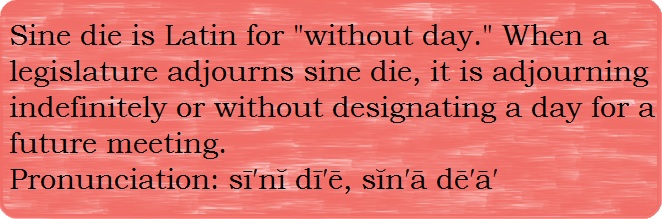
    With the advent of the 120th legislative day, the Seventieth General Assembly adjourned sine die Wednesday evening. The 2016 legislative session was busy with the introduction of 468 House bills – the most in a session in recent memory – as well as 217 Senate bills, nine concurrent resolutions, 68 joint resolutions, and five joint memorials. Of that number, they passed 387 bills, 178 of which the Governor has already signed. The Governor must act by June 10 on the remaining 209 bills that passed or they will become law without his signature. So far, the Governor has not vetoed any of the bills passed this year.

    The 2016 legislative session saw many long committee hearings (the last House Judiciary Committee meeting began on May 5 and didn’t adjourn until 4:48 a.m. on May 6) during which the legislators debated many significant issues. They considered 20 bills that addressed marijuana in some way, 94 bills on education, and 61 bills that had something to do with taxes. They passed bills to legalize rain barrels; to address the sentences for juveniles who were tried as adults and convicted of a class 1 felony; to eventually allow for the sale of liquor in grocery stores; to change the procedures for emergency 72-hour mental health holds; and to increase the transparency and security around student personally identifiable information collected by the state and by school districts.

    On top of all that, the House and the Senate adopted a balanced state budget of about $27 billion for fiscal year 2016-17, and they enacted a school finance bill that increased the total program funding for public education to a statewide average of $7,425 per student – $112 more than in fiscal year 2015-16.

    The House and the Senate managed to complete almost all of the items on their calendars, unlike past years when several bills and resolutions expired at the final gavel. Items often die on the calendar because section 7 of article V of the state constitution requires the regular legislative session to end every year no later than midnight on the 120th legislative day, regardless of whether the legislative work is completed.

    This has not always been the case. The 120-calendar-day-limit on regular legislative sessions is a relatively recent development.

    The Colorado constitution originally required the General Assembly to meet at “12 o’clock, noon” on the first Wednesday in January in 1876 and again in 1879, and then every other year “forever thereafter, and at other times when convened by the Governor.” Once convened, the legislators could stay as long as they liked. When they convened in regular legislative session every other year, they could consider bills on any topics they thought necessary or important. And there were no limits on how many bills legislators could introduce in each legislative session.

    But as we all know, nothing is forever. Things changed after about 75 years.

    At the general election in 1950, the people of Colorado passed House Concurrent Resolution 11, changing the session times for the General Assembly. Starting in 1951, the General Assembly convened the regular legislative session at 10:00 a.m. on the first Wednesday after the first Tuesday in January every year. There was still no limit on how long they could meet, but in even-numbered years legislators could only enact bills that raised revenue or made appropriations or that addressed subjects that the Governor identified in writing within the first 10 days of the session. And there were no limits on the number of bills introduced.

    In 1977, the General Assembly first limited the number of introduced bills. House Joint Resolution 1016 amended the joint rules to limit each legislator to introducing six bills during the session, not counting appropriations bills or bills that a legislator requested by December 1 and introduced by the first day of the session. A legislator could ask permission from the delayed bill committee in his or her chamber to introduce additional bills.

    In 1982, the voters first limited the length of a legislative session with the adoption of Senate Concurrent Resolution 1. This amendment limited the regular legislative sessions in even-numbered years to 140 calendar days. But the legislators could consider any topics they thought necessary or important during those 140 days; the voters removed the Governor’s power to control the legislative agenda. Legislative sessions in odd-numbered years could still continue as long as the legislators thought necessary. The legislative deadline schedule for these years contemplated at least 175-day sessions.

    In 1984, the General Assembly further limited the number of bills: Six bills during the legislative sessions in odd-numbered years and four bills during the legislative sessions in even-numbered years. A legislator could also introduce an unlimited number of appropriations bills and up to four interim committee bills, but the General Assembly eliminated the exception for pre-filed bills.

    Finally, in 1988, the voters approved another Senate Concurrent Resolution 1, requiring the General Assembly to meet every year, no later than the second Wednesday of January, and adjourn no more than 120 calendar days later. The “calendar day” requirement means that, once the regular legislative session starts, every day counts whether the General Assembly meets or not. In 1990, the General Assembly amended the joint rules to limit each legislator to five bills introduced each regular legislative session, not counting interim committee bills or bills approved by certain statutory committees.

    So far as we know now, the legislators will not convene again until Wednesday, January 11, 2017, when the members of the 71st General Assembly take office. But there’s always a chance the 70th General Assembly might reconvene during 2016. One never knows when the Governor or two-thirds of the legislators may decide to call a special legislative session

    Sine Die

    Correction: May 13, 2016
    An earlier version of this post misstated the total number of passed by the General Assembly as 385. The Correct number is 387, and accordingly, the Governor must act by June 10 on the remaining 209 bills (not 207) that passed or they will become law without his signature.

  • When Private Commerce Meets the Public Good: Impairing the Obligations of Contracts

    by Jery Payne

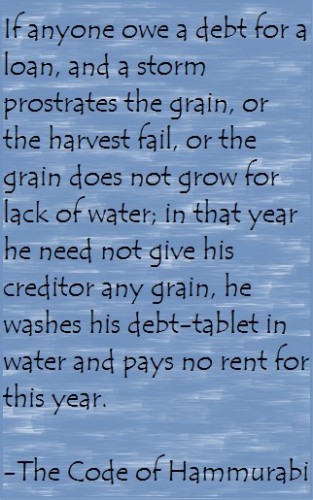
    Code of HammurabiIn about 1789, a group of people in Georgia and South Carolina formed a secret society called the Combined Society. They wanted to make money in land speculation. In the mid-1790s, they approached the governor of Georgia and many state legislators with cash and promises in hand. Georgia began as a penal colony, and they apparently hadn’t gotten it out of their system yet. The bribes worked.

    The Georgia legislature passed the Yazoo Land Act of 1795, which authorized the governor to sell 35 million acres of land. The governor ended up selling most of what is now Mississippi to land speculators for $500,000. That comes out to about 1.5 cents per acre.

    The voters of Georgia were not pleased, so they voted the scoundrels out of office. And the new legislature set about cleaning up the mess. They repealed the bill that allowed the sale. They also passed a bill voiding the original sale. They wanted the land back.

    This made subsequent buyers a bit grumpy. One buyer, Robert Fletcher, sued the speculator, John Peck, from whom he had bought the property. The case worked its way up to the United States Supreme Court.

    In Fletcher v. Peck, the Supreme Court held that the state law voiding the sale was unconstitutional. It was the first time the Court had ruled a state statute unconstitutional. The ruling was based on the obligation of contracts clause: “No State shall…pass any…Law impairing the Obligation of Contracts….” Article 1, Section 10 of the United States Constitution.

    The court ruled that this provision forbids a state from rescinding a sale that was legal—no matter how unscrupulous—when it was made.

    In another case, Ogden v. Saunders, the court found that the constitutional drafters included the provision because:

    The power of changing the relative situation of debtor and creditor, of interfering with contracts … had been used to such an excess by the state legislatures as to break in upon the ordinary intercourse of society, and destroy all confidence between man and man. The mischief had become so great, so alarming, as not only to impair commercial intercourse, and threaten the existence of credit, but to sap the morals of the people and destroy the sanctity of private faith.


    Although it makes sense to say that politicians shouldn’t try to get votes by promising to let us out of paying our debts, it eventually became clear that this provision can’t be taken at face value. It can’t apply to every contract because anything could be the subject of a contract. People have contracted for another person to commit murder. Taken literally, no legislative power is beyond its grasp.

    I can guess what some of you are thinking: “No, it only stops legislatures from interfering with existing contracts. A contract that is made after a law is passed is still subject to the law.” Fair enough. This line of reasoning makes sense. It was the first distinction the courts found significant. To this day, the courts are more likely to overturn a law that affects existing contracts.

    And yet, the words of the contracts clause don’t actually draw that distinction. Even with the courts confining this provision to retrospective effect, they realized that this reading was still too broad. What if a new pollutant has some serious side effect like turning everyone’s hair green? And what if a company had contracted to dispose of the pollutant in Colorado waters? Must the state stand aside and let all our hair turn green?

    Here’s an actual case from 1987: Keystone Bituminous Coal Ass’n v. DeBenedictis. A coal company had the rights to mine coal under a town. The state passed a statute saying coal mining operations had to leave enough coal to keep the towns above from falling down into a black pit. The coal company didn’t like the fact that this meant their investment would probably lose money. So they sued.

    The coal company wasn’t heartless; they didn’t intend to actually destroy the town. They asked that the state be made to reimburse them. But what if the coal company had been heartless? Did the state have no power to prevent its towns from falling down black holes?

    No. The court held in Keystone that “[I]t is well settled that the prohibition against impairing the obligation of contracts is not to be read literally.” The law was not held to be an impairment of contracts that ran afoul of the obligation of contracts provision, so the state did not have to reimburse the company.

    Another 1980s case, Energy Reserves Group, Inc. v. Kansas City Power & Light Co., sets forth a test to harmonize the obligations-of-contracts clause with a state’s legislative power. To prevail, the person seeking relief must first show that there has been a substantial impairment of a contractual relationship. If the law constitutes a substantial impairment, then the state may justify the law by showing that the impairment serves a significant and legitimate public purpose. If such a purpose exists, then a court should analyze whether the legislation is reasonably and appropriately related to the purpose. If the court gets to the last test, they are going to be very deferential. If a reasonable person could think that the law affects the public purpose, they won’t second guess the law. So if the law isn’t goofy, the court will uphold it.

    But, as in the case that began this post, the courts are going to be extra strict if a state seeks to get out of its own obligations.