Month: January 2016

  • Gallagher Amendment Reduces Residential Property Tax Bills

    by Julie Pelegrin

    Recently, every real property owner in Colorado received a property tax bill for 2016. The bill states the actual value of the real property, the assessed value, the number of mills levied by the various local governments with jurisdiction over the property, and, finally, the amount owed. For many persons, their annual property tax bill is one of life’s great mysteries. Who collects this money? How do they calculate the property tax owed? How is real property valued for taxation? What is the Gallagher amendment everyone talks about, and how does it affect property tax? And what is a mill, anyway?

    First, the easy part: A primer on property tax.

    Counties collect property tax for themselves and on behalf of the other local governments or special districts that are located within each county. When you look at your bill, it will probably have a mill rate for the county, the municipality, the school district, and maybe one or more special districts in which your property is located.

    A mill is one-thousandth of a dollar, which means one mill is equivalent to one-tenth of a cent or $0.001. The mill rate is the total number of mills that a local government – or multiple local governments – levies against the assessed value of a piece of property. To calculate your property tax bill, the county treasurer multiplies the assessed value of property by the total mill rate and divides the product by 1,000.

    Every two years, each county assessor determines the actual value of all taxable real property located in the county. Under the Taxpayer’s Bill of Rights (TABOR), the county assessor must determine the value of residential property solely by using the market approach to appraisal, which is based on recent sales of comparable properties. The assessor uses market value and other methods to determine the actual value of other taxable real property.

    But your property tax bill isn’t based on the actual value of your property; it’s based on a percentage of the actual value, which is called the assessed value. The percentage is called the valuation for assessment ratio, commonly referred to as the assessment rate. There are actually two assessment rates. The assessment rate for residential real property is 7.96% for the 2015-16 property tax year, and the assessment rate for all other taxable real property for every property tax year since 1985 is 29%.

    This is how your property tax bill is calculated. The county assessor calculates the assessed value of your residential real property by multiplying the actual value of your residential real property by 7.96%. Then, the county treasurer multiplies the assessed value of your property by the number of mills levied by the local governments where your property is located and divides the product by 1,000, and – voila – you have your property tax bill.

    So here’s the hard part: The Gallagher Amendment.

    In 1982, the General Assembly referred a constitutional change dealing with property tax to the statewide ballot; the change passed at the general election held that fall. Part of that referred measure is called the Gallagher Amendment, and it controls the assessment rate for residential real property.

    The Gallagher Amendment directs the General Assembly to review the assessment rate for residential real property every other year, starting in 1985. The General Assembly was required to look at the total statewide assessed value of all taxable real property in 1985 and calculate what percentage of that total came from taxable residential real property. And for every year since then, the General Assembly must make sure that the percentage of the assessed value of taxable residential real property relative to the assessed value of all other taxable property remains essentially the same.

    Part of the constitutional change passed in 1982 set the initial residential real property assessment rate at 21%, subject to subsequent adjustments by the General Assembly, and fixed the assessment rate for all other taxable real property at 29%, with no authority for adjustments. So, to maintain the percentage of assessed value of residential real property relative to the assessed value of all other taxable real property, the General Assembly can only adjust the assessment rate for taxable residential real property. And the adjustment usually lowers the residential assessment rate.

    Since 1985, the assessment rate for taxable residential real property has dropped from 21% to 7.96% to keep the proportion of statewide assessed value of taxable residential real property to the assessed value of all other taxable real property at about 46% to 54%.

    What’s the real impact of decreasing the assessment rate for residential real property?

    A lower assessment rate for residential real property usually means that homeowners and landlords pay less property tax, but it generally has a negative impact on property tax collections by school districts and other local governments (the state does not collect property tax). Most school districts have more residential real property than other real property. So, as the residential assessment rate has decreased, the amount of property taxes that these school districts and other local governments collect has decreased, because the school districts and local governments can’t raise the mill levy to offset the rate decrease without voter approval under TABOR.

    Also, in some years, the assessment rate for residential real property should actually have been increased to maintain the proportion of assessed value, but increasing the assessment rate requires voter approval under TABOR. So, in those years, the assessment rate for residential real property has remained unchanged and the amount of property tax revenue that the school districts collect is lower than it otherwise would have been if the residential assessment rate had increased.

    All of this means that the state must use more state revenues to pay the costs of public education. It also means that the amount of property taxes collected statewide by local governments has generally decreased, which means the state pays for more services that would otherwise be provided locally.

    So, while the Gallagher Amendment helps keep your residential property tax bill down, it decreases the amount of property tax revenues available to pay for local government services and increases the demands on the state budget.

  • Civility is Key to a Successful Legislative Session

    by Julie Pelegrin

    With the opening of the Second Regular Session of the 70th General Assembly, now might be a good time to spend a few minutes thinking about civility and why it’s important. The Colorado General Assembly actually doesn’t have a problem with civility; the debates under the Gold Dome are, in most instances, very civil and relationships are generally cordial. But the General Assembly is facing many important issues this year and there is significant disagreement on how to address most of them. And it’s an election year. So reviewing what we know about the importance of civility and what civility means is time well spent.

    Parker Palmer QuoteFirst – what is civility? The Institute for Civility in Government says:

    Civility is about more than just politeness, although politeness is a necessary first step. It is about disagreeing without disrespect, seeking common ground as a starting point for dialogue about differences, listening past one’s preconceptions, and teaching others to do the same. Civility is the hard work of staying present even with those with whom we have deep-rooted and fierce disagreements. It is political in the sense that it is a necessary prerequisite for civic action. But it is political, too, in the sense that it is about negotiating interpersonal power such that everyone’s voice is heard, and nobody’s is ignored.


    Civil Politics describes their view of civility as:

    the ability to disagree productively with others, respecting their sincerity and decency. Civility does not mean agreement. We think citizens are well served when political parties represent different viewpoints and then compete vigorously to recruit voters to their side.


    Second – why is civility important? Recently, an organization called FairVote teamed with the Bipartisan Policy Center to look at state legislatures in which one of the chambers was evenly split between Republicans and Democrats and how the chambers made power-sharing work. In their report – Best Practices for Collaborative Policymaking – they looked at the Oklahoma Senate (2007-08), the Oregon House (2011-12), and the Washington House (1999-2001). While tied, each chamber adopted what is called a “co” agreement – pairs of members from each party held the leadership and committee chair positions.

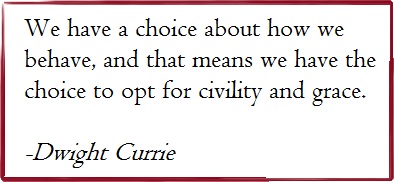
    Dwight Currie QuoteInterestingly, legislators from Oklahoma and Oregon described their time under the “co” agreements as being very productive and cooperative. Legislators in both states remembered these years as times of great bipartisan agreement and civility.

    In Washington, however, the legislators remembered their years of power-sharing as a time of gridlock during which few significant bills were passed and partisanship was especially rampant.

    Why the difference?

    The report concludes that one reason is a difference in how the legislative rules in each state distributed the power to control the agenda. In both Oklahoma and Oregon, the rules ensured that both parties were able to get their legislation on the committee calendar and on the House second reading calendar without being blocked by the other party. In Washington, however, committee co-chairs had to agree to calendar legislation for committee hearings, and each co-Speaker could block consideration of the other party’s legislation on second reading. Each party used this power in retaliation for actions by the other party, leading both parties to feel shut out of the process.

    But, in talking with legislators from all three states, the researchers concluded that the relationships among legislators – and especially among the leadership in both parties – were more important to achieving a successful legislative session than the rules. The report quotes political scientist Thom Little, commenting on power-sharing arrangements: “Trust between the leadership of the parties is by far the most important factor. No matter what the rules are, if the two leaders don’t trust each other, it will be a disaster.”

    And in Oklahoma and Oregon, where the power-sharing agreements were successful, the researchers found that the co-chairs of committees and the rest of the legislators in the House followed the example of trust and mutual respect set by the co-Speakers. Further, the co-Speakers specifically emphasized civility and cooperation from the beginning of the session.

    Even though Colorado’s General Assembly isn’t operating under a power-sharing agreement within a single house, control of the chambers is split between the parties: Republicans hold the majority in the Senate and Democrats hold the majority in the House. This means that relationships of trust, mutual respect, and civility between the leadership in the two chambers and among all of the legislators are the key to a successful legislative session for the entire General Assembly.Mary Wortley Mantagu Quote

    In May of 2011, the NCSL Executive Committee adopted a Civility Accord. It sets out six principles of civility:

    • Respect the right of all Americans to hold different opinions.
    • Avoid rhetoric intended to humiliate, de-legitimatize or question the patriotism of those whose opinions are different from ours.
    • Strive to understand differing perspectives.
    • Choose words carefully.
    • Speak truthfully without accusation and avoid distortion.
    • Speak out against violence, prejudice, and incivility in all their forms, whenever and wherever they occur.

    And the Accord closes with:

    We … pledge to exhibit and encourage the kind of personal qualities that are emblematic of a civil society: gratitude, humility, openness, passion for service to others, propriety, kindness, caring, faith, sense of duty and a commitment to doing what is right.


    Good words to keep in mind as the legislative session progresses.