Month: March 2023

  • On Ejusdem Generis & Squirrels

    by Jery Payne

    1.     Is Adam a Burglar?

    Adam worked at a truck shop. His duties included delivering clothes to the other workers’ lockers. Although it was possible to secure the lockers using a padlock, none of the workers actually used locks. The workers should have used the locks, however, because several workers noticed money missing from their work lockers. Suspecting theft, one of the workers installed a small video camera in the room. The camera recorded Adam looking through the lockers and taking items from them. This led to Adam’s arrest for burglary and theft.

    At trial, Adam was found guilty of the burglary charge. Here’s the law, section 18-4-204, C.R.S., forbidding burglary:

    A person commits third degree burglary if with intent to commit a crime he [sic] enters or breaks into any vault, safe, cash register, coin vending machine, product dispenser, money depository, safety deposit box, coin telephone, coin box, or other apparatus or equipment whether or not coin operated.

    Adam appealed the guilty verdict, but the appeals court affirmed the conviction because he “entered or broke into what is tantamount to a vault.” The Colorado Supreme Court, however, reversed the appeals court because of ejusdem generis.

    Ejusdem generis is a Latin phrase that means “of the same kind or class.” This doctrine of statutory interpretation holds that, when a catchall phrase follows a list, the catchall phrase should be read to apply only to persons or things that are of the same kind as the items on the list. This means that the catchall phrase should not be read to cover everything that it says it covers. Instead, the catchall phrase should be limited to covering persons or things that are similar or in the same class as the things on the list.

    Ejusdem generis is actually a specific application of another rule of statutory interpretation: Every word in a statute must be given effect. When, for example, a statute applies to raspberries, strawberries, or other fruit, the words raspberries and strawberries are redundant with the word fruit. Therefore, reading fruit literally to mean all fruit means that the words raspberries and strawberries don’t do anything, and they don’t have any effect. So courts have decided that, to give every word meaning, we have to use the redundant items on the list to narrow the meaning of the catchall.

    Returning to Adam’s burglary case, the Colorado Supreme Court reasoned that all the items in the statutory list “are almost always used to contain money or valuables exclusively: vaults, safes, cash registers, coin vending machines, product dispensers, money depositories, safety deposit boxes, coin telephones, and coin boxes.” Therefore, the list doesn’t include equipment that holds mere property; the list includes only equipment that holds money and valuables. “Thus, whether any given container falls within the purview of the statute depends on whether the apparatus or equipment is merely a storage receptacle or is of the same kind or class as those items enumerated in the statute, that is, whether the container is designed for the safekeeping of money or valuables[.]” So, the Colorado Supreme Court held that Adam had not committed burglary.

    2.     Ejusdem Generis Is Squirrely.

    Imagine that you’re a court interpreting a statute that reads:

    To be imported into Colorado, cherries, tomatoes, cranberries, and other fruit must be inspected by the commissioner of agriculture.

    The statute has three fruits and the catchall of other fruit, so this statute should be read in light of ejusdem generis. The catchall word, fruit, presumably shouldn’t be read to cover all fruit, so you must decide what types of fruit aren’t covered. Here are some options:

    • The listed fruit, cherries, tomatoes, and cranberries, aren’t citrus, so no limes;
    • The listed fruit have skin that is normally eaten, so no pineapples;
    • The listed fruit are red, so no blueberries; or
    • The listed fruit are spherical, so no bananas.

    Which of these options is the right class? Which do you choose? Do you choose all of them?

    Wouldn’t it be better to avoid this guessing game?

    Sutherland’s Statutory Construction explains that ejusdem generis “expresses a meaningful insight about language usage that can be a relevant aid, if not a simple and certain exponent….”[1] When it passes a law, the General Assembly is trying to achieve a goal. Doesn’t this mean that the body wants as much certainty as possible?

    The concern isn’t whether the rule makes sense; the concern is that the rule is a wellspring of uncertainty.

    In Adam’s burglar case, the appeals court believed the statute applied to lockers, but the Colorado Supreme Court held that it didn’t. Regardless of what the General Assembly wanted, two courts came to opposite conclusions. Wouldn’t it be better to draft the statute so that both courts read the statute the same way?

    3.     Don’t Shroud the Law in A Mist; Do Away with The List!

    How should we improve the burglary statute? We can avoid the issue by not using a list:

    • If the intention is to make the burglary statute apply to lockers, then forgo the list. Write something like, “A person commits third degree burglary if, with intent to commit a crime, the person enters or breaks into a container used to store property.”
    • If the intention is, as the Colorado Supreme Court held, to apply only to a container that is used to store valuables, write something like, “A person commits third degree burglary if, with intent to commit a crime, the person enters or breaks into a container used to store money or valuable property.”

    The ambiguity is removed by redrafting the provision to get rid of the list.

    4.     Sometimes, A Belt and Suspenders Are Necessary.

    I imagine that every drafter at the Capitol has heard from a bill’s proponents that “We need a belt­-and-suspenders” provision. This is legislative shorthand for “we may need some redundancy.” In stakeholder negotiations, it is sometimes necessary to list an item or two in a statute to assuage the concerns of a nervous stakeholder.

    For example, a stakeholder may be worried that the word fruit won’t be read to include tomatoes and peppers. This is frequently what leads to phrases like tomatoes, peppers, and other fruit. Recall that ejusdem generis applies when a catchall follows a list, so the word fruit may be limited in some way to not apply to all fruit. Maybe a court will hold that the phrase tomatoes, peppers, and other fruit applies only to less-sweet fruit or, maybe, only to fruit that’s native to North America. If all fruit is meant to be covered, the phrase should be rewritten.

    This is when it makes sense to use the word including:

    To be imported into Colorado, fruit, including tomatoes and peppers, must be inspected by the commissioner of agriculture.

    This is better than tomatoes, peppers, and other fruit because courts usually hold that the words includes and including enlarge or extend rather than limit the general term. Here are some examples:

    One note of caution: it is possible to find cases where an including phrase has been held to be limiting out of a desire to give every word effect. An example is Shelby Cnty. State Bank v. Van Diest Supply Co. This case dealt with a lien on

    [A]ll inventory, including, but not limited to, agricultural chemicals, fertilizers, and fertilizer materials sold to Debtor ….”[Emphasis added.]

    In this case, the 7th circuit explained that:

    [I]t would be bizarre as a commercial matter to claim a lien in everything, and then to describe in detail only a smaller part of that whole. … But if all goods of any kind are to be included, why mention only a few? A court required to give “reasonable and effective meaning to all terms” must shy away from finding that a significant phrase (like the lengthy description of chemicals and fertilizers we have here) is nothing but surplusage.

    So the court did interpret the word including as limiting, and the judges didn’t care that the contract used the phrase but not limited to. Therefore, it is better to avoid using a list. But if that isn’t an option, then use an including phrase.


    [1] N. Singer, 2A Sutherland Statutory Construction § 47.07 (Seventh Edition)

  • Concerning bill titles, and, in connection therewith, explaining everything you need to know about the single-subject and original purpose rules.

    Concerning bill titles, and, in connection therewith, explaining everything you need to know about the single-subject and original purpose rules.

    by Megan McCall

    “And the coat rule is relaxed.” “The ayes have it and journal from the previous day is adopted.” “Does it fit under the bill title?” These are all frequently uttered phrases under the Dome, although the last might not be spoken with the same enthusiasm as the first two. The question of whether a matter fits under a bill title has undoubtedly come up a time or two for you during session and probably in a variety of contexts. It might have been a conversation with a bill drafter in the initial drafting of your bill, or perhaps the question has arisen in relation to evaluating an amendment request with a lobbyist or with another member of the General Assembly.

    Section 21 of article V of the Colorado Constitution states that “No bill, except general appropriations bills, shall be passed containing more than one subject, which shall be clearly expressed in its title….” Many of your counterparts in other states also have to comply with their state’s single-subject rule, although notably Congress does not. The Colorado courts have specifically identified the desire to prevent “log-rolling” as a core tenet to the single-subject rule, meaning the rule is intended to prevent several unrelated measures that may not pass individually be joined together in order to garner a majority of votes for the combined measure. Courts have also identified an intention to prevent public surprise as another primary purpose for the rule. A bill’s title should sufficiently put the public on notice as to the contents of the legislation.

    To comply with the nuances of the single-subject rule, bill titles may be drafted broadly or narrowly, and the compliance with the rule is a primary consideration for your drafter in the bill’s initial drafting stages. It is the custom of the OLLS to draft narrow or “tight” bill titles unless otherwise instructed by the bill’s sponsor. Sometimes a narrow bill title, however, is not possible based on the content a bill sponsor wants to cover in the bill. The Colorado Supreme Court consistently has held that generality in a title is not objectionable, and the Constitutional requirements are met if the matters contained in the bill are germane to the subject of the title. Thus a general, or a broad, bill title that describes the general subject matter of the bill should withstand scrutiny as long as the substance of the bill is germane to that title.

    A bill with a broad title may include what is called a “trailer,” which is a way of providing additional information to the reader as to its specific contents. This trailer will list and describe the varying components of the bill. Trailers can be lengthy and although they are in bold font just like the bill title, they are not the title of the bill for purposes of the single-subject analysis. If a bill has a trailer, the best way to keep track of the bill title is to remember that the title is everything after the first word “Concerning” and before the phrase “…, and, in connection therewith,”.

    Keeping a handle on the title of a bill is important as it is moving its way through the legislative process and amendments are offered to the bill, whether it is to your own bill or the bill of another member. This is in light of an ancillary constitutional provision in section 17 of article V that states that “No bill shall be so altered or amended on its passage through either house as to change its original purpose.” Meaning, just as the contents of an introduced bill must relate to the single-subject of the bill as evidenced in the title, so too must any amendments offered to the bill. Once a bill is introduced, the bill title cannot be amended to be made broader, as that would suggest the original purpose is being changed, or perhaps, that there is now more than one subject. A bill title can be amended to narrow its scope (although if narrowed, it can later be amended again to revert back to the original title). Bill trailers can always be amended, and frequently are, to add, revise, or remove specific descriptions of provisions impacted by the substance of amendments.

    The drafter of a bill may advise a member that an amendment request may raise a title issue, meaning the substance of the amendment may not fit under the bill’s title. An amendment that falls outside the bill’s title may be challenged, and the question is ultimately decided by the chair of the committee of reference or of the committee of the whole, depending on when the amendment is offered, and is in the chair’s sole discretion.

    Courts have jurisdiction to consider challenges to a bill’s compliance with the single-subject rule, but courts will generally defer to the judgment of the General Assembly when passing the bill. If the court finds a violation, only the portion of the bill that does not fit within the bill title will be held invalid. Additionally, the General Assembly passes a bill every regular session to enact the Colorado Revised Statutes, republished with all changes passed by bill in the preceding session, which has the effect of curing any title defects that may have existed within any bills passed in the prior session. Accordingly, single subjects are infrequently challenged.

    For more information on bill titles and the single-subject rule, see the OLLS memo concerning bill titles.

  • The OLLS Hereby Finds and Declares That You Should Read This Article

    The OLLS Hereby Finds and Declares That You Should Read This Article

    by Asia Merrill

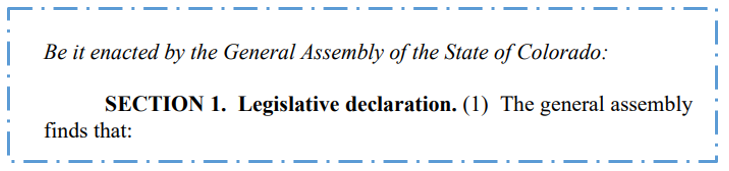
    Drafters of statute have the difficult task of turning complicated ideas into plain and clear legislation. They work closely with legislators to translate the legislators’ ideas into laws that avoid the need for complex interpretation. The intent of the General Assembly must be as clear as possible so that the law can be administered or followed in the manner that the General Assembly intends. If a statute is interpreted by the Colorado courts, then between precedent and the statute itself, everyone should receive a just and consistent interpretation. Despite this, when several interpretations of a law do arise, lawyers and judges may turn to legislative declarations and statements of intent if they are included in the bill that enacted the law in dispute to help interpret the statute.

    Most of the time when legislators decide to include a legislative declaration or a legislative statement of intent, they choose legislative declarations. Per the Colorado Legislative Drafting Manual, legislative declarations are a formal announcement about a bill. They can establish a philosophical reason behind the new statute or deliver context or history regarding the fiscal or social issue driving the law. In general, they encapsulate the “why” and sometimes the “how” of the proposed legislation. Legislative declarations may also provide data and findings by the General Assembly to support the legislature’s claims and associated actions.

    Legislators may choose between nonstatutory or statutory legislative declarations. Both hold the same legal weight, but each serves a different organizational purpose. Usually, if a bill creates a new entire part or article or it only creates a new section, a statutory legislative declaration is the obvious choice. It’s a way to attach the declaration to the language itself in the statute books, where attorneys and citizencan most easily access it. If a drafter creates or amends multiple areas of statute, however, a nonstatutory legislative declaration most effectively gives context to the language without repeating the declaration in each new or amended section. Nonstatutory legislative declarations are only shown in the Session Laws, but they are cross-referenced in editor’s notes after a statute in the Colorado Revised Statutes.

    Legislators will also use a statement of legislative intent, which describes the intended purpose and desired effect of a bill. In general, legislative intents focus on what the outcome of the bill should be. Statements of intent should never be necessary to understand the desired outcome of the statute and should only supplement the bill. A relatively simple example of a statement of legislative intent is section 6-1-401, C.R.S., which establishes that the entire part is intended to:

     [Assure] that assistive technology [is] provided to persons with disabilities, is of quality, and is covered by adequate warranties to maintain their assistive technology in proper working condition; to assure availability of appropriate loaner replacement assistive technology while their own is being repaired; and to encourage manufacturers and dealers to cooperatively pool assistive technology resources for loaner purposes to assure availability without an undue burden.

    While short and sweet, the statement acts to announce the people the law is intended to serve and simply establishes the desired outcome.

    Legislators should use neither declarations nor statements of intent to simply garner support for a bill, although that certainly seems to happen from time to time. On the other hand, legislators should exercise caution when putting too much weight into a legislative declaration or a legislative statement of intent, lest the underlying statute may fail to address the problems they are trying to solve. It goes without saying that a legislator, and in turn, a drafter, should never use a legislative declaration to replace clear, concise statute.