Month: February 2020

  • Good Morning Sunrise!

    by Jery Payne

    You’re sitting in your office with your cup of joe or grande ristretto caffe latte—depending on your style—reading the newspaper when in walks a lobbyist, who says “I want to talk to you about bank robbing.” As you take a drink, she continues, “The bank­-robbers association believe their occupation needs to be licensed.”

    After the coffee is wiped up, you manage to ask her, “They have an association?”

    “Yes,” she replies, “they play an important part in the economy, and licensing is very important to avoid poor quality, which can be dangerous. The banks support licensing.”

    “The banks?”

    “Yes,” she adds, “The banks suffer the most from poor­-quality testing of bank security.”

    “Ah, I thought you meant actual thieves.”

    “No, silly. Legal bank robbers: the people who try to circumvent physical and electronic security measures.”

    After a long talk, you agree that licensing legal bank robbers may be the best way to help Colorado banks. Before you put in a bill request, however, you may want to find out if the proponents have obtained a sunrise report from the Department of Regulatory Agencies. It might save you some trouble.

    Section 24‑34‑104.1 sets the basic requirements necessary to propose “the regulation of any unregulated professional or occupational group.” This section requires such a proposal to be submitted by December 1 to the Department of Regulatory Agencies for analysis. The proposal must be signed either by ten members of the occupation or by ten other people. The proposal must contain the following:

    • A description of the group proposed for regulation, including a list of organizations representing practitioners in Colorado, and an estimate of the number of practitioners;
    • A description of the problem and why regulation is necessary;
    • The reasons why the specific form of regulation is proposed;
    • The public benefit of the regulation;
    • The cost of the regulation; and
    • If the proposal seeks to disqualify a person based on criminal history, a description of the disqualifications and how the disqualifications serve public safety or commercial or consumer interests.

    If the proposal is in order, the department should analyze the proposed regulation and send the analysis to the proponents and the General Assembly by October 15 of the following year. If the department finds that the lack of regulation “poses an imminent threat to public health, safety, or welfare,” the department will promptly notify the proponents and the Legislative Council, which will hold a hearing on the matter. If the Legislative Council at the hearing agrees there is an imminent threat, the department may forego the analysis, and a legislator may introduce legislation without having the report.

    If the matter is not so dire, the department will evaluate and analyze the proposal and make a recommendation in a report based on whether:

    • Unregulated practice concretely harms or risks public health, safety, or welfare;
    • Regulating occupational competence is needed and beneficial;
    • The public can be protected in a more cost‑effective manner; and
    • Disqualifications based on criminal history serve public safety or commercial or consumer interests.

    Once you have the report, you may introduce the bill within two regular legislative sessions.

    The department may decline to conduct the analysis if it already did the analysis within the last three years and no new information has been submitted that would change the department’s mind.

    If the department doesn’t do a new analysis, it will reissue the previous report. This means you have a report and may introduce a bill within the next two regular legislative session.

    Now I bet I know what a lot of you are thinking: “What exactly does ‘regulating’ mean?” The Office of Legislative Legal Services thinks it means legislation concerning a job that hasn’t previously been the specific subject of legislation. The Governor’s Office, however, has said that it means only licensing, registration, and certification. The Governor’s Office reasoned that most occupations are subject to some laws; therefore, the sunrise statute cannot apply to all laws specific to an occupation. Yet this reading is hard to square with the actual language of the statutory section, which requires proponents of the regulation to state “the reasons why certification, registration, licensure, or other type of regulation is being proposed …” So “regulation” appears to be more than certification, registration, or licensure.

    Another problem with the interpretation of the Governor’s Office is that it conflates the regulation of an occupation with general‑purpose laws. For example, the law forbids bankers to steal, but the law doesn’t actually mention bankers. It applies to everybody regardless of whether they are a banker, so it is a general‑purpose law that incidentally a banker must obey when doing business. But a law that specifically requires bankers to keep a log of transactions is a law regulating bankers. A law that sets a standard or requirement for someone because of the person’s occupation is the regulation of an occupation. The mere fact that an occupation is subject to a general‑purpose law does not mean it is a regulated occupation; but a new law that would create a requirement specific to the occupation should be subject to the sunrise process.

    Nevertheless, the governor may veto the bill because it does not follow his office’s interpretation. Ignore the reading of the Governor’s Office at your own risk.

    So before using a bill request to help bankers get better security testing, it makes sense to ask if the proponents have followed the sunrise process.

  • Legislative Ethics: Accepting Gifts of Travel Expenses

    by Jennifer Gilroy

    Article XXIX of the Colorado Constitution (commonly referred to as “Amendment 41”) establishes two “gift bans”: One that prohibits a member of the General Assembly from asking for or accepting gifts worth more than $65[1] from any one source in a given year and one that prohibits members of the General Assembly from accepting any money, forbearance, or forgiveness of indebtedness, unless, in either case, the member provides lawful consideration of equal or greater value in return. In today’s article, we’re going to talk about the ban on accepting gifts, specifically as it applies to gifts of travel expenses.

    There are eight exceptions that apply to both gift bans. One of those exceptions allows a legislator to accept the payment of reasonable expenses by a state or local government or by a nonprofit entity that receives less than five percent of its funding from for-profit entities to attend a convention, fact-finding mission or trip, or other meeting. To qualify for the exception, the recipient must be scheduled to speak, make a presentation, participate on a panel, or represent the state or local government. Legislators can seek an advisory opinion on a particular ethics question from the Independent Ethics Commission (IEC), created as an essential component of Amendment 41.

    On occasion, the IEC has released position statements interpreting the Amendment 41 gift bans. For example, it has interpreted Amendment 41 as permitting a covered individual to accept travel expenses from organizations whose mission it is to bring policymakers together at conferences for networking and exchanging ideas, referred to as government exchange organizations (GEO), if the government entity that employs the covered individual pays membership dues to the GEO that are invoiced expressly to cover travel and other expenses to attend its events. See, IEC PS 10-01.

    The IEC has also stated that, even if the criteria for the exceptions are not met, a covered individual may still accept the payment of travel expenses if the gift is a benefit to the government institution that employs the covered individual rather than to the individual. The IEC provided the following factors for the covered individual to consider when determining whether the gift is a gift to the government institution or to the covered individual, although no single factor is determinative and the entire context of the proposed travel must be evaluated before acceptance:

    1. Whether the offer is to a designee of an agency or government entity, rather than to a specific individual;
    2. Whether the offer is to the covered individual by virtue of the individual’s specific position or area of responsibility or expertise (ex officio);
    3. Whether the offer is for an event that is related to the covered individual’s public duties;
    4. Whether the offer poses an existing or potential conflict of interest or appearance of impropriety; and
    5. Whether the offer is for a trip for educational or government business purposes and not primarily a networking opportunity.

    See, IEC PS 12-01.


    Want to test what you’ve learned about accepting a gift of travel expenses? Here are some hypothetical situations for your consideration:


    Situation #1. You have been asked by a representative of the National Association of State Legislatures (NASL) to participate on a one-hour panel discussion at their three-day fall forum in Washington D.C. The NASL representative explains to you that NASL will pay for your airfare, hotel accommodations, and the cost of the registration to attend and participate in the conference. You learn that NASL is a nonprofit government exchange organization; however, you also learn that it receives substantially more than 5% of its annual funding from for-profit entities, despite the fact that states, including Colorado, pay substantial annual membership dues to NASL.

    May you accept payment of the airfare, hotel accommodations, and registration from NASL to attend the NASL Fall Forum in Washington D.C.?

    1. Even though NASL is a nonprofit entity, you may not accept the gift of airfare, hotel accommodations, and registration since NASL receives more than five percent of its funding from for-profit sources.
    2. YES, so long as you disclose the value of what you receive in your quarterly gifts and honoraria report that you are required to file with the Secretary of State’s office.
    3. YES, because payment of your airfare, hotel accommodations, and registration is essentially payment of an honoraria for your participation on the panel discussion.
    4. YES, because NASL is a government exchange organization to which the state pays annual dues that are expressly invoiced to cover travel and expenses related to attendance at NASL events, consistent with the IEC’s PS 10-01.

    The correct answer is d. While NASL does not meet the five percent criterion established in the exception to the gift ban, it is a government exchange organization as described by the IEC to which the state of Colorado pays membership dues each year. Because the dues are invoiced expressly to cover travel and other expenses to attend NASL events, you may accept the payment of airfare, hotel accommodations, and registration by NASL to attend its conference. You may also be permitted to stay throughout the conference if you will also be participating in other educational events and representing state government while you are there. See, IEC AO 13-11 and IEC AO 13-12.


    Situation#2. You are the chair of the House Rural Affairs and Agriculture Committee. The Speaker also appointed you to serve on the Joint Wildfire Interim Committee, which you also chair. You have sponsored five bills over the past two legislative sessions addressing various wildfire issues, and you consider yourself very knowledgeable on the topic of wildfires. A representative of the western division of the Council of State Legislatures (CSL), a nonprofit organization of legislators, has invited you to attend the three-day Western States Wildfire Conference they are hosting in Salt Lake City, Utah next month. Because of your expertise, experience, and knowledge related to wildfire issues and your position as the chair of the Joint Wildfire Interim Committee, CSL has asked you to moderate one of the sessions on environmental ethics related to the use of slurry to fight wildfires. CSL has offered to pay for your airfare and hotel accommodations as well as a round of golf at the prestigious Eaglewood Golf Course (you are an avid golfer). You are very interested in attending this conference in hopes that you will learn more from experts in the field of wildfires and other legislators from states facing wildfire issues similar to Colorado. You have recently learned that CSL receives more than five percent of its funding from for-profit sources, and you are not sure if that will prevent you from being able to attend this educational program.

    May you attend the CSL wildfire conference?

    1. Because CSL is a nonprofit entity and because you will be participating in the program by moderating one of the sessions, you may accept the gift of airfare and hotel accommodations.
    2. Because there is a golf outing associated with the conference, you may not accept the invitation.
    3. Even though CSL is a nonprofit organization that receives more than five percent of its funding from for-profit sources, due to your expertise in the area of wildfires, and your position as chair of the House Rural Affairs and Agriculture, Committee and the Joint Wildfire Interim Committee, and because there is no conflict of interest or appearance of impropriety, your attendance at this educational conference would actually benefit the General Assembly rather than just you as an individual.
    4. The CSL may be a nonprofit entity, but because it receives more than five percent of its funding from for-profit sources, you may not accept the payment of the conference expenses.

    The correct answer is c. PS 12-01 from the IEC provides that if the offer would actually benefit the government institution (here, the General Assembly) rather than just you as an individual, then you may be able to accept the payment of expenses to attend an educational conference. In this case, because you were invited to attend and participate in the conference due to your position as chair of the House Rural Affairs and Committee and the Joint Wildfire Interim Committee, because this is an area of expertise for you, and because it is an educational conference and not just an opportunity to network, it would be appropriate for you to accept the payment of expenses associated with attending this conference under the IEC’s PS 12-01, so long as there is neither an existing or potential conflict of interest nor an appearance of impropriety. You should not accept the golf outing, unless you pay for it separately yourself.


    For more LegiSource articles on gift bans and the Independent Ethics Commission, see:

    Click here for other LegiSource articles regarding ethics.


    [1] Section 3(2) of Article XXIX originally established the gift ban cap at $50, but the Independent Ethics Commission has since adjusted that amount pursuant to section 3(6) of Article XXIX, most recently in 2019.

  • The Statutory Revision Committee

    by Jessica Wigent

    Since its (re)creation in 2016, the Statutory Revision Committee (codified in part 9 of article 3 of title 2, C.R.S.) has introduced more than 100 bills that have repealed, refreshed, and cleared conflicts, glitches, and outdated provisions from hundreds of pages of statutory text, bringing the Colorado Revised Statutes into the 21st century and now into this new decade.

    During hearings held during the 2019 interim and early in the 2020 legislative session, committee members have heard memo presentations and testimony on issues including the thorny technical matter of correctly stating effective dates and references to referred initiatives in bills concerning firefighting chemicals and transportation revenue notes; tax exemptions and deductions that haven’t been updated or available to taxpayers since Beatles, Turtles, and Monkees ruled the radio waves; and the need to rehome the definition of “alternative fuel.”

    Membership

    The SRC consists of eight legislators (two appointed by the majority and minority leadership in each house) and two nonlegislators who are nonvoting attorneys appointed by the Committee on Legal Services. Per the statute that created the SRC, the chair and vice-chair elected in the 2019 legislative session have switched positions. The membership now includes:

    Senator Rob Woodward, Chair

    Senator Rachel Zenzinger, Vice-chair

    Representative Jeni Arndt

    Representative Hugh McKean

    Senator Dominick Moreno

    Senator Jack Tate

    Representative Donald Valdez

    Representative Kevin Van Winkle

    Patrice Collins

    Brad Ramming

    Attending to the Antiquated, Obsolete, and Anachronistic

    The SRC is introducing 20 bills during the 2020 legislative session, including:

    • Four bills referred to the committee by the Tax Expenditure Interim Study Committee, which remove various outdated and inapplicable tax exemptions and deductions – HB 20-1181, HB 20-1182, HB 20-1202, and HB 20-1205;
    • Five bills referred to the committee by the Department of Revenue, which clean up references to repealed tax exemptions, update cross-references, and align statutes to the legislature’s intent – HB 20-1166, HB 20-1174, HB 20-1175, HB 20-1176, and HB 20-1177; and
    • Bills to make clear the meaning of the phrase “prior fiscal year” in regard to uncommitted reserves (SB 20-134); to add references to licensed EMS providers that were missed when two different bills amended the EMS statutes in 2019 (HB 20-1036); to add a missing cross-reference in the electrician’s practice act regarding inspection fees (SB 20-046); and, among other bills, to correct an incorrect reimbursement rate in a bill from last year concerning out-of-network health care providers, which was the result of a flurry of amendments at the end of session when two of the three provisions in a bill were updated with the correct rate, but the third was mistakenly overlooked.

    How an SRC Idea Becomes a Bill

    Executive branch agencies, the judicial branch, interested Colorado residents, legislators, and nonpartisan staff from a number of agencies in and around the Capitol, as well as legislators themselves, have brought issues for the SRC to consider. Initially, staff considers these requests and whether they fall within the charge of the SRC and then prepares a memo detailing the requested change, often with a bill draft attached for the SRC to consider.

    In addition, the statutory charge of the SRC includes examining “current judicial decisions.” To that end, the SRC has asked staff to review current statutes that are found by an appellate court to be unconstitutional. Staff annually prepares memos for the SRC to bring attention to these provisions.

    An affirmative vote from at least five of the legislative SRC members is needed to introduce proposed legislation, and the SRC regularly considers more draft bills than it approves. In 2020, the SRC rejected multiple proposals it determined were outside its charge. All proposed bill drafts, including those not approved for introduction, are publicly available on the SRC’s website and in the committee’s annual report submitted to the General Assembly. You may also email staff for more information.

    The SRC plans to meet at least once during the 2020 interim, though they are still finalizing the date and the issues to be considered. Join the SRC mailing list to be notified when these details are available.

    Know of any antiquated, redundant, or contradictory laws? Please contact the SRC staff via email: statutoryrevision.ga@coleg.gov All meetings are public, and everyone is encouraged to attend or to propose issues to the SRC staff.

  • How to Keep Up With a Changing Bill

    by Patti Dahlberg and Julie Pelegrin

    You’re running late, you’re trying to get a handle on the bills they just called up on special orders, and there are seven bills on your committee calendar for this afternoon. When you need to quickly remind yourself of what’s in a bill, you will be tempted to just check the summary that appears on the first page of the bill. But, unless the bill is in the first committee in the first house, you must resist this temptation. That’s not to say the bill summary printed on a bill can’t be helpful. While the bill summary may not tell you all you need to know, it does provide a quick overview of what the bill is doing when it’s introduced. But beware, if the bill has already passed out of a committee in the first house, it may have been amended by that committee, and those amendments will not appear in the bill summary. In this situation, there may be other options you can turn to.

    Bill Summaries

    Rule No. 29 of the Joint Rules of the Senate and House of Representatives requires that every bill and concurrent resolution must include a brief summary written by the Office of Legislative Legal Services (OLLS). These summaries attempt to describe in plain language what the introduced version of the bill or concurrent resolution will accomplish if passed.

    The OLLS aims to write bill summaries that are brief (relative to the size and scope of the bill) and provide a succinct, clear, and accurate synopsis of the major points of the bill in a format that’s easier to read and, hopefully, understand than the actual language in the bill. Drafters try to avoid using legalistic and technical words in the bill summary, but sometimes using legal terms is necessary to avoid confusion or a misleading summary.

    Bill summaries take many forms and may include:

    • A description of how the bill will change existing statutes and, if useful in understanding those changes, an explanation of existing law and the legal context of the changes;
    • An explanation of the substance of a repealed statute if necessary to understanding the bill;
    • A structure that presents the statutory changes in a logical order, usually the order of importance, and may group related changes together; and
    • If the bill is recommended by an interim or statutory committee, the name of the committee in bold at the beginning of the summary.

    Preamended Versions

    On paper and electronic copies of bills, all bill summaries start with this note:

    Each bill also has its own page on the General Assembly’s website, which includes the bill summary. There is a note at the end of this summary that specifies which version of the bill the summary applies to. For example, (Note: This summary applies to this bill as introduced.)

    If a bill is amended in a committee or on second or third reading, the bill summary that’s printed on the bill or that appears on an electronic copy of the bill does not change. This is true whether the amendment occurs in the house of introduction or the second house. So how can you quickly see how a bill may have changed?

    Each bill’s webpage includes links to the text of the official versions of the bill and links to what are called “preamended versions.” These are unofficial versions of the bill that show amendments adopted by a committee as they appear in the text of the bill. The changes made by a House committee are shaded; the changes made by a Senate committee are double-underlined. If you open the unofficial preamended bill, you can easily scroll through it to see changed language. These changes, combined with the original bill summary, will help you quickly come up to speed on the bill before it’s heard in another committee or on second reading.

    Once the bill passes second reading, all of the adopted amendments are enrolled into the bill. At that point, you should read the engrossed bill – also available on the bill page. But note: The printed and the electronic version of the bill summary is still not changed. The same is true of the reengrossed version of the bill, created after the bill passes on third reading in the first house. As with the preamended versions, changes made by the House are shaded; changes made by the Senate are double-underlined.

    Updated Bill Summaries Online

    So, is the bill summary ever updated? Yes—but never on the bill itself.

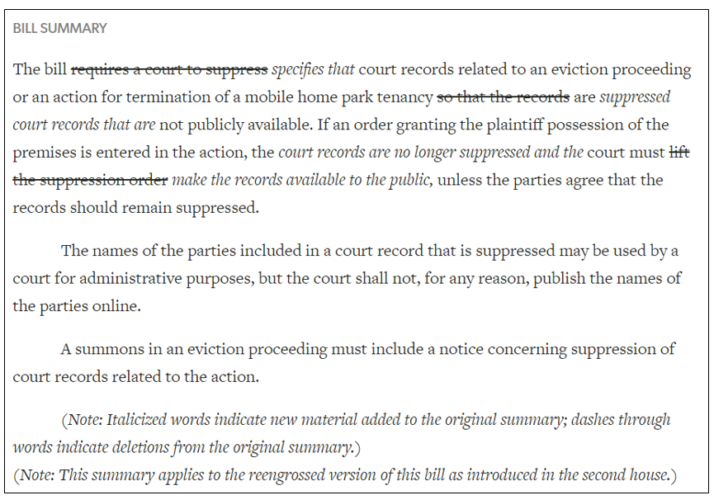
    If a bill is significantly amended in the first house, and the original bill summary no longer accurately describes the bill, the bill drafter updates the bill summary when the bill is introduced in the second house. The updated bill summary is posted on the bill’s webpage, but it does not appear on the paper or electronic copy of the bill itself. To make the changes in the updated bill summary readily apparent, new language appears in italics and deleted language appears in strike type. Also, once the bill is introduced in the second house, the note at the bottom of the online bill summary will read: (Note: This summary applies to the reengrossed version of this bill as introduced in the second house.).

    Before considering a bill in the second house, you should check the summary on the bill’s webpage to see how the first house changed the bill. If the online bill summary does not show any language in italics or strike type, then the first house did not significantly amend the bill.

    Final Bill Summary

    After the legislative session ends, the bill drafters prepare a final summary for each bill that the General Assembly enacts. The final summary is posted to the bill’s webpage with this note: (Note: This summary applies to this bill as enacted.) The OLLS also collects these final bill summaries and annually publishes them in paper copy and online as the digest of bills for each legislative session.