Category: History

  • 1876: Perseverance Leads to Statehood

    The United States 38 Star Flag, used after Colorado became the 38th state in the Union in 1876 and until 1888.

    by Patti Dahlberg

    When at first you don’t succeed, try, try, and try again. Colorado became the 38th state of the Union in 1876, but only after more than 15 years of overcoming various roadblocks and multiple rejections. According to Thomas B. Corbett’s brief history of Colorado included in The Legislative Manual of the State of Colorado1, much of Colorado and its scattered population of trappers, hunters, traders, various Native American tribes, and Mexican citizens existed with only sporadic local law protection. Residents also lived without legislative representation in the Kansas territorial legislature, even though the region was part of the Kansas Territory from 1854 to 1861. 

    The Colorado Gold Rush, starting in 1858, quickly attracted 20,000 inhabitants to the mining areas. With another 80,000 or so new residents arriving over the next few years, the urgency increased for an accessible and organized government in Colorado in order to more adequately protect life and property.

    Thus, in 1858 and 1859, Colorado citizens petitioned Congress to establish a government separate from the distant one assigned to them in Kansas. In April of 1859, interested parties in Colorado met to discuss organizing a new territory or state. The prevailing sentiment of the group was to pursue statehood directly. A convention of delegates was formed, and a state constitution was drafted and finalized by that August. 

    The constitution and the question of pursuing statehood were sent to the people for approval and were subsequently rejected. But the convention delegates had prepared for this outcome and had resolved that, should the state constitution be rejected, an emissary be elected to represent the Jefferson Territory to Congress and for a new slate of delegates be chosen to form a provisional territorial government. A new constitution, called the “Organic Act of the Territory of Jefferson,” was framed and adopted, and the elected emissary was sent to memorialize Congress to separate the Pike’s Peak region from Kansas. The endeavor was unsuccessful in Congress, but those pesky Coloradans remained undeterred, and the Jefferson Territory Provisional Government continued to operate without Congressional approval.

    On January 29, 1861, Kansas became a state, and then, on February 28, 1861, Congress passed a bill2 providing for the political organization and administration of the Colorado Territory and drawing the boundaries of the new territory, mainly from the western portion of the Kansas Territory, as well as smaller segments of the Nebraska, Utah, and New Mexico territories. Obtaining statehood remained the final goal of the territorial government. In spite of the Confederacy secession from the Union and the ensuing Civil War, upon petition from the Colorado legislature, Congress passed and President Abraham Lincoln signed a bill enabling the territory to organize a state government in order to enter the Union. A convention of delegates met in Denver on July 4, 1864, and framed a state constitution, which was then rejected by the people the following October.  

    Down but not out, interested parties decided to make another attempt at statehood in 1865, and another convention met that August to frame a state constitution, which was adopted by the people. State officers and a state legislature were elected the following November, and delegates presented the application to Congress twice, with it passing twice. Subsequently it was vetoed twice by President Andrew Johnson, purportedly due to Colorado’s low population numbers. After Johnson left office in 1869, Congress failed to pass a statehood bill for Colorado on three separate occasions between 1869 and 1873.

    Fast forward to March 3, 1875, when a president amenable3 to Colorado statehood encouraged Congress to consider “An act to enable the people of Colorado to form a constitution and State government, and for the admission of said State into the Union on an equal footing with the original States”.4 After several amendments, the bill passed with a stipulation: Coloradans must pass or reject a state constitution in a vote in July of 1876. 

    Colorado’s Constitutional Convention of 1875–1876 was held at the Odd Fellows’ Hall, located on the third floor of the First National Bank at the corner of 16th and Blake Streets. (The facility, later dubbed “Constitution Hall,” burned to the ground in 1977.) With the population of the territory well over 100,000 and more arriving on the major railroad now connecting the state with the rest of the country, it seemed like the time for statehood was now or never. 

    The 39 delegates of the constitutional convention worked from December 20, 1875, to March 15, 1876, to create and finalize the constitution. Delegates were divided into committees to frame and present topics of the constitution for discussion and, at times, extended debate. These topics included the judiciary; education and educational institutions; suffrage; corporations; revenue and finances; mines and mining; water and irrigation; agriculture and manufacturing; military affairs; state, county and municipal debt; forest culture; and citizen rights. The final constitution, modeled after the U.S. Constitution and other state constitutions, started with a Bill of Rights and allowed for future amendments to be made to the constitution. 

    Printed for citizen review in three languages and voted on July 1, 1876, the 1876 state constitution5 was approved by 15,443 to 4,062 (79% to 21%). On August 1, 1876, President Ulysses S. Grant signed Proclamation 230,6 admitting the State of Colorado to the Union as the 38th state and as the one and only Centennial State.

    Although official records or journals of convention activity were not published during or immediately after the convention, there was extensive newspaper coverage available for those unable to attend. Finally in 1907, Senate Bill 217 directed the Secretary of State to prepare all records of the 1876 Constitutional Convention in book form. In August of that year a Proceedings of the Constitutional Convention8 was published.

    The 1876 Colorado Constitution

    The Constitution of the State of Colorado, written and ratified in 1876, laid the framework for the state’s government. The original, hand-written constitution was 40 pages long and was and remains one of the longest state constitutions on record. It left power in the hands of the people through a representational government and granted the ability to hold referenda on laws and constitutional amendments enacted by the legislature. In 1910, the Initiative and Referendum Amendment empowered Coloradans to draft proposed statutes or constitutional amendments, gather signatures on petitions, and have their proposals presented to the voters for approval.

    Some little-known provisions of the 1876 constitution included:

    • Until 1900, laws passed at each session were to also be published in Spanish and German in a sufficient number of copies to supply the new laws to that portion of the inhabitants of the State who speak those languages and who may be unable to read and understand the English language.9 (In 1988, a citizens’ initiative added an English-only provision.)
    • The Colorado Supreme Court consisted of three judges who were elected and served fixed 9-year terms.10 Today, the Supreme Court consists of seven justices who are appointed by the governor and are subject only to removal through retention elections. (The current structure was established by an amendment to the constitution adopted in 1966.)
    • The Governor of Colorado served a two-year term11, similar to many other states at that time. By the late 20th century, nearly all states had converted to four-year terms. (An amendment was passed in 1956 extending the governor’s term to four years.)
    • The Constitution suggested that the General Assembly adopt laws allowing women’s suffrage. It mandated universal suffrage for males over 21 years of age but stipulated that the General Assembly, at its first session, “enact laws to extend the right of suffrage to women of legal age.”12 Although that did not happen in that first legislative session, Colorado would eventually extend suffrage to women in a state referendum in 1893 – more than 25 years before America adopted women’s suffrage at the national level.
    • Slavery is specifically prohibited. The Colorado constitution specifically stated that “[t]here shall never be in this State either slavery or involuntary servitude…”.13 

    This year, we commemorate Colorado’s 150th Anniversary as a state and America’s 250th Anniversary as a nation. Celebrations will be held throughout the country, but as the only Centennial state, Colorado is celebrating two anniversaries this year. You can find  more information on the America 250 Colorado 150 anniversary celebrations scheduled throughout the state on the Colorado History website.

    Some related Colorado LegiSource articles:

    1. The Legislative Manual of Colorado, published in 1877, contains more than 350 pages of information on the new state for members of the General Assembly on how the new legislature would be organized, a “manual of parliamentary practice,” a “manual of customs, precedents, and forms,” House and Senate rules, lists of officers, biographical sketches of legislators, a brief history of Colorado, etc. ↩︎
    2. Thirty-Sixth Congress. Session II, Chapter 59, February 28, 1861. ↩︎
    3. Ulysses S. Grant was the president amenable to Colorado statehood and was also the first sitting U.S. President to visit the Colorado Territory. ↩︎
    4. Forty-Third Congress. Session II, Chapter 139, March 3, 1875. ↩︎
    5. https://archives.colorado.gov/collections/authenticated-constitution ↩︎
    6. https://www.presidency.ucsb.edu/documents/proclamation-230-admission-colorado-into-the-union ↩︎
    7. https://scholar.law.colorado.edu/cgi/viewcontent.cgi?article=1763&context=session-laws-1901-1950 ↩︎
    8. Proceedings of the Constitutional Convention, published 1907. Available online from Colorado State Archives. ↩︎
    9. 1876 Colorado Constitution, Article XVIII, Section 8. ↩︎
    10. 1876 Colorado Constitution, Article VI, Sections 5 and 7 ↩︎
    11. 1876 Colorado Constitution, Article IV, Section 1. ↩︎
    12. 1876 Colorado Constitution, Article VII, Section 2. ↩︎
    13. Colorado Constitution, Article II, Section 26. The original provision included an exception that allowed the use of slavery or involuntary servitude as punishment for a crime, but that exception was repealed by Amendment A, which was approved by the voters in 2018. ↩︎

    Sources:

  • 1876

    The United States 38 Star Flag, used after Colorado became the 38th state in the Union in 1876 and until 1888.

    by Jery Payne

    On August 2, 1876, Jack McCall entered the No. 10 Saloon in the town of Deadwood in what is now South Dakota, walked up behind “Wild Bill” Hickok, shouted a curse and “Take that!”, and shot Wild Bill in the back of the head. Wild Bill was holding two black eights and two black aces. Ever since, this hand has been called the “dead man’s hand.”

    Jack tried to flee but never made it out of Deadwood. The town itself was illegal because the Lakota Sioux tribe owned the land, but then Lieutenant Colonel George Custer had led an expedition that discovered gold, so the town popped up anyway. The federal government tried to buy back the gold fields, but the Lakota were not in a selling mood. Being an illegal town, there was no real law and there were no real courts. The townsfolk put together a makeshift court and tried Jack.

    Jack’s defense was that Wild Bill had killed his brother and therefore deserved death. He actually used the “he needed killing” defense. The defense succeeded; Jack was set free.

    In 1872, Sitting Bull and his warriors were locked in a stalemate with Custer’s 7th Cavalry. Sitting Bull was trying to forge the entire Lakota Sioux tribe into a single fighting force. He needed to show that he was the man to lead the entire tribe. The stalemate did not bode well for his leadership and people grumbled, so Sitting Bull gathered up his pipe and tobacco and walked down to the front lines, within range of the enemy’s guns. He sat down with bullets striking all around him. He then lit the pipe and smoked it, seeming to be indifferent to the danger. After taking a few puffs, he called his men to join him. Four warriors braved it but wanted to return after taking a few puffs. Sitting Bull slowly smoked the rest of the pipe, cleaned it out, and casually walked back to his warriors. His legend was made, and, by 1876, he led the entire tribe.

    The 1870s West favored the bold risk-taker.

    But boldness has its cost. In June of 1876, Custer had looked over a settlement on the Little Bighorn River. Custer could not see the entire settlement, but it was bigger than any he could have expected. The Lakota Sioux, Cheyenne, and Arapaho tribes had come together to discuss war. Custer could see that he was outnumbered, but he probably didn’t understand that it was at least three to one. His biggest concern was that the tribes would melt away and fail to give him a fight. Without a fight, he could not get the victory that would put him back in the good graces of the U.S. Army.1

    Custer needn’t have worried. He faced Sitting Bull and Crazy Horse, two legendary warriors who wanted to fight—especially since Crazy Horse had recently defeated the U.S. Army in the Battle of the Rosebud. A few hours later, Crazy Horse and his warriors had killed Custer and half his men and defeated the 7th Cavalry.

    Two months later, Jack McCall bragged about killing Wild Bill, who was a U.S. marshal, in front of another U.S. marshal. This marshal arrested Jack. At the new trial, he was sentenced to hang. Next morning, a U.S. marshal carried out the sentence.

    This may seem like ancient history that is foreign to our modern Colorado. But in 1876, the modern world was beginning to take shape. On March 10, Alexander Graham Bell made the first successful telephone call, saying the words, “Mr. Watson, come here, I want to see you.” On February 2, The National League of Professional Baseball Clubs was formed. This league became the National League of Major League Baseball.

    A game is rules. Change the rules, and you change the game. Without the rules you have no game. And without rules, you have no order.

    The story of 1876 is America lying by a campfire staring up into the stars. The campfire gives light and heat but also smokes and burns, and all the while the stars in the sky are distant, pretty, and spellbinding. You need the light and heat for a time, but the stars fill your dreams. In Deadwood, justice was makeshift, but in Colorado, laws and institutions were coming. For the first time, a telephone wire hummed and a curveball was pitched. The West was changing. The day before Wild Bill gazed at his dead man’s hand, the federal government and Colorado dealt a very different hand to Colorado’s citizens: statehood.

    1. Custer had fallen out with the U.S. Army because he had traveled to Washington D.C. to testify to Congress about corrupt kickbacks. While in Washington, he had tarried for multiple reasons, including trying but failing to meet with President Grant to make peace. (Grant’s brother was tangentially implicated in the scandal.) But most people familiar with the situation suspected he tarried because he was having too much fun. Custer had been ordered to lead the 7th Cavalry west on April 6. Custer’s absence delayed the expedition by two months, so he had technically disobeyed an order, but also, he had angered the commander in chief. ↩︎
  • 150 Years for Colorado, 250 for the Nation

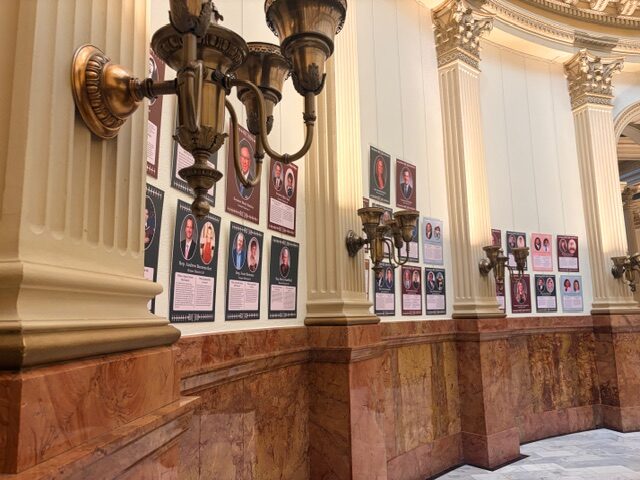
    Photo of a portion of the "Inspired to Serve" exhibit at the Colorado State Capitol.

    by Amanda Clapham, Legislative Council Staff Visitor Services Deputy Manager, Education and Curation

    If you are a regular at the Capitol, you have walked by the “Women’s Gold” tapestry on the first floor innumerable times, and you’ve probably marveled at the brilliant colors of the stained-glass Heritage Windows in the Old Supreme Court, the Emily Griffith window on the second floor, north side, and the Virginia Neal Blue window in the Senate. (If you haven’t marveled, please walk over there and marvel immediately). These artifacts feel like they’ve been here forever. But they haven’t.

    Colorado is nicknamed the Centennial State because we became a state on our nation’s 100-year anniversary. In 1976, the nation and Colorado went all out for the United States’ 200th anniversary and Colorado’s 100th. In addition to the many activities and celebrations statewide, the Capitol participated by adding several installations that are now so well established: the tapestry and the collection of stained glass. 

    The math nerds out there may have already gotten there, but 2026 is our 150th year of statehood! While celebrations are going on throughout the 50 states in honor of the country’s 250th birthday, Colorado’s celebration of its 150th anniversary makes us special. Senate Bill 22-011 created the America 250-Colorado 150 Commission to commemorate this unique anniversary, and the planning began there! Visit the commission’s website to learn more.

    While there are activities across the state and country, we have several commemorations planned for the Capitol as well.

    An exhibit entitled “Inspired to Serve” opened Friday February 20th; it features all 100 legislators currently serving in the Colorado General Assembly, with pictures of them now and as children. Each legislator has answered two key questions: “What inspired you to serve?” and “What is special about your district?” This exhibit will run through the end of 2026. While our building is historical, the legislature, by its nature, is always looking to the future. This exhibit is meant to inspire Colorado’s future generations to learn about civics and maybe one day run for office themselves!

    You may have heard that the official sea level in the United States has changed, making our Mile High Marker incorrect! Capitol staff is working with the Colorado School of Mines to re-measure our treasured marker that resides on the West Steps. If you’re a Capitol nerd, you know that there are three Mile High Markers currently embedded on three different steps, originally measured in 1909 (15th step), and then re-measured in 1969 (18th step) and 2003 (13th step). Both sea level and the accuracy of measurement techniques have changed over time. It’s the latter that the School of Mines will explore as they measure for us, again. Engineering Professor Jeff Holley and his students will be using old surveying techniques as well as GPS to give us the real mile high measurement for 2026.

    In Mr. Brown’s Attic, the space above the third floor of the Capitol, there is a scale model of the Capitol building, which is really popular, especially with kids. And what is more popular with kids of all ages than LEGO? The Denver Lego Users Group will be building a scale model of the House and the Senate for the 2026 celebrations. Both fun and colorful, these models will draw the attention of visitors of all ages and act as a gateway to civic education. 

    In addition to these exciting projects, the Capitol will be working with History Colorado as well as other cultural, educational, and civic organizations throughout the state, to create one of our biggest and best Colorado Day celebrations EVER! Join us on August 1, 2026, for bands, food, history, entertainment, and some special surprises! Events will take place in Civic and Lincoln Memorial parks, on Broadway, from History Colorado to Colfax, and inside and on the West Steps of the Capitol Building.

    This commemoration isn’t just about Colorado’s past 150 years, but also who and what we are as a state right now. It is our chance to tell the future what is important to us (and also to have some fun!).

  • Everything Under One Roof: The Original Colorado State Capitol

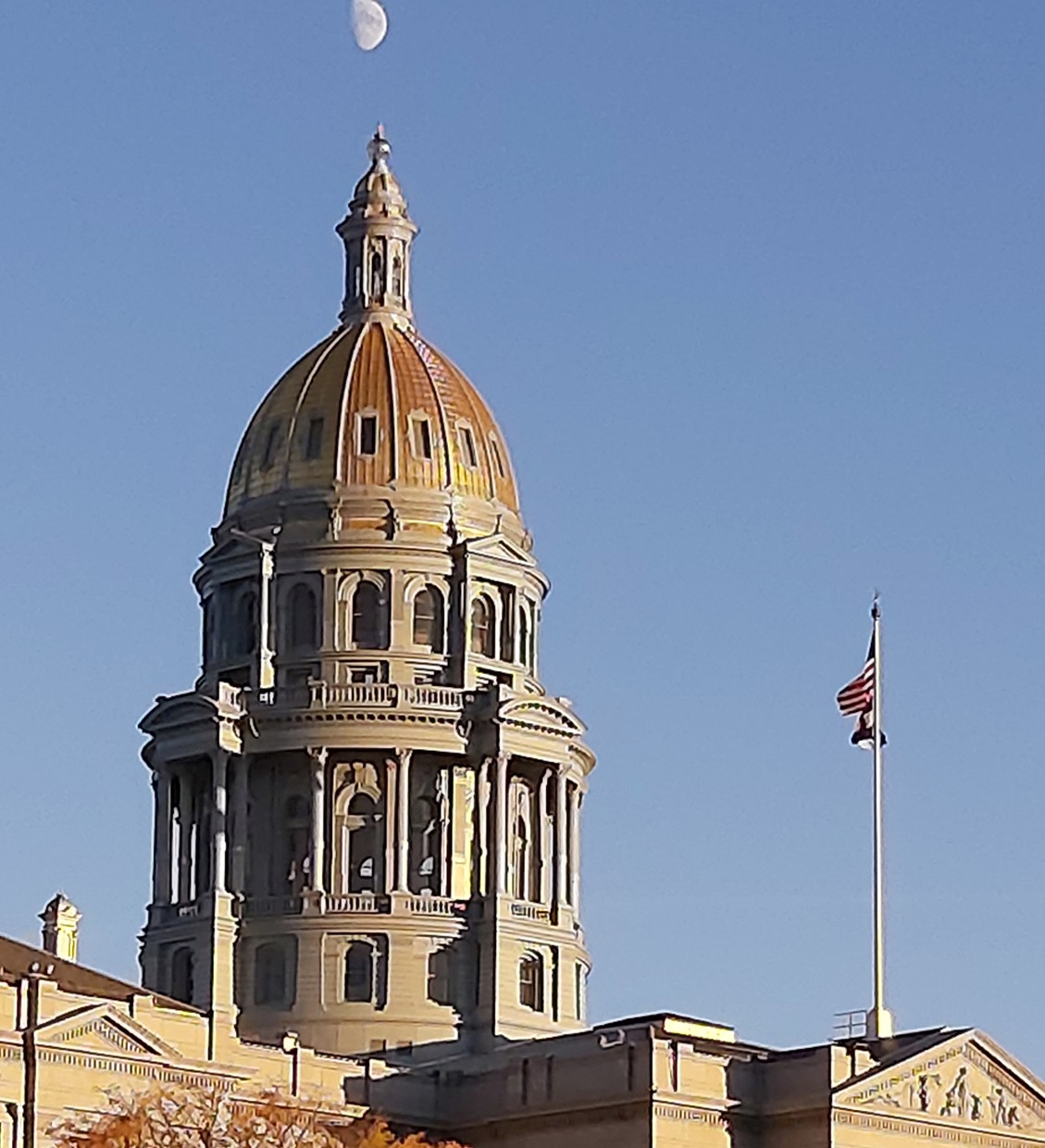
    Top of Colorado State Capitol building with observation deck and gold-plated dome.

    by Faith Marcovecchio

    In February 1861, with Abraham Lincoln about to take office and the Civil War just weeks from breaking out, President James Buchanan signed legislation establishing the Colorado Territory. Immediately, the territory’s first governor, William Gilpin, began thinking about where the capital of the new territory would be. Towns up and down the Front Range vied for the honor, and in the territory’s first years, the center of government moved from Colorado City to Golden and finally, in 1867, found its home in Denver. Now it was time for political leaders to think about a site for a statehouse.

    Money was tight, so when contractor and builder Henry Cordes Brown offered government officials a 10-acre swath of land south of town as a gift, they jumped at the opportunity. Years of fundraising followed. In the centennial year of our nation’s founding, Colorado became a state, and soon after, the General Assembly set aside money for a capitol building. Finally, in 1885, a plan and an architect, Elijah Myers, were chosen.

    At a time when Colorado’s population stood at 200,000, Myers had an interesting idea: Every agency of state government, including boards, commissions, and all the public servants who worked for those agencies, would be housed within the walls of his simple but grand building. The structure would be so large that it would serve the new state as the sole state government building for generations to come. 

    When the State Capitol was finally completed 15 years later, Myers’s grand vision was realized: The legislature’s beautiful bicameral chambers shared a floor with the Colorado Supreme Court. The governor’s office sat across from the offices of the state treasurer, attorney general, and five other executive branch officers. And, perhaps most interesting, on the main floor Myers set aside space to showcase the most powerful influences in nineteenth-century Colorado: Mining, agriculture, and land management.

    Walking into the statehouse in its early years was like visiting a museum featuring all that Colorado had to offer. In the west wing, collections from the State Historical and Natural History Society were on display, including pottery, tools, and baskets from Mesa Verde; stuffed birds, bison, bears, and bighorn sheep from Colorado’s mountains and plains; and Civil War-era cannons, firearms, and banners used in the Battle of Glorieta Pass. Down the hall, glittering minerals and polished stone filled cabinets in the Bureau of Mines quarters. In yet another room, the State Horticultural Society displayed the trees, flowers, fruits, and vegetables grown in Colorado. There were even quarters where Union Civil War veterans could gather (until they were evicted in 1897 for too much card playing and carousing).

    The treasures found on the Capitol’s main floor, along with the brass chandeliers, marble floors, rose onyx walls, and soaring rotunda above, attracted tourists in droves. But the dome itself was the most important element, marrying the functions of government with the natural beauty that encircled the building. An observation deck offered sightseers, as Myers had hoped, “an unequaled view of the surrounding country.” The architect knew the panorama of the Rocky Mountains from Pikes Peak to Longs Peak was the building’s greatest feature.

    As the nineteenth century came to a close and the twentieth century dawned, a variety of embellishments were added. A sweeping staircase rose through the center of the rotunda, replacing cast-iron staircases in the north and south atriums. The copper-plated dome, which quickly oxidized, was covered with gold leaf in a glittering nod to the Pikes Peak gold rush. Brightly colored stained-glass portraits of Colorado pioneers were installed in the rotunda.

    Some of these changes were in tune with Myers’s original vision. Others were not. But the building’s greatest promise, that it would hold every office and function of Colorado government for generations, quickly shattered. By 1907, so many new agencies and commissions had been created that the statehouse had reached its limit.  Fewer than 10 years after the Capitol’s grand opening, its managers were looking for a place to expand.

    Today, though shiny minerals and taxidermied mammals no longer fill the first floor of the statehouse, the grandeur and beauty of the Gilded Age still make the Colorado Capitol an attraction to tourists from throughout the state, the country, and the world. 

    To learn more about the planning, construction, and evolution of the Colorado statehouse, see Derek R. Everett’s book, “The Colorado State Capitol: History, Politics, Preservation,” University Press of Colorado, October 1, 2018, on which this article is based.

  • Plans Continue for Sand Creek Memorial Near Capitol West Steps

    by Richard Sweetman

    On June 25, 2020, protesters pulled down the statue of the civil war soldier that stood atop the pedestal monument near the west steps of the Colorado capitol. Since that day, legislators and members of the American Indian community have discussed a replacement monument. But, to this day, the space where the civil war soldier statue once stood remains empty.

    The original plan to replace the civil war soldier with a statue of an American Indian woman mourning the events of the Sand Creek massacre was approved by the Capitol Building Advisory Committee in November 2020. The Committee based its decision on a seven-inch prototype of a statue by the artist Harvey Pratt.

    In March 2022, however, more than a year after the Capitol Building Advisory Committee sent its recommendation to Capital Development Committee, Mr. Pratt withdrew his statue from consideration. Representatives of the Northern Cheyenne and Northern Arapahoe tribes asked Mr. Pratt to make modifications to his design, and the artist declined their request. This development sent the proponents of the new monument back to the drawing board.

    On May 17, 2024, the Capitol Building Advisory Committee met again and heard testimony from the tribes’ representatives regarding the status of the memorial. During the meeting, the representatives announced that they had agreed upon a new design. A team of four individuals, including a representative from each of the two tribes, a Denver sculptor, and a project architect from the University of Denver collaborated to develop a new concept and enlist a new sculptor to execute it.

    The supporters of the new design described the proposed new sculpture as a bronze structure in the likeness of a tepee, with visible poles, to be placed on the ground rather than upon a pedestal. The new monument would be placed on a circular pad on the site of the former monument.

    The proponents estimated the cost of the new monument at somewhere between $200,000 and $300,000. They expressed their hope that the One Earth Foundation would pay the bulk of this amount, but they also indicated their hope that the Capital Development Committee and the legislature will chip in some portion of the costs to pay for site preparation.

    Sculpture mock-up for Sand Creek Memorial.

    On November 15, 2024, the proponents appeared again before the Capitol Building Advisory Committee to share a miniature prototype of the new monument. Sculptor Gerald Shippen presented a slide show that displayed the prototype from various angles and perspectives. The planned monument will depict three Native American figures standing before a tepee without any walls — only poles. The figures will be larger than life — about seven feet tall — and the poles of the skeletal tepee will be approximately 23 feet high.

    The prototype of the monument depicts an American flag hanging from the highest tepee pole, but according to Mr. Shippen, the plan is to incorporate this design element only on special occasions. For example, when the tribes hold the annual Sand Creek Massacre Spiritual Healing Run, the tribal runners will approach the west steps of the capitol and lay a ceremonial lodge pole on the tepee. The lodge pole will display a United States flag and a white flag of peace, which were the flags that Chief Black Kettle of the Southern Cheyenne had displayed on his tent on the day of the Massacre.

    The Committee voted unanimously to approve the design and recommend it to the Capitol Development Committee.